


Robotics UK: Mapping Innovation, Industry Leaders, and the Future of Automation
The United Kingdom’s robotics ecosystem is fast becoming a cornerstone of global automation. Robotics UK represents a vibrant network of technology companies, research institutions, and industrial pioneers reimagining how machines and humans collaborate across production lines, laboratories, and warehouses.
As industries face mounting pressure to boost productivity, address labor shortages, and meet sustainability goals, robotics has transitioned from a specialist tool into a national strategic priority. Government-backed R&D funds, world-class innovation hubs, and agile startups are converging to position the UK as a global contender in industrial automation.
In this dynamic landscape, understanding who’s driving progress—and where the next breakthroughs will emerge—is essential for business leaders and investors alike.
What You’ll Discover
- Key players: From industrial robot manufacturers to AI-enabled integrators redefining flexible automation.
- Emerging technologies: The rise of agile robots, cobots, and intelligence-embedded robotic systems.
- Ecosystem building blocks: How universities, testbeds, and Catapult centres fuel commercialisation and adoption.
- Market momentum: Growth projections, investment opportunities, and policy frameworks shaping high robotics across UK industry.
Together, these forces reveal how Robotics UK is setting the stage for the next generation of smart factories, precision healthcare, and resilient supply chains.
The Evolving Robotics UK Landscape: Growth Driven by Demand, Policy, and Innovation
The robotics UK market is entering a decisive growth phase, shaped by global competition and internal modernization pressures. Valued at roughly USD 474.7 million in 2024, it is expected to surge to over USD 1.4 billion by 2033, as detailed by IMARC Group’s industrial robotics market report. This near-tripling in scale reflects both industrial necessity and strategic government intervention. As energy costs rise and manufacturers struggle with persistent labor shortages, robotics has shifted from an optional investment to an operational imperative. The convergence of intelligent automation, rising ESG obligations, and Industry 4.0 integration is refashioning how factories, logistics centers, and healthcare facilities across the UK operate at scale.
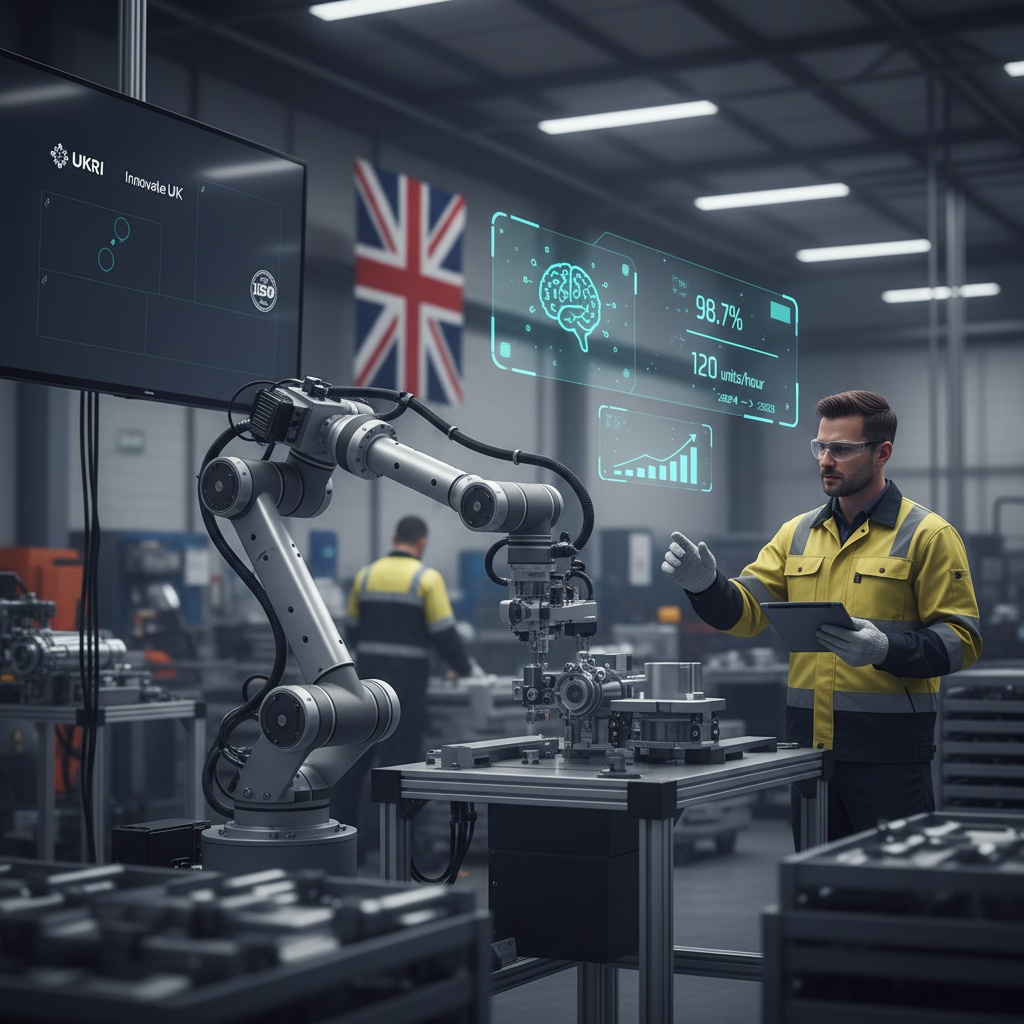
Market Acceleration and the Rise of High Robotics Adoption
Although the UK still trails countries like Japan, Germany, and South Korea in robot density, its rate of adoption is accelerating dramatically. According to recent findings from the International Federation of Robotics, approximately 2,500 new industrial robots were installed in 2024, following a 2023 high of 3,800 units. This trend signals a nation still scaling but learning fast—moving toward high robotics environments that emphasize agility, interoperability, and AI-enhanced coordination between robots and human workers.
For manufacturers, the push toward agile automation isn’t limited to capacity expansion. It is an adaptive strategy for managing workforce constraints and reshoring production closer to domestic demand. Whether through small cobots on a factory floor or multi-robot systems in logistics hubs, robots in the UK are becoming multi-purpose allies rather than isolated assets.
Policy Frameworks Fueling the Robotics Transition
The country’s industrial strategy has become the scaffolding for this transformation. The UK Industrial Strategy 2025 dedicates over £2.8 billion for R&D across emerging technologies, with robotics and automation positioned as keystone sectors. This includes the Made Smarter Innovation Challenge providing £29 million annually for smart-factory development, as well as £40 million targeted toward new Robotics Adoption Hubs designed to accelerate uptake among small and medium-sized enterprises.
These funding vehicles complement long-standing institutions such as UK Research and Innovation (UKRI) and Innovate UK, which connect research laboratories with commercial application partners. By coupling academia with industry, they accelerate prototyping cycles and transform conceptual robotics into export-ready technologies. The emphasis on safety, codified through standards like ISO 10218 and ISO/TS 15066, reinforces confidence in collaborative systems operating in shared human spaces—a crucial factor for cross-sector deployment.
Bridging Research, Industry, and Manufacturing Through Robotic Systems
A defining characteristic of the robotics UK ecosystem lies in its research-to-industry connectivity. The Manufacturing Technology Centre (MTC) in Coventry and the Advanced Manufacturing Research Centre (AMRC) in Sheffield exemplify the “Catapult” model, enabling pilot manufacturing cells where new robotic systems can be tested, validated, and optimized before full-scale rollout. This infrastructure has helped reduce integration costs and provide early-stage companies with test environments aligned with industrial standards.
In this ecosystem, system integrators hold a pivotal role. Firms like Tharsus and Automata specialize in designing bespoke applications using diverse robot brands such as ABB, FANUC, and Universal Robots. This neutral integration approach ensures that both established manufacturers and startups can deploy solutions tailored to operational needs, rather than being restricted by a single hardware platform. For readers seeking deeper understanding of OEM strategies, exploring [ABB automation](https://YOUR WEB/abb-automation-industrial-transformation) reveals how global manufacturers influence local markets through hardware innovation and smart control software.
Investment Momentum and the Growth of Agile Robots
As the UK races toward deeper automation, a growing class of agile robots is reshaping production economics. These systems combine perception capabilities through AI vision tools, soft-material actuation for nuanced motion, and reconfigurable software that lets operators easily retask machines. The implications are significant for industries characterized by variable production volumes—food handling, electronics assembly, and medical device manufacturing.
According to 6Wresearch’s UK robot market assessment, many British SMEs are now turning to Robotics-as-a-Service models to lower capital expenditure and trial automation concepts before committing to full deployment. In parallel, government-backed pilot programs are demonstrating how low-code integration and digital twins can increase confidence in technology adoption for small-scale manufacturers.
Comparative Overview: UK vs. Global Robotics Adoption
| Region | Approx. Robot Density (per 10,000 manufacturing workers) | Adoption Focus | Growth Drivers |
|---|---|---|---|
| United Kingdom | 111 | Cobots, flexible systems, SME adoption | Policy incentives, reshoring, AI integration |
| Germany | 397 | Automotive, heavy manufacturing | Legacy ecosystem, automation efficiency |
| Japan | 399 | Electronics, precision systems | Industrial consistency, advanced OEMs |
| South Korea | 1,000+ | Electronics, automotive | Workforce optimization, tech nationalization |
Though global benchmarks remain high, the UK’s flexibility and cross-sector strength give it unique competitive potential. Unlike countries where industrial robotics is dominated by a few verticals, British deployment extends into logistics, healthcare, and construction—a reflection of agile systems that adapt well to the nation’s diversified economy.
Strategic Partnerships and Reshoring Opportunities
Collaborations between universities, private firms, and global manufacturers are unlocking new market efficiencies. Integrators often partner with international industrial robot manufacturers like KUKA, Yaskawa, and FANUC, blending imported robotic hardware with domestic control software, AI modules, and value-added engineering. Localized supply chains for actuators, sensors, and autonomous navigation stacks are also expanding, partly driven by sustainability commitments and the need to reduce dependencies on overseas suppliers.
At the same time, the National Robotarium in Edinburgh operates as a national testbed, offering companies access to simulation environments that can validate robotic workflows before physical deployment. This reduces risk and accelerates time-to-production, a particularly appealing model for investors evaluating early-stage technologies.
Market Momentum Setting the Stage for What’s Next
Industrial automators across the UK are now leveraging robotics not only for task efficiency but also for sustainable transformation. Energy optimization, human-machine safety cohabitation, and digital twins are no longer future concepts—they are tangible deliverables appearing on factory floors. As robotics UK continues evolving, the convergence of flexible cobots, AI
From Innovation Labs to Industry Floors: How UK Robotics Translates Research into Real-World Deployment
The UK’s robotics strength lies in how it connects research excellence to industrial execution. Unlike ecosystems that separate invention from production, the Robotics UK network has mastered the art of translation—from theoretical breakthroughs within universities to functioning robotic systems on factory floors, hospitals, and warehouses. This interplay between academia, startups, and integrators creates a continuous innovation loop that keeps the sector dynamic and future-oriented.
The Engine of Applied Research: UK’s Testing Grounds
At the core of this innovation web are leading research hubs that drive adoption forward. The Bristol Robotics Laboratory (BRL), for example, operates as a technology incubator where concepts like human-robot empathy and tactile sensing evolve into commercial prototypes. Meanwhile, the Oxford Robotics Institute sharpens the frontier of autonomous systems, providing the algorithms that underpin safe navigation for mobility robots. The National Robotarium in Edinburgh acts as a pipeline that transforms validated lab work into industry trials, offering simulation and testbed environments for pilot projects in inspection, logistics, and manufacturing.
These centres form a distributed but collaborative ecosystem—a structure mirrored in Catapult facilities like the Manufacturing Technology Centre (MTC) and AMRC, which serve as applied engineering intermediaries. Together they support proof-of-concept validation, operator upskilling, and integration readiness assessments. This ensures that innovative robotic technologies are not trapped within academia but consistently enter production cycles.
Visual suggestion: Ecosystem map diagram linking laboratories, companies, and industrial sectors to show technology transfer flow.
The Rise of Agile Robots in Complex Environments
Across multiple verticals, the UK’s movement toward agile robots signals a major shift from fixed automation to adaptable, intelligent systems. These robots learn from contextual variation and uncertainty, critical for small-batch, high-mix production that dominates UK manufacturing. For instance, the Shadow Robot Company engineers dexterous robotic hands with advanced AI-driven grasping, enabling flexible manipulation of non-uniform parts—an area once off-limits to robotic automation.
Similarly, startups like Automata are empowering smaller manufacturers through compact cooperative robots that support low-code programming and rapid redeployment. Their modular designs allow SMEs to achieve high robotics utilization levels without the infrastructure demands of traditional assembly lines. These developments reshape the accessibility of automation by aligning flexibility with affordability.
Case Spotlights: Translating Innovation Across Sectors
No sector demonstrates the UK’s robotics convergence quite like logistics, where Ocado Technology has become a global benchmark for warehouse automation. Its high-density storage and coordinated robotic systems manage inventory with precision, turning AI-driven scheduling into real-time operational advantage. By integrating sensors, vision systems, and machine learning, Ocado’s robots embody the agility needed to handle unpredictable order patterns.
In healthcare, CMR Surgical illustrates how advanced robotic integration redefines modern medical practices. Its Versius platform blends precision mechanics, ergonomic controls, and intelligent feedback into a compact design adaptable for various surgical environments. These innovations don’t simply automate—they extend clinical capability while reducing fatigue and improving consistency.
Meanwhile, Q-Bot in the construction sector and Small Robot Company in agriculture exemplify how nontraditional industries are now leveraging robotic intelligence. Q-Bot’s inspection and retrofitting machines address the housing sector’s productivity gap, while agricultural micro-robots use AI for planting and soil analytics, marking a leap toward sustainable automation.
Bridging the Gap Between Hardware and Integration
The success of the UK’s robotics rollout also depends on synergy between industrial robot manufacturers and system integrators. Global OEMs such as ABB, KUKA, and FANUC supply the mechanical backbone, whereas UK-based integrators customize robotic cells for specific production contexts. This dual structure ensures local adaptability even when leveraging international components.
A growing focus on open architecture robotic platforms is reshaping how buyers source technology. Integrators increasingly prioritize robotic systems compatible with open-source frameworks like ROS and adaptable to multiple vendors. This move away from vendor lock-in allows businesses to scale automation incrementally and encourages experimentation across tasks—from packaging automation to in-line inspection.
Practical Pathways: Scaling Robotics from Pilot to Production
To move from pilot experiment to operating workflow, UK firms are refining a structured adoption pathway. The process begins with scoping—mapping each process for automation viability and collecting data on payload, reach, repeatability, and programming complexity. Once a PoC is validated in simulation, integration specialists execute staged rollouts that combine cobots, sensors, and software layers for modular, upgradable robotic systems.
An emerging best practice involves establishing digital twins to simulate robotics behavior under variable production conditions. These predictive environments help teams pre-empt collisions, optimize tooling, and validate performance under different part geometries before any physical deployment takes place. As a result, the cost and risk associated with early-stage automation drop significantly.
Expanding the Frontiers Through Collaborative Infrastructure
UK robotics circles are steadily weaving themselves into global partnerships that catalyze continuous evolution. Entities like ROS-Industrial Europe and the International Federation of Robotics (IFR) create standards for interoperation, enabling UK advancements to integrate effortlessly into global supply chains. The involvement of international players, including Agile Robots with a UK footprint, also infuses novel sensor technologies and lightweight actuation methods into domestic manufacturing lines.
These multi-institutional collaborations also unlock shared datasets, benchmarking frameworks, and best-practice toolkits essential for scaling across sectors. In doing so, the UK avoids the silo effect that often constrains national industries, instead cultivating a more cohesive industrial automation ecosystem.
Toward a Human-Robot Partnership Culture
While automation dominates the conversation, the UK’s robotics frontier is increasingly centered on human-robot collaboration. The shift is not merely technical but cultural—reflecting new approaches to ergonomic design, workforce reskilling, and ethical integration. Modern cobots are designed to complement operators, not replace them, aligning with ISO safety standards that emphasize shared workspaces. Employers now pair robotic deployment with training programs, often led through apprenticeship frameworks supported by the Made Smarter Innovation initiative.
By emphasizing coexistence rather than substitution, British industry is building resilient work models where human judgment and robotic precision reinforce each other. This human-centered approach positions the UK as a balanced innovator—not simply automating tasks, but redesigning how automation fits within the modern workforce.
Through these connective strategies and targeted implementations, the nation’s robotics sector continues to evolve from research-driven potential to enterprise-level reality. Each project, from a tactile gripper prototype to a full-scale logistics automation grid, reflects a deliberate synthesis of science, engineering, and human insight—an approach defining the next phase of robotics development in the United Kingdom.
Conclusion
The trajectory of robotics in the United Kingdom is no longer theoretical—it is decisively underway. With industrial automation advancing through intelligent collaboration, localized component production, and sustainability-driven design, the nation stands at a point of inflection. The convergence of agile innovation and policy support has repositioned British industry as a challenger among global technology leaders rather than an observer.
By aligning research excellence with practical deployment, the UK has transformed its robotics ecosystem from experimental labs into a commercial force. Strategic partnerships with top-tier manufacturers, combined with the rise of Robotics-as-a-Service for SMEs, are democratizing access to automation once reserved for large enterprises. These developments ensure that intelligent robotic systems now form the backbone of the nation’s renewed industrial resilience.
The evidence is conclusive: high-performance automation is not simply augmenting productivity—it is redefining it. The organizations that act now, investing in skills, data-driven robotics, and adaptive infrastructure, will command the next era of growth.
Ultimately, the evolution of robotics in the UK embodies a broader truth about industrial transformation: progress belongs to those prepared to integrate intelligence, agility, and sustainability into every operation. The path forward is defined—what remains is to move with precision, confidence, and vision into the automated future already within reach.
Frequently Asked Questions
What does the term “Robotics UK” encompass?
Robotics UK refers to the complete ecosystem of robotic technologies, research institutions, and industrial players advancing automation across sectors such as manufacturing, logistics, healthcare, and agriculture in the United Kingdom. It includes everything from academic R&D and government-backed innovation to industrial robot manufacturers, integrators, and emerging Robotics-as-a-Service providers. Together, they form a fast-evolving network driving the UK’s contribution to global industrial automation.
Why is Robotics UK gaining momentum now?
The growth of Robotics UK is fueled by rising labor shortages, productivity demands, and adoption of Industry 4.0 principles integrating AI, IoT, and machine learning. Government programs like Innovate UK, Made Smarter Innovation, and new Robotics Adoption Hubs are accelerating industrial uptake. Global competition—particularly from Asia’s high robot density—also pushes the UK to expand automation faster to stay competitive.
Which sectors benefit most from robotic systems in the UK?
The most active adopters of robotic systems are logistics, electronics, automotive, healthcare, and food and beverage. For example, Ocado Technology‘s warehouse robotics and CMR Surgical’s medical systems are transforming their respective industries. In addition, construction (retrofit robotics) and agriculture (autonomous field robots) are emerging growth sectors thanks to innovation in agile robots.
Who are the leading robotics companies operating in the UK?
Key UK players include Tharsus, Automata, Shadow Robot Company, Dexory, Small Robot Company, and Q-Bot. In specialized sectors, Ocado Technology leads logistics, while CMR Surgical leads healthcare robotics. Global industrial robot manufacturers such as ABB, KUKA, FANUC, and Yaskawa also play major roles through partnerships with UK-based system integrators who customize and deploy tailored robotic solutions.
What are ‘agile robots’ and how do they contribute to UK manufacturing?
Agile robots are advanced, flexible machines powered by AI, computer vision, and adaptive control, allowing them to handle variable or unstructured tasks. They enable British manufacturers—especially SMEs—to shift from rigid automation to high robotics environments capable of quick reconfiguration and low-volume production. This agility helps UK industry stay competitive with more automated economies.
How do industrial robot manufacturers and system integrators differ?
An industrial robot manufacturer designs and builds robot hardware—arms, actuators, controllers, and sensors—while a system integrator configures these components into complete, operational robotic systems optimized for a customer’s specific workflow. In the UK, many companies use hybrid partnerships where global hardware suppliers collaborate with local integrators like Tharsus or MTC to deliver turnkey automation cells.
What government support and funding are available for robotics in the UK?
The UK government offers multiple R&D and deployment incentives through organizations like UKRI, Innovate UK, and Catapult Centres such as the Manufacturing Technology Centre (MTC). Programs like Made Smarter Innovation and Robotics Adoption Hubs fund pilot projects, skills training, and SME support, while national standards such as ISO 10218 ensure safety and compliance across robotic systems.
What are the biggest challenges facing robotics adoption in the UK?
Key challenges include high upfront costs, skills shortages, and fragmented supply chains. Many SMEs struggle to justify investment without Robotics-as-a-Service models or government-backed funding. Closing skills gaps in engineering, programming, and robotics integration is also critical, as is fostering domestic component production to strengthen the UK’s resilience and reduce import dependencies.
How does Robotics-as-a-Service (RaaS) help UK SMEs implement automation?
Robotics-as-a-Service allows smaller firms to access cutting-edge robotic systems through subscription rather than capital expenditure. This flexible model reduces risk, enables faster proof-of-concept testing, and simplifies scaling. It’s particularly beneficial for firms in logistics, manufacturing, and packaging seeking to enhance efficiency without large upfront investments.
What is the future outlook for Robotics UK over the next decade?
By 2033, the UK industrial robotics market is expected to reach over USD 1.4 billion, driven by broader adoption of AI-integrated and collaborative robots, increased local manufacturing, and robust ESG initiatives promoting greener automation. With strategic collaboration between global
