

The Function of AI: How Artificial Intelligence Learns, Reasons, and Transforms Modern Life
Artificial Intelligence (AI) has moved from science fiction into the engine room of today’s economy—powering search engines, designing drugs, detecting fraud, and generating art. But what exactly is the function of AI, and how does it simulate thinking, perceiving, and learning the way humans do?
At its core, the function of AI is to replicate human cognitive abilities—learning from data, reasoning about complex problems, and adapting through experience. Through algorithms, models, and neural networks, machines now perform tasks that once demanded intuition and judgment, driving innovation across nearly every sector.
Advances like foundation models, multimodal systems, and autonomous agents have vastly expanded AI’s reach, enabling machines to not only process information but to create, decide, and interact. These breakthroughs come amid crucial questions about governance, ethics, and the balance between automation and human work.
This guide explores:
- Core mechanics behind modern AI—data pipelines, model training, and inference
- Diverse applications transforming industries from healthcare to finance
- Latest developments in AI, including generative and reasoning systems
- Societal dimensions, such as AI and job displacement, reskilling, and responsible adoption
By understanding how artificial intelligence functions at its foundation, we uncover both its immense potential and the transformative changes it brings to work, creativity, and human progress.
Foundations and Definitions of the Function of AI
Understanding the function of AI begins with viewing artificial intelligence not as a single technology but as an evolving ecosystem of disciplines aimed at replicating human cognitive abilities in machines. From early rule-based systems to today’s deep learning models, the goal has remained constant: enabling systems to learn from data, make autonomous decisions, and improve over time through feedback. When organizations implement AI effectively, they move from basic automation to intelligent optimization, shifting from reactive data use to proactive insight generation.
AI performs human-like operations—learning, perception, and reasoning—by converting raw data into actionable understanding. In practice, these capabilities rely on algorithms trained on massive datasets to detect patterns, adapt to new inputs, and make inferences. Unlike traditional software, which follows hard-coded instructions, AI refines its own behavior through experience, much as a person learns through trial and adjustment. This distinction makes AI central to the next wave of innovation across industries like manufacturing, healthcare, and logistics. For example, hospitals now apply machine learning–based diagnostics that detect subtle patterns in x-rays faster than the human eye could achieve.
Understanding the Function of AI Through Cognitive Simulation
At its core, the function of AI is to simulate human cognition—how we perceive surroundings, interpret language, and make complex judgments. Algorithms interpret signals, such as pixels in an image or words in a sentence, in a way that mirrors the layered processing of the human brain. Neural networks, a key architecture inspired by biological neurons, enable this process by translating raw data into meaningful representations.
In a retail context, cognitive functions drive recommendation systems that anticipate what customers might want before they articulate it. In manufacturing, AI-driven control systems enhance quality assurance by identifying defects invisible to the naked eye. Each of these applications stems from the same foundational idea: AI learns from patterns, refines operations, and uses reasoning to optimize outcomes.
Data and Learning: The Central Engine of AI
Data is the fuel that powers all forms of AI intelligence artificial. Without diverse, high-quality data, algorithms cannot achieve consistent performance. Every process—from facial recognition to speech synthesis—starts with structured or unstructured data sources that algorithms use for training. These algorithms adjust model parameters iteratively, minimizing error rates while learning to generalize from examples.
The image below depicts this process, where learning from data drives the improvement of predictive and generative systems.

In practical terms:
- Raw information is collected through sensors, transactions, or digital interactions.
- This data is preprocessed to remove errors, standardized, and augmented.
- AI models identify trends or anomalies using mathematical optimization techniques.
- Over time, feedback mechanisms allow continuous improvement and adaptation.
Businesses that treat data as a strategic resource often harness AI more effectively, applying it to predictive maintenance, customer engagement, or automation initiatives aligned with the principles explained by Michigan Technological University’s overview of AI.
Differentiating AI from Its Related Fields
To grasp the concept AI, it’s essential to separate the broader field from its subdisciplines—machine learning, deep learning, and data science. Machine learning (ML) emphasizes the use of statistical methods to learn from labeled datasets. Deep learning (DL) builds upon ML with neural networks that automatically extract features, excelling in computer vision and natural language understanding. Data science, in contrast, applies statistical modeling and data visualization for hypothesis-driven insight generation.
| Domain | Description | Primary Objective | Typical Use Case |
|---|---|---|---|
| Artificial Intelligence (AI) | Encompasses systems that emulate cognitive functions | Make autonomous, human-like decisions | Chatbots, robots, perception systems |
| Machine Learning (ML) | Subset of AI using algorithms to learn from examples | Predict outcomes from data patterns | Fraud detection, recommendation engines |
| Deep Learning (DL) | ML with neural architectures for representation learning | Handle complex input structures | Image recognition, speech translation |
| Data Science | Broader analytics field combining statistics and engineering | Generate insights and visualizations | Business intelligence reporting |
Each contributes to realizing AI’s potential, but only AI integrates them into goal-driven reasoning systems that perceive, decide, and act. This hierarchy explains why AI intelligence artificial is viewed as an umbrella concept governing multiple technical approaches.
The Expanding Role of AI in Real-World Systems
In practice, AI’s function spans perception, prediction, and generation. In healthcare, computer vision models read radiology images; in finance, anomaly detection spots fraud in milliseconds; in education, adaptive learning platforms personalize content to student needs. These examples illustrate how AI mimics a combination of sensory input and reasoning—a hybrid of what humans do naturally.
The same principle applies to robotics and autonomous systems. Robots enhanced by AI move beyond mechanical repetition to situational decision-making. In fields like [robotic solutions](https://YOUR WEB/robotic-solutions-manufacturing-transformation) and autonomous delivery, AI processes enable movement planning, environment recognition, and smooth human-robot collaboration.
Through advances in model design, such as transformers and diffusion techniques, the latest wave of innovation brings generative and multimodal functionality to these systems. These breakthroughs extend AI’s role from data interpretation to creative synthesis, driving the surge in generative text, image, and code tools explored in the [AI recent news insights](https://YOUR WEB/ai-recent-news-november-2025).
Why the Function of AI Matters for the Future Workforce
Beyond technology, AI’s expansion carries workforce implications. While the discussion on AI and job displacement will deepen later, understanding the current transformation is key. AI automates routine, data-centric tasks—data entry, inspection, basic analysis—allowing humans to focus on creativity, strategy, and relationship-driven work. This trend does not remove human contribution; it reshapes it, emphasizing oversight, ethical judgment, and domain expertise.
Companies that pair automation with re-skilling initiatives will benefit most. AI-driven copilots, document summarizers, and analytics assistants illustrate how decision support augments—not replaces—human intelligence. For example, a manufacturing operator might use an AI-powered predictive system to anticipate equipment failures before they occur, preventing costly downtime while expanding technical skills in diagnostics.
Setting the Stage for Core AI Concepts
The understanding developed here establishes why the function of AI operates both as a technological mechanism and a strategic capability. To use AI effectively, one must grasp the foundational distinctions that shape its design—what makes concept AI a guiding framework and how ai intelligence artificial captures the integration of learning, perception, and reasoning. The next section explores these ideas in depth, explaining how AI systems interpret data, adapt autonomously, and apply their knowledge across domains—from perception to reasoning—to form the foundation of intelligent behavior.
Advanced Functions in Practice: From Theoretical Design to Cognitive Execution
The depth of artificial intelligence function reveals itself not in isolated algorithms, but through interconnected mechanisms that enable machines to interpret, plan, and act with adaptive precision. Once the basic architecture of concept AI is established, the critical question becomes how these components collaborate in real systems. More than computational mimicry, AI’s operational power lies in the interplay between modular intelligence components across perception, contextual understanding, and decision flow.
In technical ecosystems, each layer serves a role—data serving as raw cognitive material, models acting as interpretive logic, training as the process of behavioral acquisition, inference as real-time cognition, and feedback loops simulating experiential learning. When integrated, they form a closed cognitive system resembling adaptive thought. The next stage is how industries and researchers design functionalities that evolve independently through continual data exposure rather than fixed programming.
Adaptive Intelligence and Situational Awareness
True progress in AI intelligence artificial design depends on situational context—teaching models to react dynamically rather than executing static responses. For instance, in autonomous navigation systems, perception and reasoning modules must merge to distinguish a pedestrian from a shadow, then decide on safe maneuvering within milliseconds. This interaction marks the leap from algorithmic response to behavior-based adaptation.
Developers now employ neural-symbolic systems to unite logic-based rules with data-driven insights. Symbolic reasoning ensures consistency and explainability while neural layers interpret ambiguous real-world patterns. The advantage appears clearly in robotics and logistics, where physical variables—temperature, motion, and surface conditions—must influence digital models in continuous feedback loops.
Visualizing this dynamic process becomes essential for understanding the bridge between theory and execution:
Cognitive Layers Beyond Perception
Earlier generations of AI aimed for efficient pattern recognition. Modern systems extend this ambition toward comprehensive cognitive layering. The function of AI now includes tasks that require meta-understanding—analyzing not just what an event is but why it happens and how to adjust to its evolution. This reflective capacity appears in diagnostic recommendation tools that interpret medical imagery, compare results to patient histories, then adapt predictions as new data flows in.
These advancements align with the ongoing trend toward cognitive automation, where models are not passive executors but participants in continual problem decomposition. Predictive maintenance illustrates this transformation: rather than simply forecasting potential failures, the system prioritizes interventions based on the operational impact, fiscal parameters, and safety thresholds. AI becomes a reasoning partner instead of merely a forecasting instrument.
Applying Concept AI to Large-Scale Systems
In large-scale deployment, conceptual intelligence moves from isolated models to distributed architectures capable of handling multimodal input streams. Cloud-based learning environments aggregate visual, auditory, and textual data to refine models across tasks—from language translation to environmental monitoring. The foundational concept AI structures that define perception or planning at small scales expand into large, collaborative AI ecosystems.
One emerging standard in applied environments is federated learning, where multiple nodes or devices train models locally and share only learned parameters, not raw data. This method not only enhances privacy but mirrors human collective learning—the iterative refinement of shared intelligence without exposure of private experience. Federated structures are now being tested across healthcare research networks to balance insight with compliance requirements.
Evolution of Human-AI Collaboration
The deeper the understanding of AI’s internal functions, the more profound its implications for collaboration between human expertise and synthetic cognition. In design, professionals use adaptive copilots to generate code, analyze designs, and validate engineering models in real time. These systems learn from iterative corrections, effectively transforming from assistants into creative partners guided by contextual reasoning.
This trend redefines the notion of AI intelligence artificial within workplace transformation. Rather than a substitute for reasoning, these systems become augmentation frameworks. In domains like law, chemistry, or architecture, human professionals delegate exploratory or quantitative subtasks to autonomous models, reserving strategic synthesis for human judgment. The challenge, however, remains ensuring alignment: that algorithmic goals conform to human intent.
Deep Integration and Model Autonomy
Integration has become the new frontier of automation. Functions that were once domain-specific—like vision or speech—are now integrated within composite architectures called multimodal systems. These networks combine linguistic, visual, and numeric reasoning into a single operational framework, capable of producing generalized responses to diverse inputs. The latest-generation architectures have demonstrated unprecedented adaptability in customer interaction, real-time translation, and simulation-driven research.
Yet autonomy imposes risk. As systems achieve higher independence, they also inherit error propagation potential. Quantitative oversight, risk modeling, and ethical calibration remain integral design stages. Researchers at Carnegie Mellon University suggest integrating human-in-the-loop validation metrics for critical applications like robotics and financial automation to prevent untraceable decision drift.
Redesigning Systems for Continuous Learning
The function of AI changes fundamentally when continuous learning becomes central rather than supplementary. In this paradigm, feedback data—user corrections, sensor updates, environmental changes—serves as a recurrent input stream that keeps models synchronized with shifting conditions. This process is modeled on biological adaptation, aiming to maintain equilibrium between stability and plasticity.
For enterprises adopting large-scale models, lifelong learning pipelines handle adaptation through micro-updates that refresh model layers without retraining from scratch. This not only preserves computational resources but allows systems to evolve alongside their environment. Industries applying this include renewable energy management, where grid optimization algorithms continuously adjust forecasts to weather patterns and consumption changes.
Benchmarking Cognitive Efficiency
The maturation of AI function requires clear evaluation parameters beyond accuracy. Cognitive efficiency now includes adaptability, contextual relevance, ethical neutrality, and explainability. Measurement tools increasingly blend qualitative feedback with quantitative analysis. For example, user-trust studies in conversational AI frameworks evaluate not only linguistic coherence but perceived empathy and transparency.
Recent AWS research highlights the need for hybrid evaluation—technical performance supplemented by user-centered design measures—to ensure sustainable alignment. These evolving benchmarks redefine success metrics from mere predictive precision to holistic system efficacy.
Advancing the Technical Frontier
The next evolution in applied artificial cognition introduces self-reflective AI—systems that monitor their reasoning chains to detect bias, uncertainty, or logical gaps before producing output. Early prototypes use confidence estimation modules to assess how “sure” a model is about its responses. While still a developing field, self-assessment mechanisms point toward a future where AI performs meta-analysis on its reasoning process.
Other frontiers include neuromorphic computing, where chip architectures emulate synaptic processes to achieve energy-efficient modeling. These innovations blur the line between computation and cognition, signaling a paradigm where foundational principles of concept AI morph into embodied machine intelligence that learns and reasons organically within its environment.
Strategic Implementation Across Domains
Organizations exploring the function of AI can optimize implementation through modular layering. Begin with narrow intelligence applications—like predictive analytics or process optimization—then integrate perception and reasoning for adaptive automation. Each project cycle should capture operational data to fuel iterative learning. The combination of governance, monitoring, and scalable infrastructure transforms these models from tools into operational ecosystems.
Linked domains such as robotic solutions in manufacturing and teleoperation robotics already demonstrate this layered maturity, merging perception, precision control, and human feedback for continuous optimization.
Across industries, these systems no longer function solely as computational augmentations but as biologically inspired networks of distributed intelligence capable of transforming decision models, operational workflows, and cognitive ecosystems from reactive to anticipatory performance.
Conclusion
Artificial intelligence has evolved from a theoretical construct into an indispensable force of modern progress. Its true power lies in its ability to learn, perceive, reason, and generate—executing tasks once reserved for human intellect with remarkable autonomy and precision. This synthesis of cognition and computation is redefining every industry and reshaping how we work, create, and decide.
The latest developments in AI—foundation models, autonomous agents, and multimodal systems—have expanded what intelligence means in digital form. These innovations no longer mimic human thought; they amplify it, converting data into decisions and information into insight. Yet with such capability comes responsibility. The shift toward widespread automation demands rigorous governance, ethical safeguards, and proactive reskilling to safeguard the workforce against unnecessary displacement and ensure equitable progress.
Ultimately, the function of AI is not to replace humanity but to extend human capacity. Real transformation occurs when organizations balance innovation with integrity—piloting practical applications, embedding responsible frameworks, and investing in continuous learning. Those who act decisively now—grounded in understanding and guided by purpose—will lead the next era of intelligent enterprise. Your next move is clear: build literacy, start small, and evolve responsibly.
Frequently Asked Questions
What does the function of AI actually mean in simple terms?
The function of AI refers to how machines replicate human cognitive abilities like learning, reasoning, perception, and problem-solving. In essence, AI takes in data, processes it through algorithms or models, and produces outputs such as decisions, predictions, or generated content. This enables applications like facial recognition, chatbots, and recommendation engines to act intelligently without direct human instruction.
How does concept AI differ from artificial intelligence in practice?
Concept AI describes the theoretical foundation of how machines can mimic human intelligence. It sets the principles and goals behind AI development. Artificial intelligence (AI intelligence artificial), on the other hand, represents the practical implementation of those concepts—where actual models and systems learn from data to make predictions, automate tasks, or generate insights. In short, concept AI is the “why,” while artificial intelligence is the “how.”
What are the main functions of AI across industries today?
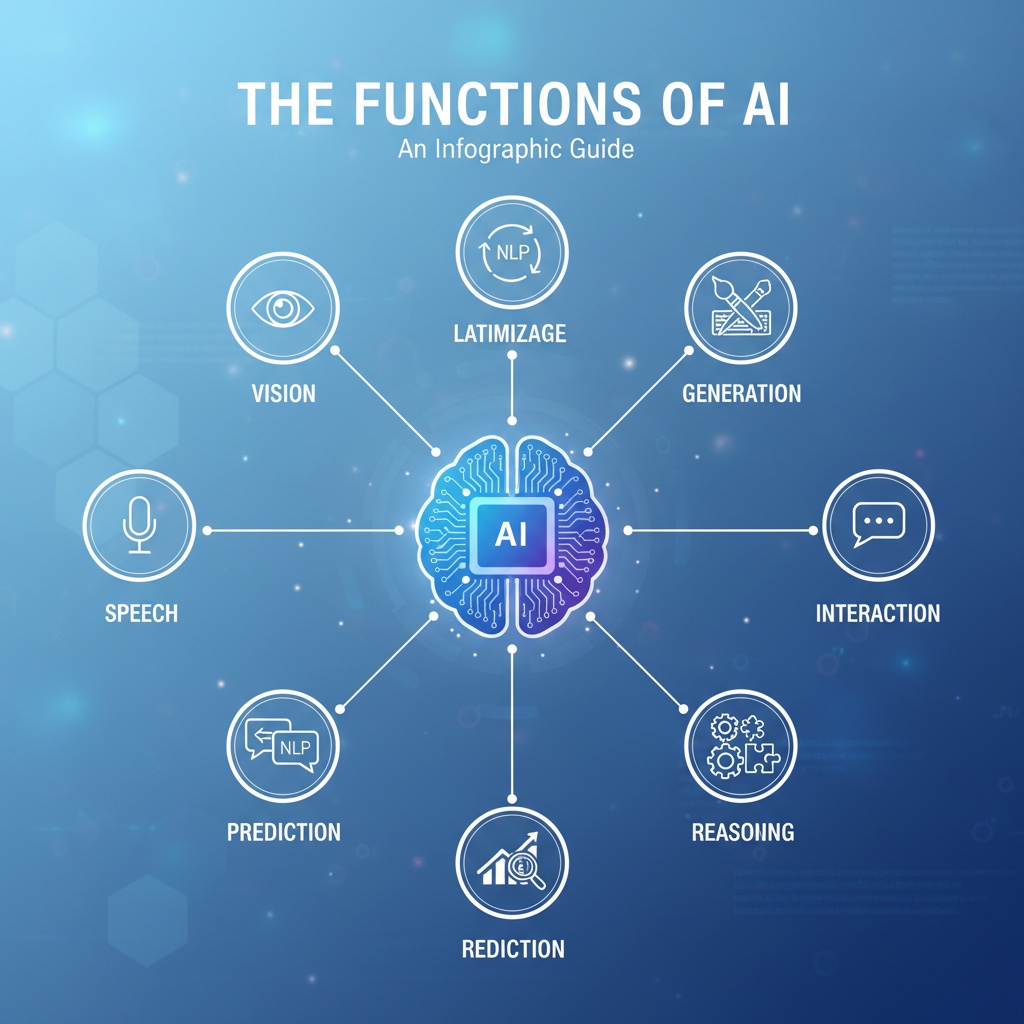
Across sectors, the core functions of AI include perception (recognizing images or sounds), prediction (forecasting outcomes), reasoning (decision-making), and generation (creating content). For example, in healthcare, AI interprets medical images; in finance, it detects fraud; in manufacturing, it predicts maintenance needs; and in marketing, it personalizes product recommendations.
How do the latest developments in AI change its functions?
Recent advancements in AI—such as foundation models, multimodal systems, and autonomous agents—are greatly expanding AI’s capabilities. These systems can handle multiple data types simultaneously (like text, images, and audio), perform complex reasoning, and even act autonomously in workflows. They redefine AI’s function from static automation to adaptive intelligence that can learn, plan, and interact across contexts.
What causes AI and job displacement, and how can it be mitigated?
AI and job displacement occur when automation replaces tasks traditionally done by humans—especially repetitive or predictable ones. However, this shift also creates opportunities for augmentation (enhancing human capabilities) and new roles like AI ethicists, prompt engineers, and MLOps specialists. Mitigation strategies include upskilling, promoting digital literacy, and adopting human-AI collaboration models to ensure technology complements rather than replaces the workforce.
How can organizations apply AI responsibly and avoid misuse?
Responsible adoption starts with AI governance frameworks that address fairness, transparency, and privacy. Techniques like bias auditing, explainable AI (XAI), and data minimization help ensure ethical use. Companies should also establish model testing, human oversight, and feedback loops to maintain accountability. Responsible implementation balances innovation with protection against errors or bias.
Is AI adoption expensive and complex for small businesses?
AI doesn’t have to be costly or complicated. Small businesses can start with cloud-based AI tools or pre-trained models from platforms like AWS or Azure, reducing upfront development costs. By starting with narrow use cases—such as automating customer support or improving sales analytics—they can measure ROI quickly. Gradual integration allows scaling as data and confidence grow.
What skills do professionals need to work effectively with AI systems?
Key skills include data literacy, understanding of machine learning fundamentals, and the ability to interpret AI-generated insights. Roles that bridge technical and business areas—like AI product managers or data strategists—are especially valuable. Beyond technical expertise, critical thinking and ethical reasoning are essential to guide AI application responsibly.
When is the right time for a company to adopt AI?
The best time to adopt AI is when an organization has sufficient data quality, clear objectives, and measurable use cases. Companies should begin with pilot projects, validate performance through metrics like accuracy or efficiency gain, and then scale. Early adoption offers a competitive edge, but long-term success depends on continuous monitoring and retraining as AI evolves.
What trends should we expect next in artificial intelligence?
Expect rapid progress in agentic AI systems that can perform multi-step reasoning, small language models optimized for edge devices, and expanding multimodal capabilities integrating text, visuals, and actions. There will also be stronger emphasis on AI safety, regulation, and transparency, ensuring that next-generation AI delivers innovation aligned with human values and societal benefit.
