

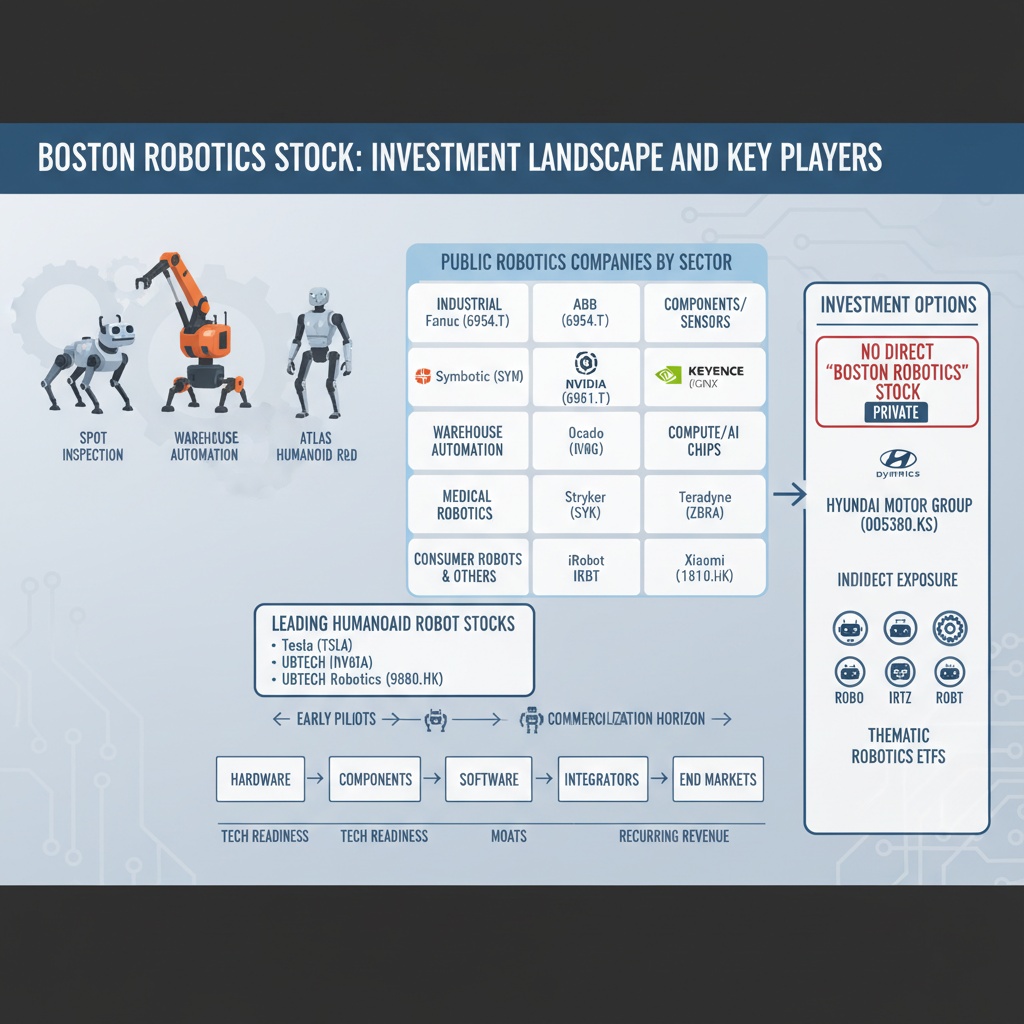
Boston Robotics Stock: How to Access AI Robotics, Public Companies, and Humanoid Robot Investments
Many investors search for boston robotics stock believing they can buy into the groundbreaking innovation of Boston Dynamics. Yet the truth surprises most—there is no Boston Robotics stock to purchase because Boston Dynamics remains a private company, without a public ticker or listed shares.
Still, that doesn’t mean the door to robotics investing is closed. The sector of AI robotics, automation, and humanoid systems is expanding rapidly, with plenty of public robotics companies driving the next wave of industrial and AI transformation.
This guide will help you understand:
- Why there’s no direct Boston Robotics stock — and what that means for investors.
- How to gain indirect exposure through Hyundai Motor, robotics ETFs, and key suppliers.
- Which top AI robotics companies and humanoid robot stocks could define the future of automation.
Let’s explore the real landscape behind the Boston Robotics search and uncover where the investable opportunities truly lie.
Is There a Boston Robotics Stock?
Curiosity around “Boston Robotics stock” has surged as robotics and artificial intelligence increasingly shape the future of industry. Yet the phrase itself is a misnomer. People using that search term almost always mean Boston Dynamics, the pioneering robotics company famous for its agile quadrupeds and humanoid prototypes. The key reality investors need to know upfront is that there is no Boston Robotics stock ticker, no publicly traded shares, and no market valuation because Boston Dynamics remains a private company.
Clarifying the Naming Confusion
It’s common for searchers and investors to mistakenly refer to “Boston Robotics” when they mean Boston Dynamics. Despite the mix‑up, the distinction matters. Boston Dynamics is headquartered in Waltham, Massachusetts, and was founded as a spinout from MIT. Its recognition stems from its advanced robots such as Spot and Atlas, whose mobility and balance have become viral symbols of progress in AI‑driven robotics. But none of that fame translates into a tradable stock; as a private entity, Boston Dynamics does not disclose quarterly earnings or list shares on any exchange.
Ownership and Hyundai’s Role in Boston Dynamics
In 2021, Hyundai Motor Group acquired about 80% of Boston Dynamics from SoftBank, valuing the company at roughly $1.1 billion. This acquisition was strategic: Hyundai sought to embed robotics into its vision of smart mobility and next‑generation manufacturing. Investors who want exposure to Boston Dynamics’ potential can turn to Hyundai Motor (tickers: HYMTF, 005380.KS), which trades publicly in both the US over‑the‑counter market and on the Korea Exchange.
Hyundai now includes Boston Dynamics as part of its Hyundai Robotics Lab initiatives, where advanced automation supports vehicle manufacturing and industrial logistics. While this makes Hyundai the most direct public proxy for Boston Dynamics exposure, it’s worth noting that Boston Dynamics forms only a small fraction of Hyundai’s diversified automotive portfolio. Analysts at platforms like Stock Analysis and WallStreetZen highlight Hyundai as the closest indirect gateway to benefit from Boston Dynamics’ success until a future IPO arrives.
Could a Boston Dynamics Spin‑Off or IPO Happen?
Investors regularly ask whether Boston Dynamics might eventually be listed independently. That scenario remains possible but speculative. Some market watchers have suggested that, if Boston Dynamics achieves steady commercial profitability, Hyundai could spin it off or initiate an IPO to unlock shareholder value. Pre‑IPO tracking platforms such as Forge Global and UpMarket confirm there is no current timeline or IPO filing, though they monitor private share activity for institutional investors. If made public, it would carry its own ticker, likely attracting considerable attention among ai robotics stock enthusiasts.
Indirect Investment Avenues Beyond Hyundai
Since there is no direct Boston Robotics stock, investors seeking exposure can look toward adjacent categories of public robotics companies that benefit from similar automation trends. Here are several indirect paths worth examining:
- Hyundai Motor (HYMTF) – Primary exposure through its ownership stake in Boston Dynamics and integration of robotics into its vehicle production and logistics systems.
- Robotics and AI ETFs – Thematic exchange‑traded funds like ROBO, BOTZ, IRBO, and ROBT hold a diversified range of AI robotics stocks. These funds sometimes include Hyundai and numerous industrial robot leaders, giving investors a broad footing in the sector.
- Enabler Companies – Public firms supplying sensors, computing chips, and servomotors to robotics manufacturers—such as NVIDIA, Cognex, and Keyence—offer ways to invest in the ecosystem powering Boston Dynamics and its peers.
- Robotics Ecosystem Partners – Developers and system integrators working in warehouse automation, logistics, and industrial robotics may indirectly benefit as Boston Dynamics technology scales.
The Broader Robotics Investment Context
The interest in a nonexistent “Boston Robotics stock” signals something larger: public excitement about the growing commercial potential of humanoid robot stocks and AI automation. Businesses are increasingly turning to intelligent machines to offset labor shortages, improve factory safety, and enable continuous operation in hazardous environments. This momentum benefits a wide range of public robotics companies, from industrial automation leaders like ABB and Fanuc to warehouse innovators such as Symbotic.
These firms share a unifying theme—deployable robotics systems that move beyond experimental labs into real‑world production environments. As this deployment scales, investor appetite naturally extends from individual names like Boston Dynamics to diversified holdings across the robotics value chain.
Understanding What “Indirect Exposure” Really Means
Owning shares of Hyundai or participating in robotic ETFs does not provide a pure‑play equivalent to holding a Boston Dynamics IPO stock. Instead, it offers thematic exposure to the same industry growth drivers: robotics hardware manufacturing, AI navigation software, and automation adoption across manufacturing and logistics.
| Exposure Path | Accessibility | Nature of Robotics Exposure | Key Considerations |
|---|---|---|---|
| Hyundai Motor (HYMTF) | Publicly traded | Direct owner of Boston Dynamics | Robotics is a small part of automotive operations |
| Robotics/AI ETFs (ROBO, BOTZ, IRBO, ROBT) | Publicly traded ETFs | Basket of global robotics and automation firms | Diversified but diluted exposure |
| Component Suppliers (e.g., NVIDIA, Cognex, Keyence) | Publicly traded | Enable sensors, compute, and vision systems | Broader AI and industrial exposure |
| Pre‑IPO or Secondary Markets | Restricted access | Private share exposure (limited liquidity) | High risk, speculative access only |
This table helps highlight how different strategies intersect with the robotics opportunity, each with unique risk‑return trade‑offs.
What It Means for Prospective Investors
For retail investors, the absence of a Boston Robotics stock price can be disappointing, but the robotics sector offers numerous accessible pathways to participate in the broader trend. While waiting for any potential spin‑off, purchasing shares of Hyundai or spreading risk through thematic ETFs allows engagement with the same innovation themes Boston Dynamics represents.
Those keen on deeper research can follow Hyundai’s robotics investments in its sustainable manufacturing plans, as well as industry conferences such as the [Robotics Summit & Expo](https://YOUR WEB/robotics-summit-expo-2025), where Hyundai and Boston Dynamics have jointly presented future strategies. Tracking these developments offers insights into possible valuation shifts before any public listing is announced.
A Foundation for Deeper Exploration
Understanding the lack of a Boston Robotics stock lays the foundation for evaluating the wider field of AI robotics investments. The next step is examining Boston Dynamics’ own strategy, product portfolio, and competitive edge within the robotics ecosystem. These details clarify how its technologies—from the industrial quadruped Spot to the humanoid Atlas platform—shape future commercial opportunities and influence investor sentiment across the sector.
Image: Inside a robotics lab featuring Boston Dynamics’ Spot robot inspecting industrial equipment.
The following section builds on this groundwork by exploring Boston Dynamics’ market positioning and outlook, outlining how its technologies, business model, and industry role define the path forward for both Hyundai shareholders and investors tracking the global advancement of robotics intelligence.
Boston Dynamics Market Positioning and Outlook
Boston Dynamics occupies one of the most distinctive positions in the robotics industry. Unlike traditional automation firms that focus on rigid-task manufacturing, Boston Dynamics centers its research on locomotion, balance, and embodied AI—the ability for a machine to understand and respond to its environment dynamically. This emphasis allows the company’s robots to traverse uneven terrain, manipulate objects with precision, and integrate into real-world workflows where conventional robots struggle. The strategy places Boston Dynamics at the frontline of robotics capable of performing “last 10 percent” human-equivalent tasks that have historically defied automation.
Its portfolio showcases this evolutionary trajectory. Spot, a quadruped inspection robot, is widely deployed across energy facilities, construction sites, and remote industrial locations. Its reliability in data collection, powered by autonomous navigation and perception modules, demonstrates commercial scalability beyond the lab. Stretch, the box-moving robot for warehouses, goes after a massive logistics automation market, proving that robotics can thrive in repetitive heavy-lifting tasks where throughput and uptime are critical. Meanwhile, Atlas, though still described as an R&D platform, continues to validate complex motion control and manipulation systems that could feed into future industrial or humanoid applications.
Visually, the company’s electric Atlas prototype—first revealed in new research videos—represents more than just engineering prowess. It embodies the direction of future humanoid systems, where power efficiency, safety, and full-body coordination create bridges between factory automation and service robotics. This R&D platform indicates how Boston Dynamics could expand Hyundai Motor Group’s foundation in intelligent manufacturing.

Beyond the hardware, Boston Dynamics’ real differentiator lies in its layered autonomy software stack. Each robot integrates real-time mapping, collision avoidance, and cloud-based fleet coordination. These capabilities enable the company to transition from one-time hardware sales to scalable robot-as-a-service (RaaS) models. The RaaS approach mirrors subscription software logic, helping enterprises avoid upfront costs while Boston Dynamics secures steady recurring revenue. If this framework succeeds under Hyundai’s corporate umbrella, it could redefine how high-performance robotics firms build sustainable profitability.
Commercially, Boston Dynamics has repositioned itself from experimental projects toward enterprise deployment. Large logistics companies already run pilot programs for warehouse automation, while manufacturing and utility clients rely on Spot to enhance safety inspections. Such adoption signals real progress beyond promotional videos. For Hyundai, these field-proven deployments serve dual purposes: near-term operational gains through automation and long-term validation of technology that could cascade across its automotive plants.
However, expanding this commercial reach requires navigating a competitive field. Major players such as ABB, Fanuc, and Yaskawa dominate traditional robotics for assembly lines, while upstarts like Symbotic and AutoStore specialize in modular warehouse architectures. In the humanoid segment, Boston Dynamics is facing growing visibility from Tesla’s Optimus, Agility Robotics’ Digit, and Figure AI’s humanoid platform. Competitive differentiation now depends not only on mechanical sophistication but also on how effectively firms merge perception, motion planning, and AI-driven learning to reduce downtime and maintenance costs.
Hyundai’s ownership strengthens Boston Dynamics’ strategic leverage. Using robotics as a cross-industry catalyst, Hyundai envisions robots in construction, manufacturing, healthcare, and smart cities. Boston Dynamics provides the intellectual and technical backbone to that ambition. The synergy between industrial scale and frontier robotics creates a compelling long-term value proposition—especially if an eventual spinoff or IPO materializes when revenue consistency improves.
From an investor’s viewpoint, Boston Dynamics represents technological premium but limited accessibility. Since it remains private, investors seeking exposure must analyze Hyundai’s robotics initiatives, joint R&D projects, and operational disclosures. Market observers often interpret such alignment as an early signal that the company might later transition from private ownership to a public listing, following the path of firms like iRobot or Symbotic after proving product-market maturity.
The Investable Landscape of AI Robotics Stocks
Even without a direct Boston Robotics stock, opportunities to participate in robotics growth remain substantial through public markets. The global robotics industry intertwines advanced mechanics, software, and AI. Each segment contributes differently to shareholder outcomes, making it essential to distinguish among hardware manufacturers, component suppliers, and system integrators.
1. Hardware Platforms
These firms produce the visible side of automation: robotic arms, autonomous mobile robots (AMRs), and emerging humanoids. Companies such as ABB, Fanuc, and Teradyne dominate high-volume production robots that populate factories worldwide. Their scale and well-established service networks create operational moats, although growth rates often mirror industrial capex cycles. Investors who favor resilient compounders may lean toward this category for predictable returns and steady dividends.
2. Components and Enablers
Less visible but critically strategic are component manufacturers. Firms like NVIDIA, Keyence, and Cognex supply vision systems, sensors, and compute modules essential for robot autonomy. The demand for smaller, faster, and energy-efficient processors makes chip suppliers a parallel play on robotics adoption. This tier often benefits from cross-industry exposure since the same sensor or chip may power autonomous vehicles, drones, and factory robots.
3. Software and Integration Layers
Enterprise automation increasingly hinges on the intelligence that stitches hardware together. Companies with robotic operating systems, cloud orchestration, and warehouse management integration are evolving into indispensable partners. Platforms such as those offered by Symbotic or software integrators within Honeywell and Zebra Technologies highlight how AI-driven optimization differentiates modern logistics. Investors evaluating this tier should focus on gross margin trends and recurring revenue contracts, which identify sustainable growth models in a hardware-intensive field.
Evaluating these AI robotics stocks demands deeper diligence than simply chasing thematic appeal. Sophisticated investors analyze technology readiness levels, validated deployment data, and the ratio of R&D to revenue. Unit economics matter: a robot with low failure rates and quick payback improves customer retention and accelerates recurring license renewals. Monitoring order backlogs and signed multi-site deals provides clues about momentum that quarterly earnings statements sometimes mask.
In practice, a multi-layered assessment model can clarify risk and reward:
- Technical maturity — Are robots performing autonomously at scale or still supervised?
- Financial structure — How aligned are sales cycles with recurring service revenues?
- Competitive moat — Does the company control critical data, algorithms, or integration APIs?
- Supply resilience — Are there dependencies on limited semiconductor or actuator sources?
By mapping investments across these parameters, investors can construct diversified exposure. For instance, holding ABB for industrial reliability, NVIDIA for AI compute leverage, and ISRG for medical robotics breadth captures different contours of the same automation wave. ETF vehicles such as ROBO and BOTZ encapsulate these layers for investors seeking thematic coverage without managing individual positions.
Understanding this structure gives context to Boston Dynamics’ role within the wider ecosystem. While private today, its innovation pipeline influences entire categories of public robotics companies developing companion technologies. As embodied AI and humanoid robotics mature, lessons from Boston Dynamics may increasingly shape how the next generation of AI robotics stocks achieve scalable commercial success.
Conclusion
Ultimately, the search for a Boston Robotics stock leads to one clear truth—there is no direct path to owning Boston Dynamics shares today. Yet, this realization opens a far broader and richer opportunity. The robotics revolution is not confined to a single company but driven by a network of pioneering innovators across industrial automation, humanoid platforms, and artificial intelligence integration. Investors willing to study this ecosystem gain far greater leverage than chasing one elusive ticker.
The landscape of public robotics companies—from industrial giants like ABB and Fanuc to AI enablers such as NVIDIA and Teradyne—offers diverse gateways into robotics’ exponential growth. At the same time, thematic ETFs across automation and embodied AI provide efficient, diversified exposure to these transformative markets. The key lies not in speculation but in disciplined evaluation: focusing on proven technology readiness, commercial traction, and sustainable financial metrics.
The evidence shows that robotics is moving from demonstration to deployment. Those who build portfolios around companies delivering real-world impact—not marketing hype—will capture the sector’s true value creation. With insight, patience, and strategic allocation, investors can position themselves at the center of the next industrial age—one defined by intelligent machines shaping how the world works, builds, and moves.
Frequently Asked Questions
Is there a “Boston Robotics stock” I can buy today?
No — there is no publicly traded Boston Robotics stock. The name most investors are searching for is Boston Dynamics, which is privately held and does not have a ticker symbol or listed shares. The only indirect exposure to Boston Dynamics comes through Hyundai Motor Group (HYMTF / Korean listing), which owns a controlling stake after acquiring the company from SoftBank.
Why do people confuse Boston Robotics with Boston Dynamics?
The confusion usually comes from search habits—many assume “Boston Robotics” refers to Boston Dynamics, the famed maker of robots like Spot and Atlas. The correct company name is Boston Dynamics, headquartered in Waltham, Massachusetts, and it remains one of the most recognized brands in advanced robotics despite its private ownership.
Can I invest in Boston Dynamics through Hyundai Motor Group?
Yes, indirectly. Since Hyundai Motor Group holds the majority stake in Boston Dynamics, buying Hyundai’s publicly traded shares offers partial exposure to its robotics investments. However, Hyundai is a diversified automaker, meaning Boston Dynamics represents only a small portion of its total business portfolio.
Are there any plans for a Boston Dynamics IPO?
As of now, no official IPO or stock listing for Boston Dynamics has been announced. Industry speculation suggests the company might go public in the future if its commercial robots achieve broad market traction, but there is no confirmed timeline. Until then, investors must rely on Hyundai’s ownership or participate in pre‑IPO platforms that track private valuations without guaranteeing access.
What are the best AI robotics stocks to watch instead?
For exposure to the robotics theme, consider established public robotics companies like ABB, Fanuc, and Teradyne (TER); logistics automation specialists like Symbotic (SYM); and enabling technology leaders such as NVIDIA (NVDA) and Cognex (CGNX). These represent the broader universe of ai robotics stocks actively traded on global markets.
Which companies are leading in humanoid robot development?
While Boston Dynamics’ Atlas sets the benchmark in maneuverability, other notable players include Tesla (TSLA) with the Optimus project, and UBTECH Robotics (9880.HK), a publicly listed humanoid developer. Private ventures like Agility Robotics and Figure AI are also pioneering humanoid applications for logistics and manufacturing, though they remain non‑investable for retail investors.
How can I invest in robotics if I don’t want to pick individual stocks?
Investors seeking broader exposure can choose robotics and AI ETFs such as ROBO, BOTZ, IRBO, or ROBT. These funds include a mix of industrial robotics, AI enablers, and automation leaders, giving a diversified portfolio of robotics-related companies without concentrating on a single stock.
What factors should I consider before investing in AI robotics stocks?
Evaluate each company’s technology readiness, market adoption, and financial health. Look for recurring revenue streams, strong R&D pipelines, and proven real‑world deployments rather than hype-driven demonstrations. Diversifying across regions and subsectors—hardware, sensors, software, and integrators—helps reduce risk in this fast‑evolving industry.
When might humanoid robot stocks become commercially significant?
Humanoid robots are still in the R&D and pilot phases, with commercial scale likely several years away. Most companies are testing humanoids in manufacturing, logistics, and inspection roles to validate safety and performance. For investors, this means humanoid robot stocks are a long‑term opportunity, not yet a revenue driver in 2024.
What’s the best strategy for investors interested in the robotics theme?
Start by building a watchlist of leading public robotics companies, examine their earnings reports for robotics-related growth, and consider a mix of direct stocks and ETFs. Focus on businesses showing sustained revenue from real-world deployments rather than prototypes. A disciplined, research‑based approach can help capture the robotics industry’s growth while managing volatility effectively.