

The Top 10 Robotics Companies in the World: Leaders Revolutionizing Automation
Robotics has evolved from science fiction into one of today’s most transformative forces across industries. With over four million robots operating worldwide and a market projected to surpass $185 billion by 2030, automation is no longer optional—it’s a strategic imperative.
In this guide to the top 10 robotics companies in the world, we dissect the global leaders defining the next era of intelligent machines. These innovators aren’t just automating tasks—they’re redefining how humans and technology collaborate in factories, hospitals, warehouses, and cities.
From industrial icons like FANUC and ABB to emerging powerhouses in collaborative, surgical, and mobile robotics, each company on this list showcases pioneering advancements in artificial intelligence, sensors, and system integration.
What You’ll Learn
- Which companies dominate industrial automation and cobot innovation
- How robotics is transforming manufacturing, logistics, and healthcare
- The methodology used to evaluate global footprint, innovation, and real-world impact
- Emerging trends driving sustainable and intelligent automation
Let’s explore the vision, technology, and market strategies behind the organizations shaping the future of robotics—and why they stand at the forefront of the world’s automation revolution.
The Top 10 Robotics Companies in the World Leading the Automation Revolution
The robotics sector has evolved into one of the most dynamic pillars of global industry, now valued at over $73 billion and projected to more than double by 2030. Understanding which organizations are driving this transformation helps executives and innovators identify where the future of automation is being built today. Among the top 10 robotics companies in the world, five stand out not only for their massive industrial impact but also for redefining what efficiency, precision, and collaboration mean in modern manufacturing. These leaders are shaping the blueprint for smart factories, agile supply chains, and human-safe automation.
FANUC: The Gold Standard in Industrial Robotics
FANUC remains synonymous with reliability and longevity in industrial robotics. Based in Japan, its bright-yellow mechanical arms have become icons of global automation, deployed across thousands of factories in the automotive, electronics, and general manufacturing sectors. The company holds one of the largest installed bases of robots worldwide, a testament to its consistent engineering excellence and factory-hardening of each product line.
FANUC’s range includes six-axis arms, SCARA robots, and collaborative robots (cobots), built for both speed and endurance. Each unit integrates seamlessly with CNC systems to create a unified smart manufacturing ecosystem. The company’s Zero Downtime initiative and extensive predictive maintenance systems help minimize production interruptions—a defining advantage in industries where each minute of downtime translates into substantial financial loss.
What sets FANUC apart is its obsessive focus on reliability. Automotive giants depend on these robots for tight tolerance welding and painting, while electronics firms rely on them for repetitive micro-assembly. Their commitment to robustness and precision makes FANUC the go-to partner for facilities seeking scalable, 24/7 production automation. For businesses exploring how robotic precision reshapes manufacturing, the discussion aligns closely with our insights on [robotic solutions transforming modern manufacturing](https://YOUR WEB/robotic-solutions-manufacturing-transformation).
ABB Robotics: Integrating Industrial Strength with Collaborative Intelligence
ABB Robotics from Switzerland and Sweden has established itself as one of the best robotics companies by blending industrial engineering excellence with cutting-edge automation intelligence. With a presence spanning over 50 countries, ABB’s robots power sectors ranging from automotive painting to logistics and electronics assembly.
The company’s flagship technologies—high-payload robotic arms and flexible industrial automation systems—bridge traditional manufacturing robustness with the adaptability required for modern smart factories. ABB’s robots, such as the YuMi and GoFa series, emphasize safe interaction and collaborative performance, reducing the need for safety cages while maintaining strict performance thresholds.
One of ABB’s defining contributions is AI-driven visual quality inspection systems, allowing robots to adapt in real time to variable product designs, materials, and environmental conditions. Its open architecture allows deep integration with MES and ERP platforms, a crucial enabler of smart, data-driven operations.
ABB’s balanced footprint in industrial and collaborative domains reflects its versatility—supporting both long-established manufacturers and next-generation startups. This adaptability underlines why ABB consistently earns recognition in lists such as the Top 20 Most Valuable Automation Companies of 2025.
KUKA Robotics: German Precision Meets Next-Gen Collaboration
KUKA Robotics, headquartered in Augsburg, Germany, merges mechanical precision with a forward-thinking approach to human-robot synergy. Known for its signature orange robots, KUKA’s portfolio spans from high-payload spot-welding units to collaborative robotic systems like the LBR iiwa, designed for lightweight, dynamic use alongside humans.
Its advanced systems dominate automotive plants globally but have also found success in logistics, metal processing, medical manufacturing, and food handling. KUKA’s digital twin technology allows manufacturers to simulate and optimize production cells before deployment, minimizing risk and accelerating ROI.
A major differentiator for KUKA lies in its embrace of intelligent connectivity. The firm’s AI-based predictive maintenance tools deliver insights on component wear, ensuring uptime and limiting unexpected failures. These features make KUKA a powerful ally for enterprises seeking balance between large-scale industrial throughput and adaptive human-machine collaboration.
To understand the research ecosystem driving such breakthroughs, readers may explore our piece on [robotics research and its intersections with AI engineering](https://YOUR WEB/robotics-research-2025-ai-engineering).
Yaskawa Motoman: Commanding Motion Control and Welding Automation
Among the top robotics companies in the world, Yaskawa Motoman stands as a pioneer of motion control and mechatronics excellence. Headquartered in Japan, Yaskawa’s long-standing leadership in servo technology forms the backbone of its success in welding, spraying, and material-handling robotics. Its MotionWorks and Sigma series controllers underpin some of the most complex automation environments in global manufacturing.
What differentiates Yaskawa is a relentless emphasis on precision and safety. The company’s welding automation systems dominate automotive production lines, ensuring consistent quality across millions of vehicle chassis components. Beyond heavy industry, Yaskawa is expanding into life sciences and pharmaceuticals, offering sterile, safety-certified robots capable of handling delicate laboratory procedures.
Yaskawa’s competitive advantage—its mastery of servo dynamics and safety certification—makes it a key reference point for manufacturers seeking steady accuracy across high-deposition welding and assembly tasks. With an ecosystem that integrates seamlessly with established PLC frameworks, its deployment speed and ROI are among the best in the industrial sector.
Universal Robots: Democratizing Automation for Every Business
Universal Robots, the Danish company often credited with sparking the modern collaborative robotics movement, has redefined accessibility in automation. Where industrial robots traditionally required specialized integration teams, Universal Robots’ UR series (UR3, UR5, UR10e, UR20) allows even small and medium-sized enterprises (SMEs) to deploy robots with minimal technical background.
Each cobot emphasizes plug-and-play operation, intuitive programming, and adaptability. Through its UR+ ecosystem—an extensive marketplace of end-effectors, sensors, and software add-ons—Universal Robots fosters a collaborative platform that accelerates deployment and customization. Its devices handle assembly, inspection, packaging, and machine tending, providing flexible automation suited for dynamic production environments.
This democratization of robotics has done more than reduce costs; it has reshaped workforce training and upskilling trends, aligning automation adoption with human advancement rather than opposition. The approach exemplifies how open robotic ecosystems can transition automation from large factories into workshops, education labs, and mid-sized enterprises developing specialized products.
For educational institutions and small manufacturers exploring accessible cobotic deployments, insights drawn from the rise of flexible automation in the top robotics companies in USA showcase how innovation and inclusivity coexist at scale.

Setting the Stage for Next-Generation Robotics Leaders
As industrial, collaborative, and mobile robotics reach new levels of maturity, the top five companies above represent the foundation of this evolution. They have demonstrated that excellence isn’t just about building machines—it’s about creating integrated ecosystems that amplify human capability and operational resilience. Their influence spans industries, geographies, and scales of business, from mega-factories producing millions of vehicles annually to nimble startups assembling niche electronics.
From this foundation of global industrial leadership, the next wave of robotics innovation is taking form: companies pushing boundaries in mobility, healthcare, and logistics. These innovators—Boston Dynamics, Intuitive Surgical, Amazon Robotics, DJI, and AutoStore—illustrate how robotics technology is expanding beyond production floors to touch new domains of daily and commercial life. The following section explores their breakthroughs in advanced mobility, surgical precision, and warehouse automation, continuing the lineage of innovation marked by these industry pioneers.
Expanding the Landscape of Global Robotics Leadership
The rise of the remaining innovators in the global robotics ecosystem reveals an entirely different layer of specialization—where agility, precision, and human-equivalent perception shift robotics from static automation to adaptive intelligence. Each of these leading companies extends the boundaries of how robots function in dynamic, unpredictable environments, from hospital operating rooms to aerial data collection zones and hyper-dense retail facilities.
Redefining Mobility and Perception: Boston Dynamics
Boston Dynamics represents a paradigm shift in robotics engineering. Its machines are not built merely to execute repetitive tasks—they’re designed to move, see, and react almost as living organisms do. Spot, the quadruped robot, has been deployed in energy facilities, construction sites, and defense operations to inspect and analyze environments that would endanger human workers. The Stretch system, on the other hand, transforms warehouse logistics with perceptual depth sensing and adaptable motion control, capable of unloading trailers autonomously without predefined layouts.
The company’s biomimetic approach, derived from decades of robotics research at MIT, highlights how AI-driven kinematics can reshape operational roles. When integrated into industrial or defense workflows, these systems provide real-time insights while maintaining agility in unpredictable terrain. In contrast to traditional industrial robotics that rely on structured environments, Boston Dynamics’ portfolio operates within a learning framework—robots that can balance, adapt, and reorient autonomously. These pioneers are setting early precedents for field robotics that future mobility platforms will inherit.
Precision Redefined: Intuitive Surgical and the Evolution of Robotic Medicine
While many of the top robotics companies in the world focus on industrial or logistics applications, Intuitive Surgical demonstrates robotics’ transformative potential in human care. The company’s famed da Vinci surgical system has performed over 12 million procedures worldwide, redefining what precision means in a clinical setting. A surgeon using this platform operates through high-definition visualization and micro-manipulators that filter tremors and translate minute hand movements into exact motions inside a patient’s body.
Unlike traditional manufacturing robots, surgical counterparts must meet both mechanical and ethical standards. Continuous improvements in haptic feedback, motion scaling, and instrument range have made robotic-assisted surgery a clinical standard rather than an experimental option. Hospitals evaluating robotic surgery programs focus not only on equipment capabilities but also on infrastructure compatibility, data security, and adherence to medical device regulations. According to the [latest insights on AI in surgical robotics](https://YOUR WEB/ai-surgery-robots-operating-rooms), new iterations of autonomous systems now include AI-assisted visual analytics that guide decision-making mid-procedure, foreshadowing a convergence between machine precision and clinical intelligence.
Logistical Scale as an Innovation Engine: Amazon Robotics
If industrial automation defines reliability and healthcare robotics defines precision, then e-commerce robotics defines velocity. Amazon Robotics operates at a scale that demonstrates the upper limit of robotic system coordination. Tens of thousands of autonomous mobile robots (AMRs) navigate seamlessly across massive fulfillment centers, reminiscent of digital nervous systems in motion. The introduction of Proteus—a safe, vision-based AMR that collaborates with human workers—marks Amazon’s shift from isolated automation cells to fluid human-robot coexistence zones.
Meanwhile, Sparrow, a sophisticated robotic manipulator, tackles a challenge long considered unsolved: picking diverse items without pre-labeled data. It applies deep learning and computer vision to identify, grasp, and sort items of varying shapes and materials. The combination of Sparrow and Proteus forms part of a continuous experiment in warehouse optimization, transforming operational design from linear workflows into intelligent, responsive logistics ecosystems. This integrated model hints at what future omnichannel fulfillment could look like—fluid, self-correcting, and fully digitized from order to outflow.
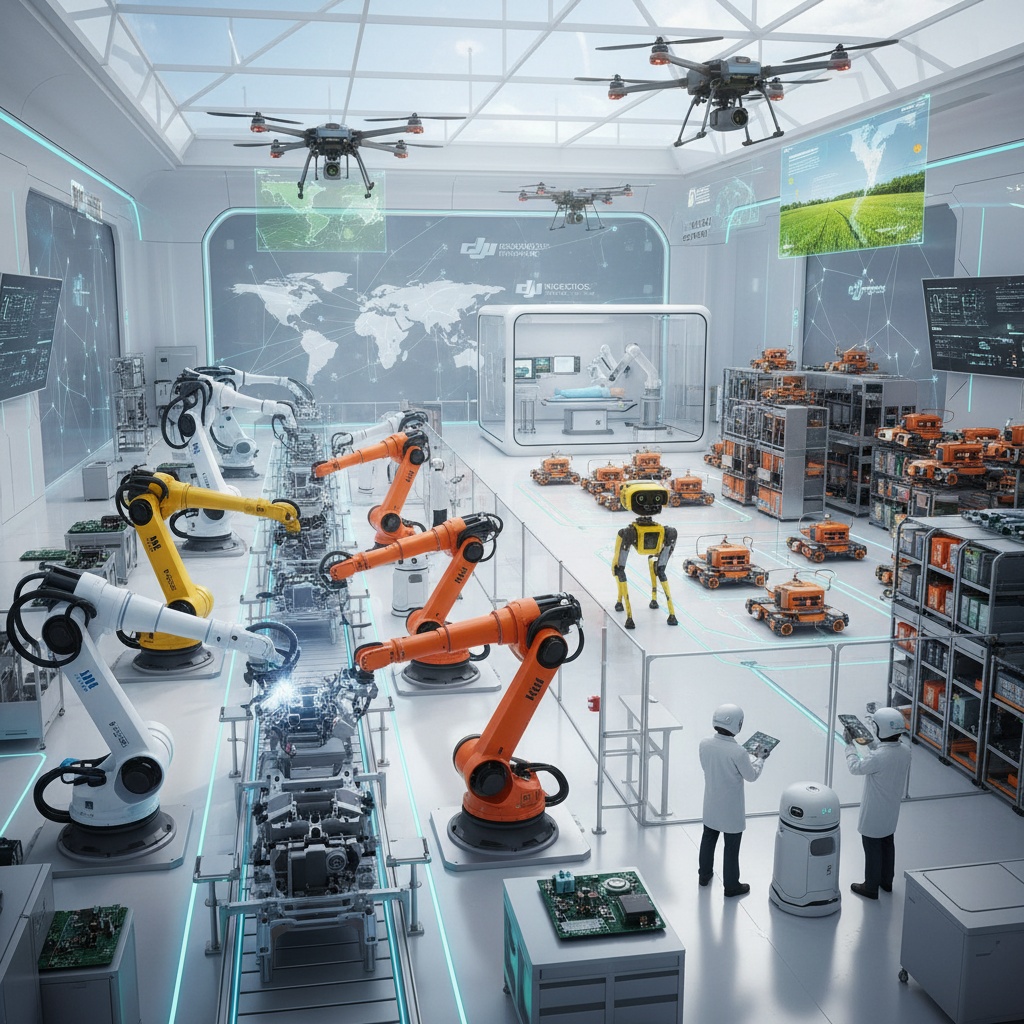
Image: Industry-Defining Robotics in Action

Aerial Autonomy and Data Intelligence: DJI Innovations
In the skies above, DJI continues to dominate with unmatched precision in flight control and visual data analytics. Once confined to recreational drone enthusiasts, DJI’s enterprise platforms now underpin industrial inspection, mapping, and precision agriculture. These drones conduct remote powerline checks, geological surveys, and crop analysis at scales that far exceed feasibility for manual teams.
DJI’s entry into ground-based robotics underscores its ambition to expand from aerial imaging to a holistic suite of autonomous systems. Through developer-focused APIs and SDKs, companies across telecommunications, public safety, and infrastructure are embedding DJI’s sensor stack into custom solutions. This transition positions the company not only as a manufacturer but also as a foundational layer for the growing robotics developer economy. As [robotics research](https://YOUR WEB/robotics-research-2025-ai-engineering) increasingly integrates AI-driven perception, DJI’s evolution showcases the shift toward robotics as a data intelligence industry rather than a purely mechanical one.
Spatial Efficiency and Retail Automation: AutoStore
AutoStore introduces robotics as an answer to space optimization challenges rather than labor replacement. Its cube storage system operates in three dimensions, enabling goods retrieval in confined spaces with nearly zero wasted volume. Each robot runs intelligently atop a grid, retrieving storage bins that contain inventory items, handing them to ergonomic workstations where operators pack or replenish goods.
The brilliance of AutoStore’s model lies in its simplicity: static inventory, high-density grids, and motion-optimized robots that work collaboratively with human operators. Retail chains and grocery networks across Europe and North America are migrating to this architecture because it lowers energy consumption while drastically increasing order throughput. When integrated with real-time order management systems, these micro-fulfillment sites allow retailers to process same-day delivery orders from inventory hubs positioned close to urban centers. Compared to conventional pallet rack systems, AutoStore’s grid yields up to four times more storage capacity within the same physical space.
Shifting the Robotics Value Chain
Each of these companies contributes not only advanced hardware but also unique operating models for scaling robotics. Boston Dynamics demonstrates mobility intelligence; Intuitive sets the clinical standard; Amazon operationalizes robotics at global scale; DJI anchors the autonomy and data nexus; and AutoStore applies applied mathematics to logistics density. Collectively, they illustrate the diversification of robotics from manufacturing roots into every sector where physical action and data intuition intersect.
These directions point toward a converging trend across top robotics companies in the USA, Europe, and Asia: robotic ecosystems designed to learn collectively, share operational data securely, and evolve over time. This continued evolution blurs the boundaries between automation and intelligence, setting the stage for the next phase of adaptive, AI-centric robotics capable of transforming industries far beyond their current scope.
Conclusion
The world’s most advanced robotics companies are not merely transforming factories—they are redefining how industries operate, compete, and innovate. From industrial powerhouses like FANUC and ABB to pioneers of mobility and autonomy such as Boston Dynamics and Amazon Robotics, each leader exemplifies the convergence of mechanical precision with intelligent, adaptive software. Together, they form the backbone of a global shift toward smarter, safer, and more sustainable automation.
Ultimately, the value of understanding the top 10 robotics companies in the world lies in clarity of direction. By recognizing their strategies, capabilities, and ecosystems, businesses can confidently chart their automation roadmap—matching the right technologies to operational goals and scaling with purpose. This is no longer about robotics as a future ambition but as a current competitive requirement.
For engineers, executives, and innovators alike, the next step is clear: evaluate where automation can most effectively amplify productivity, strengthen resilience, and position your organization at the forefront of the next industrial era. The companies leading robotics today are shaping the blueprint of tomorrow’s intelligent enterprise—and now, armed with this insight, you’re ready to be part of that transformation.
Frequently Asked Questions
What criteria were used to determine the top 10 robotics companies in the world?
The ranking was based on a multi-dimensional evaluation framework considering each company’s global footprint, technical innovation, market share, breadth of deployments, and ecosystem strength. Companies were assessed by their installed robot base, revenue momentum, advancements in AI-driven automation, and real-world performance across manufacturing, logistics, healthcare, and service sectors. Recent milestones such as product launches, partnerships, and certifications from 2023–2025 were also key selection factors.
How are robotics companies in the USA different from global competitors?
USA robotics companies excel in logistics automation, healthcare robotics, and AI-based manipulation systems, driven by strong venture capital support and large-scale use cases. Firms like Boston Dynamics, Amazon Robotics, and Intuitive Surgical reflect this distinction through cutting-edge mobility, autonomous systems, and medical precision. In contrast, Asian and European leaders like FANUC and ABB tend to dominate industrial sectors with mature, large-scale manufacturing solutions and long-term reliability.
Which industries benefit the most from robotics adoption?
The biggest beneficiaries include manufacturing, logistics and fulfillment, and healthcare. Industrial robots enhance assembly, painting, and welding processes, improving precision and uptime. Logistics relies on autonomous mobile robots (AMRs) for warehouse picking, sorting, and inventory tasks. In healthcare, surgical robots improve patient outcomes and reduce recovery times. Emerging sectors such as agriculture, construction, and hospitality are also rapidly adopting automated systems to improve efficiency and ROI.
How do collaborative robots (cobots) differ from traditional industrial robots?
Collaborative robots (cobots) are designed to work safely alongside humans without physical barriers, using torque sensors, vision systems, and safety-compliant design. They are typically smaller, more flexible, and easier to program than traditional robots. Companies like Universal Robots have made cobots accessible to small and medium-sized enterprises by offering plug-and-play automation with intuitive programming interfaces. In contrast, traditional industrial robots operate in enclosed environments at higher speeds and payload capacities.
What are the main challenges businesses face when integrating robotics?
Common challenges include high initial investment, integration complexity with existing systems (MES, PLCs, WMS), and workforce training. Organizations often underestimate the need for pilot testing, safety certification, and maintenance planning. Another hurdle lies in achieving seamless human-robot collaboration without disrupting existing workflows. Choosing vendors that offer strong technical support, API accessibility, and a proven integration ecosystem is critical to overcoming these barriers.
What is the typical ROI for robotics integration across industries?
Return on investment (ROI) depends on the robot type and application sector. On average, industrial robots deliver payback within 2–5 years, while cobots for SMEs often return value in 1–3 years due to lower upfront costs. Logistics and warehouse automation typically see ROI within 2–4 years, whereas surgical systems can take 3–7 years, reflecting longer clinical validation and equipment amortization. Factors such as utilization rate, downtime, and process optimization strongly influence ROI timelines.
Who are the emerging robotics companies to watch in Boston and the USA?
Boston’s robotics cluster is home to innovators like Locus Robotics (AMRs for warehouses), RightHand Robotics (AI-powered manipulation), and Vecna Robotics (autonomous material handling). These firms, alongside Boston Dynamics and iRobot, benefit from proximity to MassRobotics, MIT, and strong VC networks. Nationwide, high-growth players include Dexterity, Berkshire Grey, and Serve Robotics, each advancing the automation frontier in their respective niches.
How are delivery robot companies transforming last-mile logistics?
Delivery robot companies such as Starship Technologies, Serve Robotics, and Nuro are revolutionizing last-mile delivery with autonomous, low-emission vehicles operating on sidewalks or roadways. They improve efficiency, reduce labor costs, and support sustainable mobility for food, groceries, and parcels. Key challenges include urban navigation, weather resilience, and regulatory approval. Overcoming these barriers is crucial for large-scale deployment and profitability in last-mile logistics.
What safety and compliance standards should robotics deployments meet?
Robotics systems must comply with ISO 10218-1/2 for industrial safety, ISO/TS 15066 for collaborative operation, and