

The Rise of the Self-Driving Delivery Robot: Redefining the Last Mile of Urban Logistics
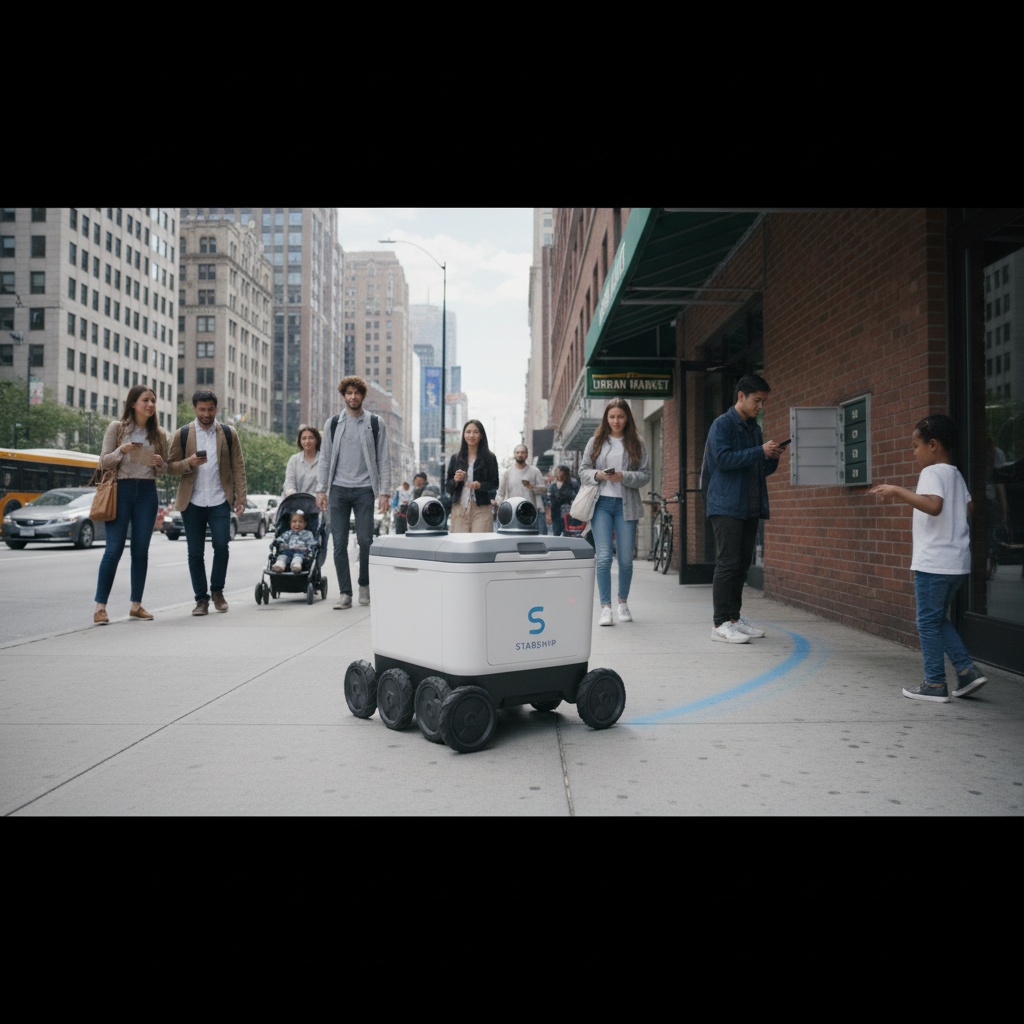
They glide quietly down sidewalks, waiting patiently at crosswalks, and roll right up to doorsteps—all without a driver in sight. The self-driving delivery robot has moved from futuristic novelty to everyday reality in cities around the world.
These compact, autonomous couriers are reimagining how we move goods through dense urban areas, tackling some of the toughest logistics challenges:
- Labor shortages that strain traditional delivery networks
- Urban congestion that slows vehicles and spikes emissions
- Rising operational costs demanding more efficient alternatives
Fueled by advancements in artificial intelligence, sensor fusion, and real-time mapping, companies like Starship Technologies and Serve Robotics are proving that robotic delivery is not just possible—it’s practical, scalable, and profitable.
As these automated delivery bots weave into the fabric of daily city life, the question isn’t if they’ll transform last-mile logistics, but how fast that transformation will occur.
The Rise of Self-Driving Delivery Robots: Exploring Starship and Other Innovators
Self-driving delivery robots are reshaping how goods travel the “last mile” from local hubs to homes and businesses. Compact, efficient, and electric, these autonomous machines are designed to move where vans cannot—across sidewalks, campus pathways, and neighborhood streets at roughly walking speed. Their ability to operate continuously while maintaining low operational costs is encouraging both startups and major logistics players to reimagine urban delivery models that reduce congestion, emissions, and dependency on human drivers.
Defining the Modern Self-Driving Delivery Robot
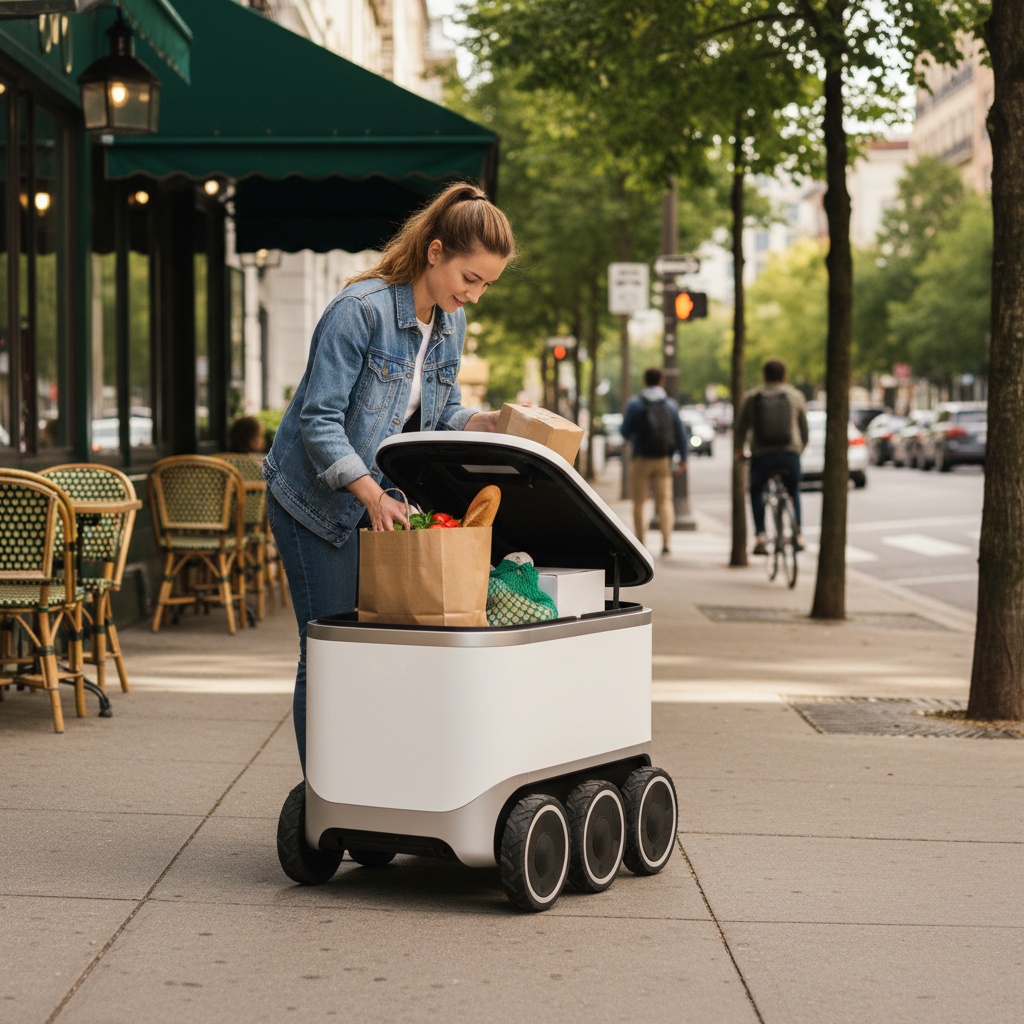
A self-driving delivery robot, or delivery bot, is a small, battery-powered machine designed to transport packages and food within short ranges typically between 1–3 kilometers. Operating at around 4 mph, it shares sidewalks with pedestrians and uses a combination of advanced sensors and real-time navigation software to avoid obstacles and reach its destination safely. Unlike autonomous delivery vehicles that move along public roads, these robots are optimized for sidewalks, pedestrian zones, and well-defined path networks.
Leading projects such as Starship Technologies, Serve Robotics, and Cartken have demonstrated how this class of robot fits neatly into everyday life. Through partnerships with universities, grocery stores, and restaurant chains, these bots have proven that reliable automation can be integrated into local delivery ecosystems without disrupting pedestrian flow.
A typical robot of this kind:
- Carries 10–15 kilograms, ideal for groceries, meals, or small retail parcels
- Travels within a few kilometers from a local hub or restaurant
- Operates fully autonomously, with remote human oversight in complex situations
- Runs on electric rechargeable batteries, ensuring quiet, zero-emission transport
This compact design allows them to deliver around-the-clock—even when demand spikes or the weather turns bad—creating a scalable alternative to human couriers for repetitive, short-range trips.
From Concept to Daily Reality
The concept of an autonomous food delivery robot started as a pilot experiment only a few years ago, but it has quickly matured into a viable micro-logistics service. According to Appinventiv’s overview on food delivery robots, the first generations were confined to campuses and controlled zones where sensor testing was easier and regulations looser. Today these robots are expanding into neighborhoods, business districts, and retail hubs worldwide.
A key factor behind their expansion has been operational reliability. Companies like Starship Technologies now report hundreds of thousands of completed deliveries each month. Through continual software updates, these robots can identify crosswalks, read road signage, and handle the unpredictability of pedestrian environments with increasing skill. Each deployment provides new data that refines navigation algorithms and strengthens the decision-making of future fleets.
Why Urban Environments Are Ideal Testbeds
The success of sidewalk-based robots depends heavily on urban design. Dense neighborhoods with consistent sidewalk networks, shorter delivery distances, and strong consumer demand provide the perfect environment. These areas amplify the robot’s advantages:
- Reduced travel times and efficient short-distance coverage
- Lower delivery costs since no driver or large vehicle is required
- Smaller carbon footprint per trip compared to scooters or vans
- Quieter streets with less traffic congestion
Universities, for example, became early adopters because of their well-mapped and pedestrian-friendly layouts. What started as campus food delivery pilots became full-scale testbeds for urban-scale logistics solutions. Cities like Milton Keynes in the UK and San Francisco’s residential neighborhoods now serve as larger demonstrations of this potential.
Starship Technologies: A Pioneer in Scaled Sidewalk Logistics
No discussion of autonomous delivery would be complete without highlighting Starship Technologies. Founded in 2014, Starship operates the world’s largest fleet of autonomous delivery bots. Its six-wheeled robots—under 70 cm long—are equipped with 12 cameras, ultrasonic sensors, and radar to generate a 360-degree view of their surroundings. The company reports that its robots are capable of completing deliveries 99% autonomously, with remote human operators stepping in only for rare edge cases.
Each Starship robot handles dozens of deliveries per day within short distances, achieving remarkable efficiency compared to van-based couriers. Local grocery stores and restaurants can dispatch orders to nearby customers almost instantly, while users track the robot’s progress via a mobile app. Upon arrival, customers unlock the robot’s secured compartment through a QR code, completing the transaction with minimal human contact.
Competing Innovations Across the Industry
While Starship leads in deployment numbers, several other innovators are expanding the boundaries of autonomy:
- Serve Robotics, spun out from Uber’s Postmates division, focuses on on-demand meal deliveries in Los Angeles, using advanced navigation to handle steep inclines and high-traffic crossings.
- Coco robots use teleoperation combined with semi-autonomous features, proving useful for tight urban corners and restaurant-heavy corridors.
- Cartken, a Google alumni startup, has developed compact robots for closed campuses, integrating sustainability goals into operations.
Each company targets different environments, revealing how flexible the category has become. Some focus on dense cities with strong mapping infrastructure, while others explore suburban and mixed-use developments.
The Human-Robot Intersection in Daily Life
Public reactions to autonomous delivery machines have evolved from curiosity to acceptance. Sidewalk robots frequently share space with joggers, pedestrians, and pets. To ensure smooth coexistence, operators collaborate with city planners to design clear pathways and rules of engagement. Robots move at pedestrian-friendly speeds and emit subtle sounds or visual signals to indicate movement or turns, which improve trust and safety in mixed-use zones.
Additionally, the tactile, friendly design of these robots—rounded edges, smooth motion, soft lighting—encourages positive public interaction. The goal is to make delivery automation feel approachable rather than intrusive, an approach many operators view as essential to long-term adoption.
Broader Impact on Logistics and Retail
For businesses, self-driving delivery robots open new channels for fulfillment. Retailers and restaurants can operate micro-fulfillment hubs close to customers rather than relying on centralized warehouses. Robots handle the short-range connection between these mini-hubs and end users. This strategy shortens delivery times, lowers storage needs, and keeps delivery prices competitive without demanding heavy infrastructure investment.
Food delivery platforms already leveraging bots report smoother capacity management during off-peak hours and cost reductions of up to 50% in select routes. It also allows human couriers to focus on longer, high-value, or complex deliveries—striking a blend of automation and human flexibility within a city’s logistics web.
Differences Between Self-Driving Delivery Robots and Larger Autonomous Vehicles
While both technologies share the core principle of autonomy, their operating contexts differ substantially. A side-by-side comparison helps define their complementary roles:
| Feature | Self-Driving Delivery Robot | Autonomous Delivery Vehicle |
|---|---|---|
| Speed | ~4 mph (pedestrian-paced) | 25–35 mph (low road speed) |
| Payload Capacity |
Key Technologies Powering the Evolution of Self‑Driving Delivery Robots
While the concept of a self driving delivery robot often conjures images of compact, wheeled machines gliding along sidewalks, the sophistication lies beneath the surface. The most significant breakthroughs originate in the integration of multiple technologies that allow these robots to “see,” “decide,” and “act” without human intervention. Each subsystem plays a distinct role in enabling safe, autonomous mobility in complex urban environments.
Multi-Sensor Perception and Environmental Awareness
Autonomous perception begins with an overlapping mix of cameras, LiDAR, radar, and ultrasonic sensors. These sensors together simulate the senses of vision and touch—critical for a robot navigating unpredictable pedestrian zones. Cameras interpret visual cues such as pedestrians, pets, and signs. LiDAR, short for Light Detection and Ranging, sends out invisible pulses of light to calculate distances, building an exact 3D model of the robot’s surroundings. Ultrasonic sensors fill the gaps by detecting close‑range objects that cameras or LiDAR may miss.
To merge these data streams, the robot uses sensor fusion algorithms that dynamically weigh information from each input. This integration creates a continuously updated “world model,” allowing the robot to anticipate movement and adjust routes accordingly. Advances in edge computing now let perception systems process data locally rather than sending everything to the cloud, significantly reducing delays and improving reaction time in crowded spaces.
Visual representation: A cutaway diagram of a delivery robot’s sensor suite highlighting LiDAR placement, camera arrays, and proximity sensors.
Mapping and Localization at the Centimeter Level
A delivery bot’s ability to navigate hinges on pinpoint accuracy. Typical GPS signals can deviate by several meters—unacceptable when operating on narrow sidewalks. To overcome this, robots combine standard GPS with Real‑Time Kinematic corrections or visual landmark recognition, narrowing position accuracy to within a few centimeters.
Simultaneous Localization and Mapping (SLAM) further refines precision. Using SLAM, the robot constructs a live map as it moves, interpreting surroundings and identifying static features such as lampposts or curbs. When GPS is blocked by tall buildings or dense foliage, this internal map keeps the robot oriented. Some newer systems even employ cloud-based high-definition (HD) maps that document curb ramps, elevation changes, and sidewalk widths collected from prior missions, helping autonomous fleets progressively learn shared spaces.
Cognitive Algorithms for Path Planning and Control
At the heart of autonomy lies decision-making—the capability to predict and respond to the movement of people, bicycles, and cars. Machine learning algorithms model a robot’s immediate surroundings, assigning probabilities to human actions such as whether a pedestrian might change direction or a car might pull out of a driveway.
Once these probabilities are established, motion‑planning software generates a safe and efficient path within milliseconds. The control system translates that trajectory into precise wheel speeds and steering angles, ensuring smooth motion even on uneven pavements. Redundancy is built in so if one sensor malfunctions, another can assume its role, guaranteeing stability and continuity of movement.
Real‑Time Connectivity and Fleet Coordination
Connectivity is the invisible backbone of reliability for every autonomous delivery vehicle in a commercial fleet. Each robot stays linked to a network via 4G, 5G, or Wi‑Fi connections that support telemetry, live video feeds, and continuous diagnostics. When sensors encounter ambiguous scenarios—a blocked crosswalk, for instance—the system can trigger teleoperation support. A human operator views the camera feed and remotely guides the robot past the obstacle before returning control to the onboard system.
Cloud connectivity enables more than safety; it facilitates coordination. Through centralized fleet management software, operators monitor dozens of units simultaneously, balancing battery levels, delivery progress, and maintenance schedules. Modern systems use predictive analytics to flag components at risk of failure, pre‑empting downtime and extending robot longevity.
Energy Systems and Intelligent Charging
Battery life dictates operational efficiency just as fuel range governs logistics trucks. Electric power systems for current delivery bots typically rely on lithium‑ion batteries with energy densities optimized for lightweight transport. Intelligent charging docks now incorporate robotic arms that automatically swap depleted batteries, maintaining continuous operation. Energy‑aware scheduling allows each robot to plan delivery routes based on remaining power, returning to a charging hub when thresholds are reached.
Future prototypes are adopting solid‑state battery technology and solar‑assisted charging, further reducing dependency on manual charging cycles. As fleets scale, energy management platforms integrate with the electrical grid to charge during off‑peak hours, lowering operational costs and minimizing carbon load.
Artificial Intelligence and Continuous Learning
Unlike traditional logistics vehicles programmed with fixed routines, autonomous food delivery robots improve through iteration. Every trip generates fresh data on pedestrian behavior, surface conditions, and obstacle types. This information feeds into distributed learning frameworks where models are updated and deployed across the fleet. A robot operating in Helsinki, for instance, might indirectly teach another in Austin to handle icy pavement by sharing anonymized parameters through the network.
Artificial intelligence also enhances contextual reasoning. Beyond detecting static objects, new perception models interpret gestures, group movement, and even the intent of a pedestrian waiting at a crosswalk. The result is smoother human‑robot interaction and greater public comfort in shared spaces.
Edge Safety Systems and Fail‑Safe Design
Safety subsystems serve as an uncompromising barrier between innovation and public trust. Each self‑driving unit contains independent braking and obstacle‑avoidance modules that continue to function even if higher-level computing fails. External LEDs and audible cues alert pedestrians of robot direction or stops, similar to turn signals in cars. Some manufacturers incorporate geofencing to ensure operation only within preapproved routes verified for accessibility compliance.
Redundant communications paths, autonomous emergency braking, and automatic hibernation upon loss of signal exemplify design principles borrowed from automotive functional safety standards such as ISO 26262. As standards evolve, these designs will anchor broader acceptance of robotics in everyday life.
Integration with Smart Infrastructure
The next wave of delivery automation depends on the merging of these robots with smart city infrastructure. Integration with connected traffic lights, digital curb maps, and vehicle‑to‑everything communication networks will extend perception beyond the robot’s onboard sensors. A traffic signal could broadcast its state over a wireless channel, enabling the robot to time crossings perfectly without relying on camera recognition.
Retail hubs and residential complexes are likewise experimenting with autonomous docks that identify arriving robots and trigger automated doors or security gates. These infrastructure connections convert point-to-point delivery into a seamless micro‑logistics ecosystem, greatly improving efficiency for high‑density neighborhoods.
Emerging Frontiers in Hardware Design
Technological progress increasingly focuses on making robots adaptable to more terrain types. Compact four‑wheel steering systems enable tighter turns, while modular wheels transition between pavement and gravel. Some research groups are developing leg‑wheel hybrid designs capable of navigating stairs and curbs, addressing one of the most persistent challenges in last‑meter delivery.
Advances in materials science also influence performance. Lightweight composites and shock‑absorbent chassis components reduce vibration, protecting fragile goods. Passive cooling systems regulate battery temperatures to prevent degradation during prolonged operation in heat. Each enhancement contributes to reliability and customer confidence, essential for scaling commercial deployment.
Linking Robotics with Broader AI Innovation
The rapid development in robotics research that powers delivery systems mirrors progress in other AI‑driven sectors. Innovations in reinforcement learning, sensor miniaturization, and predictive modeling migrate from industrial automation to these small mobile units. Enterprises exploring integrated manufacturing or warehouse automation can look to robotic solutions and AI in surgical robotics for parallels in precision engineering and control theory.
As these technologies converge, the line between autonomous logistics and intelligent infrastructure continues to blur. The self driving delivery robot becomes not just a courier but a key node in an interconnected network of smart systems gradually redefining how cities move goods and manage resources.
Conclusion
The era of autonomous delivery has arrived, redefining how goods move through our cities and communities. These compact, intelligent machines are not a futuristic concept but a functioning solution addressing real challenges—from labor shortages to carbon emissions. Their success in streamlining operations, lowering costs, and enhancing reliability marks a decisive shift in last-mile logistics.
Ultimately, self-driving delivery robots embody the next evolution of urban mobility: sustainable, efficient, and continuously learning systems that deliver value every hour of the day. Yet their true promise depends on collective progress. When technology innovators, retailers, and city planners align efforts, they create ecosystems where automation enhances accessibility, safety, and sustainability in equal measure.
Businesses now have the data, tools, and proven models to act. Piloting autonomous fleets in high-density neighborhoods or campus environments no longer represents experimentation—it is a strategic move toward competitive advantage and greener delivery networks. For cities, embracing intelligent infrastructure today ensures smoother integration tomorrow, positioning urban environments for a future powered by clean, autonomous logistics.
The message is clear: the path forward is not waiting to be discovered—it is ready to be built. Those who engage now in shaping, regulating, and adopting autonomous delivery technology will define the standards of convenience, efficiency, and environmental responsibility for the next generation of commerce.
Frequently Asked Questions
What exactly is a self-driving delivery robot?
A self-driving delivery robot is a small, battery-powered, autonomous vehicle designed to transport goods such as groceries, meals, or packages over short distances. Operating primarily on sidewalks and campuses at speeds around 4 mph, these robots use sensors, cameras, and GPS for navigation. Unlike road-based autonomous delivery vehicles, they are optimized for pedestrian routes and last-mile logistics in urban areas.
How do self-driving delivery robots navigate without human help?
These autonomous delivery robots rely on a combination of technologies collectively known as a sensor fusion system. They use LiDAR, cameras, ultrasonic sensors, and GPS to detect obstacles, map surroundings, and plan routes in real time. Artificial intelligence interprets this data to make safe navigation decisions, while remote operators can intervene if a robot encounters a complex or unexpected situation.
What are the main benefits of using delivery bots over human couriers?
Delivery bots provide several advantages:
- Cost efficiency, as they operate autonomously, reducing dependence on drivers.
- Sustainability, since they are electric and produce zero direct emissions.
- Reliability, because they can deliver 24/7 without breaks.
- Reduced congestion, by removing cars from short-distance delivery routes.
In dense neighborhoods, this makes deliveries faster, cheaper, and more environmentally friendly.
Who are the main companies developing self-driving delivery robots?
The industry’s front-runners include Starship Technologies, which operates thousands of delivery bots worldwide, and other innovators like Serve Robotics, Nuro, Cartken, and Coco. These companies collaborate with major retailers, universities, and food delivery services to test and expand robot delivery networks across cities and campuses.
What types of deliveries are best handled by autonomous food delivery robots?
Autonomous food delivery robots excel at short-distance deliveries within 1–3 kilometers. They’re ideal for restaurant meals, groceries, beverages, and small packages weighing up to 10–15 kg. Many feature temperature-regulated compartments to keep food hot or cold, ensuring quality upon arrival.
Are self-driving delivery robots safe for pedestrians?
Yes. Safety is central to their design. Robots move at low pedestrian speeds, use redundant braking systems, and feature lights and audible alerts to notify nearby pedestrians. When uncertain, the robot defaults to a complete stop. These features have resulted in strong safety records in pilot cities and campuses.
What happens if a delivery bot runs into obstacles or malfunctions?
If a robot encounters an obstacle it cannot navigate—such as a blocked sidewalk or unexpected debris—it first attempts an automatic reroute. If unsuccessful, it contacts a remote operator via live video feed for manual guidance. Damaged or non-responsive robots are quickly retrieved for maintenance, ensuring minimal disruption to service.
How are cities adapting to the rise of delivery robots?
Many cities have introduced pilot programs that regulate fleet sizes, define operating zones, and establish speed limits for these robots. Municipalities are also developing standards for sidewalk usage, accessibility, and charging station placement to ensure safe and orderly integration into urban environments. Collaboration between city planners, tech firms, and the public is essential for large-scale rollout.
Do self-driving delivery robots reduce carbon emissions?
Absolutely. Because these robots are fully electric, they emit no greenhouse gases during operation. Studies suggest that a robot delivery consumes roughly the same amount of energy as boiling a kettle of water, significantly reducing the carbon footprint compared to car-based deliveries. Their use helps promote cleaner, quieter, and more sustainable cities.
What does the future hold for autonomous delivery vehicles and robots?
The future points to multimodal delivery systems, where self-driving delivery robots, road-based autonomous vehicles, and drones work together to complete seamless deliveries. Improvements in AI perception, battery life, and urban integration will expand their reach from pilot zones to widespread adoption. As regulations mature and technology evolves, delivery bots are poised to become a standard element of modern urban logistics.