

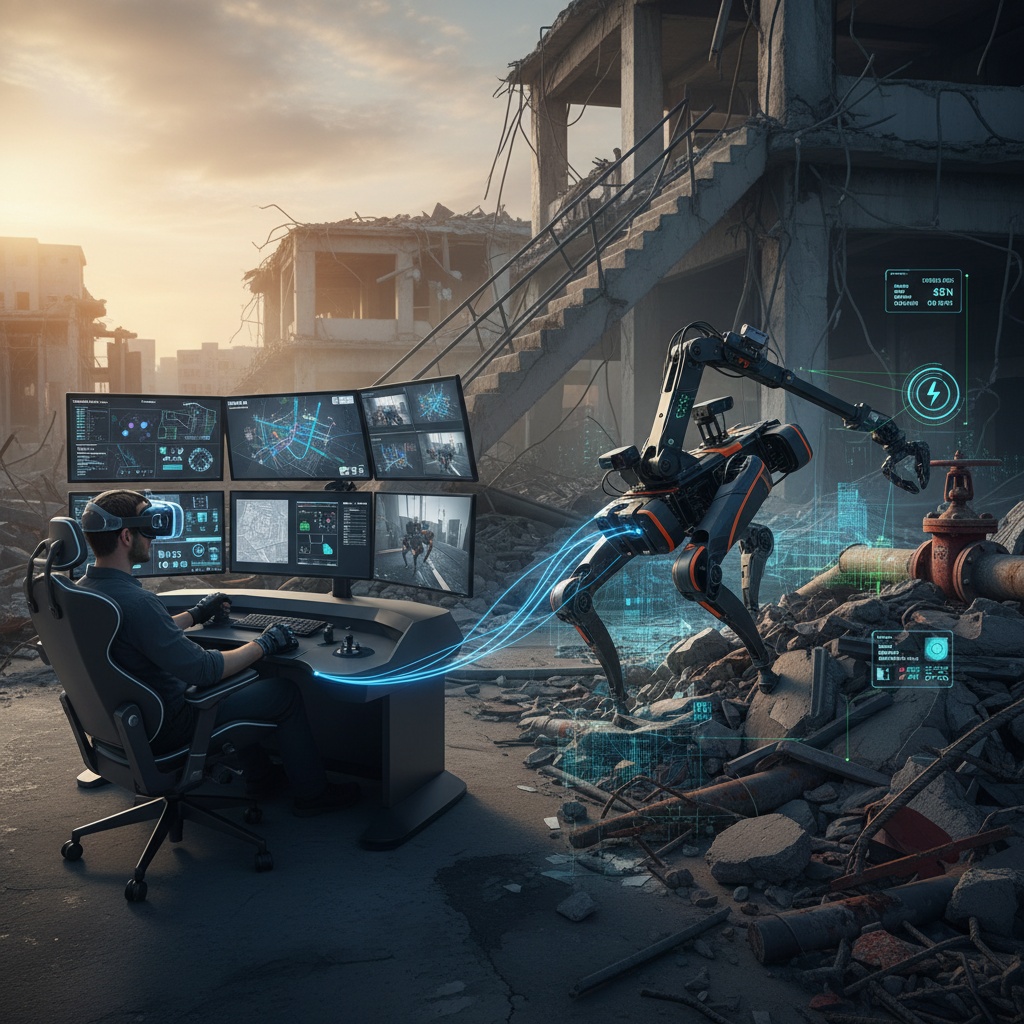
Teleoperation Robot: How Remote-Controlled Robotics Are Redefining Modern Industry
From nuclear decommissioning to deep-sea inspection, the teleoperation robot stands at the intersection of human intelligence and robotic precision. These remotely operated systems empower people to interact with—and manipulate—environments that would otherwise be unreachable or unsafe.
By enabling human operators to command robots from afar, using live visual and sensory feedback, teleoperation bridges the gap between complete autonomy and hands-on control. The result is a model of collaboration where human judgment and robotic endurance combine to deliver safer, faster, and more effective performance.
This new paradigm is shaping industries that depend on precision and resilience:
- Hazardous operations in chemical, mining, and energy sectors
- Surgical and laboratory teleoperation enhancing safety and accuracy
- Exploration and logistics extending human reach beyond physical limits
As we explore the evolving world of teleoperated systems, we uncover how remote-controlled robotics are transforming safety protocols, productivity frameworks, and the future of human-robot collaboration.
Understanding the Teleoperation Robot: The Human-Robot Partnership Redefined
The concept of a teleoperation robot sits at the nexus of human expertise and robotic capability. Unlike autonomous robots that independently process data and make decisions, teleoperated systems thrive on continuous human input transmitted through real-time communication networks. This model of human-in-the-loop control combines the operator’s judgement and adaptability with the precision, endurance, and reach of machines, resulting in safer and more flexible operations across demanding sectors. Whether in industrial maintenance, medical surgery, or hazardous exploration, teleoperation represents a bridge between manual control and full autonomy, delivering a level of responsiveness that current artificial intelligence cannot fully replicate.
Teleoperation vs. Autonomous Systems: Control Boundaries in Modern Robotics
One of the most essential distinctions in robotics lies in how much decision-making authority is delegated to the machine. Fully autonomous robots use internal algorithms and sensory feedback to navigate and complete tasks independently, while teleoperated robots rely on a live operator to issue commands and interpret environmental data. Many real-world applications now use a hybrid approach, where autonomy handles rudimentary processes like obstacle avoidance or balance, and the operator supervises or intervenes as necessary.
| Control Model | Description | Human Involvement | Typical Application |
|---|---|---|---|
| Teleoperated | Robot follows direct human commands in real-time | Continuous | Nuclear inspection, space robotics |
| Semi-autonomous | Autonomous tasks with human supervision | Periodic | Delivery bots, industrial manipulators |
| Fully autonomous | Independent decision-making with minimal oversight | Minimal | Routine logistics, floor cleaning |
This balance of autonomy and telepresence defines how quickly and safely tasks are completed. In domains such as space exploration or underwater construction—where direct contact is impossible—the teleoperation paradigm remains indispensable. According to Foxglove’s definition of teleoperation, systems functioning in this mode require real-time feedback, precise command interpretation, and highly reliable networks to ensure accurate replication of human motion and intention.
Core Technologies Driving Teleoperated Robotics
Behind the smooth operation of a teleoperation robot lies a multi-layered technological foundation that coordinates sensors, actuators, communication systems, and human-machine interfaces. At its core is a closed feedback loop composed of three fundamental elements:
- Operator Command: Using controllers, joysticks, or haptic devices, the operator issues motion directives and manipulation instructions.
- Robot Execution: Motors and actuators translate those directives into physical motion, often aided by stabilizing algorithms and onboard microcontrollers.
- Sensory Feedback: Cameras, LiDAR, and specialized sensors return live information on robot position, environment, and performance.
This loop functions as the robot’s nervous system. The operator becomes the mind directing an extended mechanical body, a process that depends on high-bandwidth, low-latency communication links. With the expansion of 5G and edge computing, constraints like latency or jitter are shrinking, allowing smoother, near-real-time synchronization even across vast distances.
Operator Interface and Telepresence Design
A critical part of teleoperation success is the user interface—how operators perceive and interact with the environment remotely. Early designs relied on simple video feeds and manual joysticks, but modern systems integrate immersive technologies that simulate real-world presence:
- Virtual and Augmented Reality (VR/AR): Operators view a three-dimensional, real-time recreation of the robot’s environment, fostering spatial awareness.
- Haptic Feedback: Gloves and exoskeletons reproduce tactile sensations, allowing users to feel resistance or pressure during manipulation tasks.
- Predictive Displays: AI algorithms anticipate robot movement, helping mask transmission delays by forecasting the next visual frame.
These advanced interfaces blur the line between operator and machine, enhancing coordination and reaction precision. As shown in TechTarget’s overview of teleoperation, immersive interfaces significantly reduce error rates during complex maneuvers, particularly in time-sensitive environments like deep-sea operations or surgical control.

Physical Configurations: From Mobile Platforms to Manipulator Systems
Teleoperated robots come in diverse architectures shaped by their operational purpose. The main categories include:
- Mobile Platforms: Wheeled or tracked robots designed for inspection, patrolling, and logistics in dynamic environments such as construction sites or warehouses.
- Manipulator Systems: Stationary or semi-mobile platforms equipped with articulated arms capable of fine manipulation, welding, cutting, or sample collection.
- Hybrid Systems: Combining mobility and manipulation, these platforms perform complex tasks in unstructured terrain or confined spaces—typical examples include agile robots like quadrupeds used in hazardous inspection missions.
- Telepresence Robots: Units with cameras and communication interfaces designed for remote monitoring, education, or healthcare applications.
Among these forms, the rise of agile teleoperated robots has redefined mobility. Devices inspired by quadrupeds, such as Spot or ANYmal, provide stability and dexterity that pure wheeled designs cannot match, allowing operators to access staircases, rubble, and confined spaces without exposing humans to danger.
Communication and Network Reliability in Teleoperation
The communication link forms the backbone of every teleoperation system. Data packet loss or delayed command transmission can cause motion inaccuracies, posing risks in delicate or hazardous missions. Engineers therefore use layered network strategies that combine wired, wireless, and cellular connectivity:
- Tethered systems: Common in subsea applications where latency control is critical but movement area is limited.
- Wireless and cellular networks: Offer range flexibility for mobile teleoperation within industrial or urban environments.
- 5G URLLC and edge AI: Support ultra-low latency and real-time video processing directly at the robot’s location.
The real innovation comes with predictive algorithms that anticipate robot state changes when delays occur. This ensures uninterrupted control and stability. As Taylor & Francis highlights, these architectures define whether teleoperation can scale beyond specialized industrial use into more mainstream commercial and logistics environments.
The Role of “High Robotics” in Research and Industry
The phrase high robotics describes an evolving field where precision engineering, AI-assisted control, and teleoperation converge. Research institutions and companies use teleoperation platforms as proving grounds for future autonomous systems. Operators generate thousands of data samples through live manipulation, which machine learning systems later use to train autonomous counterparts. This approach accelerates the transition from manual to shared-autonomy workflows.
In environments such as nuclear decommissioning or space exploration, data-driven teleoperation allows safe iteration and testing of control models that would otherwise be prohibitively costly or dangerous to trial in situ. Teleoperation thus plays a dual role: enabling operational versatility today and creating robust datasets for autonomous robotics tomorrow.
Applications Across Industries: Where Teleoperation Robots Excel
From industrial maintenance to scientific research, teleoperation continues to deliver measurable outcomes in both safety and productivity. Key domains include:
- Energy and Chemical Plants: Remote-controlled manipulators handle radioactive or corrosive material, improving worker safety.
- Mining and Exploration: Operators manage machinery from control hubs kilometers away from hazardous shafts.
- Healthcare and Surgery: Systems like the da Vinci robot demonstrate how teleoperation enhances surgical accuracy and expands access to specialized procedures.
- Disaster Response: Agile telerobots explore collapsed structures or contaminated zones where human entry would be fatal.
- Academic Research: Laboratories studying robotics research use teleoperation to benchmark manipulation dexterity and human-robot collaboration techniques.
Each deployment underscores the adaptability of teleoperated designs. Their flexibility in context-specific control differentiates them from rigid autonomous solutions bound by pre-programmed logic.
Teleoperation’s Integration with Agile Robotics
The integration of agile robots into teleoperation workflows has opened opportunities for unprecedented maneuverability. Where traditional mechanisms
Advanced Teleoperation Models in Modern Logistics
In logistics, the integration of teleoperation within autonomous robot delivery systems has reshaped the economics of last-mile fulfillment. These systems rely on human oversight for anomaly handling, transforming the once fully automated vision into a layered, resilient operational model. Real-world implementation reveals that the most efficient infrastructures are neither exclusively autonomous nor fully manual; instead, they operate as hybrid networks balancing cost, efficiency, and safety.
Operational Structures That Bridge Automation and Human Oversight
Most autonomous delivery fleets now adopt a dual-mode configuration. Autonomous navigation manages predictable paths and standardized delivery zones, while teleoperation steps in when uncertainty arises—blocked sidewalks, customer conflicts, or dynamic traffic environments. Central teleoperation hubs act as nerve centers, where operators monitor real-time telemetry from hundreds of delivery bots across multiple regions. Using high-bandwidth links and VR-assisted dashboards, a single technician can supervise dozens of robots, taking direct control only when flagged by the system’s anomaly detection algorithms.
This human-in-the-loop model leverages the cognitive flexibility of people while maintaining the scalability of automation. A clear communication protocol defines when control transfers between robot and operator, preventing conflicts during interventions. Industry leaders are investing in adaptive control stacks capable of switching from autonomous to teleoperated modes in milliseconds, safeguarding continuity of motion and task execution.
Performance Metrics That Guide Teleoperated Fleet Optimization
Key performance benchmarks determine how effectively hybrid fleets operate. Intervention frequency per route, for instance, quantifies system reliability—fewer takeovers signal maturing autonomy. Mean teleoperation duration measures how rapidly an operator can resolve complex incidents, such as navigating pedestrian-dense zones or mechanical obstructions. Another emerging metric, operator bandwidth ratio, assesses how many active deliveries one operator can manage concurrently without compromising response time or safety thresholds.
Data analytics platforms aggregate these metrics to refine machine-learning models, simulating delivery events and predicting where human input will likely be required next. The feedback loop created between teleoperation insights and AI model updates is shortening the learning cycle for delivery bots, gradually shifting more routine edge cases into autonomous handling. Continuous evaluation through dashboards supports transparent reporting and helps logistics teams benchmark efficiency across geographical areas and different network infrastructures.
Visualizing a Connected Teleoperation Ecosystem

Safety, Compliance, and Ethical Deployment
Safe operation remains fundamental to teleoperated logistics. Robots moving through public environments must comply with strict infrastructure and pedestrian safety regulations. Modern fleets incorporate multi-layered safety logic—automatic emergency stops triggered by obstacle proximity, redundant control pathways ensuring robots halt safely during signal loss, and transparent audit trails that document every operator command. Compliance with standards such as ASTM F3269 for delivery robotics and regional data-handling regulations is now considered a prerequisite for deployment.
Remote pilots themselves are trained under evolving certification frameworks similar to air-traffic or drone operation programs. These standards cover both technical proficiency and situational awareness, including protocols for human-robot interaction in mixed public spaces. The regulatory trend leans toward unified frameworks where liability, privacy, and safety standards are harmonized across national boundaries, particularly as teleoperation centers increasingly serve multiple international markets.
Emerging Strategy: On-Demand Teleassist Systems
A notable shift in logistics is the development of on-demand teleassist models, where human support is activated only when required. Rather than continuously supervising every robot, companies allocate operator time dynamically based on fleet data. This approach allows one skilled operator to manage dozens—or even hundreds—of robots simultaneously. When obstacles occur, a priority dispatch system connects the relevant operator within seconds through an encrypted control channel. Once the issue resolves, the robot automatically reverts to autonomous mode.
This dynamic staffing model lowers labor costs while maintaining safety and customer experience standards. It also enables flexible scaling during peak hours without physical redeployment of human operators. Teleassist protocols can even be extended to user-facing functions: customers in complex delivery environments can summon a live operator through a mobile interface to authorize entry, unlock containers, or troubleshoot accessibility issues. Such interaction enhances trust and extends robotic delivery capabilities to areas previously considered too complex for autonomy alone.
Communication Innovations Enhancing Real-Time Control
Behind every successful teleoperation system lies a sophisticated communications backbone. The rollout of 5G and emerging 6G networks has made low-latency, high-reliability teleoperation viable across large urban regions. With Ultra-Reliable Low-Latency Communication (URLLC), signal delay drops below 20 milliseconds, allowing natural, responsive control even during high-stakes operations. Combined with edge computing, robots preprocess sensory data locally, synchronizing only critical information with the operator. This architecture minimizes bandwidth consumption and keeps local decision loops functioning even if the network fluctuates.
Advanced data routing now incorporates predictive buffering, where AI anticipates potential latency spikes and adjusts video frame streaming preemptively to maintain operator situational awareness. Some fleets even use mobile edge nodes—temporary network servers installed within operational zones—to ensure consistent connection quality during high-density deployment events.
Multimodal Interfaces and Cognitive Support Systems
Operators today interact with robots through more than just screens or joysticks. Multimodal control systems integrate visual displays, auditory cues, haptic feedback, and natural-language commands, creating an immersive telepresence. Visual overlays combine lidar-based mapping with semantic labeling, showing not only obstacles but their classification—pedestrian, bicycle, dog, or open curb. Haptic gloves provide tactile cues when robots encounter resistance, improving precision during manual interventions.
Recent research highlighted by Foxglove Robotics shows that multimodal interfaces reduce cognitive fatigue by distributing sensory load across multiple channels. Operators maintain focus longer, and task-switching between deliveries becomes more fluid. With natural language prompting—“navigate around the parked car on the left and stop near the doorway”—robots interpret commands contextually, bridging the gap between structured control and conversational input. These human-factor advancements are transforming teleoperation from a technical task into a fluid dialogue between operator intent and machine execution.
Future-Proofing Teleoperation Infrastructure
As robotic delivery expands, scalability depends on network resilience and organizational alignment. Forward-looking companies are investing in private 5G networks to guarantee predictable latency and throughput, decoupling their fleets from public carrier congestion. Fleet management platforms now integrate cybersecurity and telemetry visualization into single dashboards, ensuring every operator session, video stream, and control command is encrypted and logged for auditability.
Partnerships between robotics developers, telecom providers, and logistics firms are converging around open standards for interoperability. Cross-vendor frameworks allow teleoperation centers to support multiple robot brands from a unified interface. This trend, showcased at major robotic summits and expos, indicates a shift toward open ecosystems where innovation in user experience, safety analytics, and AI-driven assistance can be rapidly distributed across the industry.
These collaborative models not only enhance operational resilience but also set the stage for a new category of workforce—specialized teleoperation professionals who blend technical command with real-time decision-making in networked, high-autonomy environments.
Conclusion
Teleoperation robots mark a turning point in how humanity extends its reach, merging human intelligence with mechanical precision to redefine what is possible in hazardous, remote, or intricately controlled environments. They embody the true convergence of technology and human capability—where judgment, adaptability, and creativity meet the endurance and precision of machines.
From industrial inspection to surgical precision, from agile field robotics to autonomous logistics, this human-in-the-loop model brings safety, efficiency, and control to the forefront of innovation. As communication networks accelerate, AI grows more predictive, and robotic platforms become increasingly agile, the integration of remote operation will no longer be optional—it will be essential.
Ultimately, teleoperation sets the stage for a new era of operational strategy: one where humans orchestrate from a distance, robots execute with fidelity, and both evolve together toward greater capability. Now is the time to assess your organization’s readiness, identify high-value opportunities, and embrace this hybrid model as a cornerstone of future resilience and competitive strength. The frontier of robotics is no longer a vision—it’s an interconnected system where human oversight and machine autonomy move forward as one.
Frequently Asked Questions
What exactly is a teleoperation robot?
A teleoperation robot is a machine that allows a human operator to control it remotely using command interfaces such as joysticks, consoles, or virtual reality (VR) systems. The robot sends real-time feedback—including images, sensor data, and sometimes force sensations—back to the operator. This setup enables precise manipulation and decision-making even when the operator is far from the work site. Teleoperation bridges the gap between manual control and autonomous operation, maintaining human judgment while leveraging robotic precision and strength.
How do teleoperation robots differ from fully autonomous robots?
The main difference is who makes the decisions. In teleoperation, a human operator continuously controls or supervises the robot’s actions. In contrast, autonomous robots use onboard sensors and algorithms to act independently. Many modern systems combine both approaches, allowing the robot to operate autonomously under normal conditions but switch to human control in complex or unpredictable situations. This hybrid model is widely used in sectors such as logistics, healthcare, and defense.
Why are teleoperation robots important for hazardous industries?
Teleoperation robots drastically improve safety and accessibility by removing humans from dangerous environments. They are used in nuclear facilities, deep-sea exploration, mining, and disaster response, where exposure to radiation, extreme pressure, or unstable structures would be unsafe for workers. By operating from remote control centers, operators can perform inspections, repairs, or sample collection without physical risk, achieving task performance equal to or better than on-site operation.
What technologies make remote teleoperation possible?
Teleoperation success relies on a combination of real-time communication networks, sensor feedback, and human-interface systems. Modern teleoperation robots use 5G or private LTE networks for low-latency communication, multi-camera video systems for depth perception, and haptic feedback devices to simulate touch and resistance. Edge computing, artificial intelligence (AI), and predictive displays are also increasingly used to reduce the perception of delay and assist operators in making faster, more accurate decisions.
How is teleoperation used in autonomous robot delivery systems?
In autonomous robot delivery, teleoperation acts as a safety and supervision layer. Delivery robots typically navigate using AI but rely on human teleoperators to intervene when they encounter unusual obstacles—such as roadwork, unpredictable pedestrians, or ambiguous navigation zones. Centralized teleoperation centers oversee fleets of robots, ensuring each delivery meets safety, efficiency, and compliance standards. This human-in-the-loop model balances cost efficiency with reliability and customer trust.
What are agile robots, and why are they significant in teleoperation?
Agile robots—such as four-legged or bipedal platforms—provide superior mobility and balance in terrain where traditional wheeled robots fail. In teleoperation, this agility means robots can traverse rubble, stairs, or uneven ground while maintaining stability. Their dynamic motion capabilities enable operators to perform remote inspections, rescue missions, and industrial tasks in complex settings that were previously inaccessible. Combined with autonomous balance and gait control, agile robots reduce operator workload and expand teleoperation into new use cases.
What are the main challenges in teleoperated robotics today?
The biggest challenges include communication latency, operator workload, and situational awareness. Even a small delay in data transmission can make high-precision control difficult, particularly in surgical or industrial applications. Operators must remain focused for extended periods, leading to fatigue, while limited camera views can reduce awareness of the robot’s surroundings. These issues are being mitigated through 5G URLLC networks, shared autonomy, and multi-sensor fusion systems that provide richer real-time feedback.
How do industries train operators to use teleoperation robots effectively?
Operator training combines simulator-based exercises, digital twins, and hands-on practice with real robots. Trainees learn to interpret sensor data, manage communication delays, and respond to emergencies. Ergonomics and user interface design also play key roles—teleoperation consoles must minimize fatigue and maximize comfort. Many organizations now integrate AI assistance and predictive overlays to help operators perform more efficiently during long shifts.
What is the typical cost and timeline for implementing teleoperation in an organization?
Costs depend heavily on application complexity, robot type, and network infrastructure. A basic teleoperated inspection system might be deployed in a few months with moderate investment, while multi-robot industrial setups can take 6–18 months. Budgeting must consider hardware (robots, sensors, networks), operator training, and safety certification. However, ROI often comes quickly as tele