

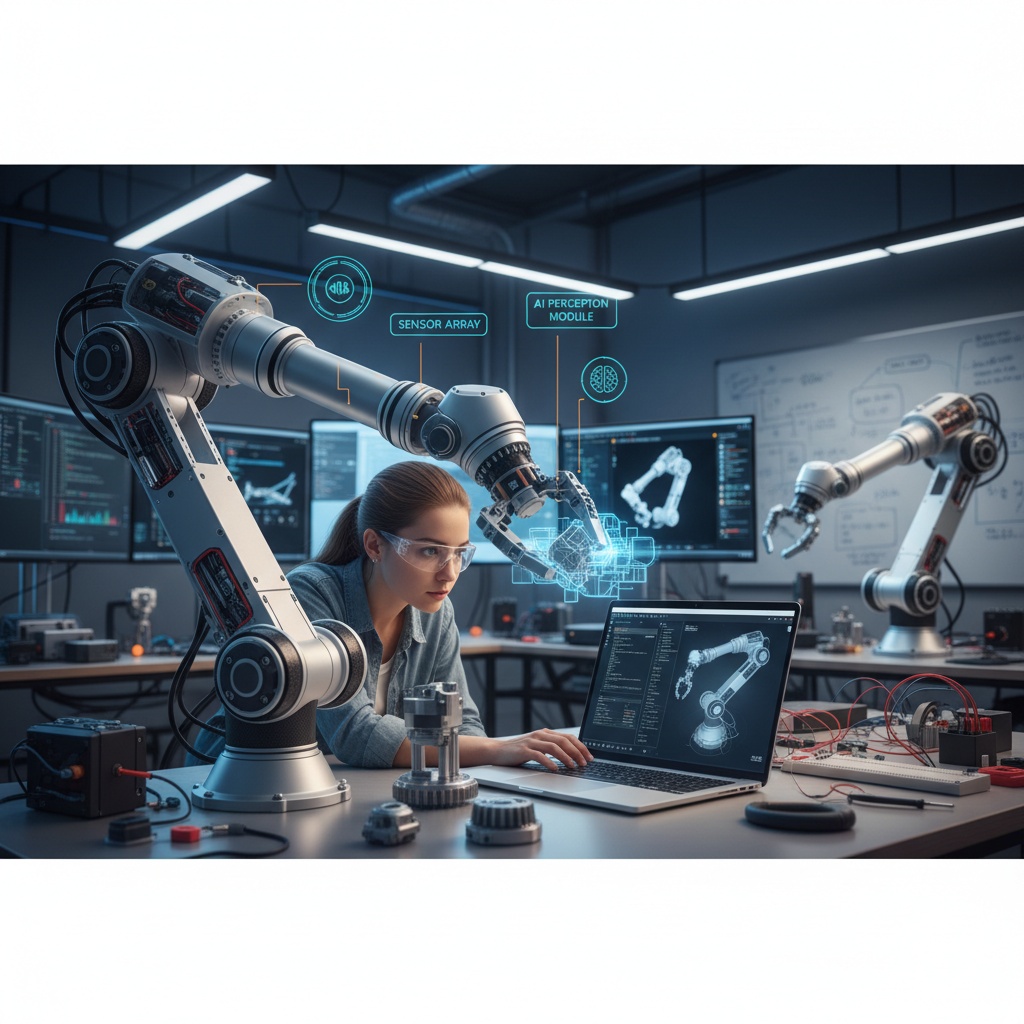
Robotics Research 2025: How AI and Engineering Are Redefining Machine Intelligence
Robotics research is undergoing a seismic transformation. As artificial intelligence matures and fuses with mechanical, electrical, and software engineering, we’re witnessing the birth of robots that don’t just execute commands—they learn, adapt, and collaborate.
This new era of robotics is defined by:
- Advanced AI integration, enabling perception and decision-making that rival human-level understanding
- Expanded sensor networks, allowing robots to interpret their surroundings with unprecedented precision
- Innovative manufacturing methods, from additive design to modular actuation, supporting agility and scalability
From hospitals to factories and autonomous fleets, this convergence is rewriting what’s possible in automation and intelligent systems. Robots are moving beyond static programming into dynamic, data-driven behavior—transforming industries, inspiring new fields of study, and redefining how we interact with machines.
In this article, we’ll unpack the key engineering foundations, explore AI-driven innovations, and reveal how the latest robotics research is shaping the intelligent machines of tomorrow.
Understanding Robotics Research Today
Robotics research is entering a defining phase where the boundaries between mechanical design, artificial intelligence, and human collaboration are becoming increasingly fluid. Once confined to repetitive, pre-programmed routines on factory lines, robots are now evolving into dynamic, perception-driven systems capable of reasoning, adapting, and learning in real-time. The most recent wave of robotics innovation reflects decades of progression from mechanical automation toward machines that embody intelligence both in hardware and algorithmic architecture.
At the heart of this transformation lies a powerful convergence of technologies: advanced sensors capturing high-resolution physical data, distributed computing enabling inferences at the edge, and AI models that synthesize perception with decision-making. These elements are not merely augmenting robots; they are redefining what it means for a system to “understand” its surroundings. Modern robotics research underscores this shift, translating abstract computational reasoning into precise, controllable motion in uncertain environments.

From Programmed Automation to Adaptive Intelligence
The evolution of robotics can be visualized as a progression through three primary stages: mechanical automation, sensor-driven robotics, and AI-integrated systems. Each stage introduced greater autonomy and contextual understanding, moving from deterministic command execution to flexible problem-solving. While the earliest robots focused on repeatable precision, today’s systems emphasize situational awareness and safe coexistence with humans.
| Era | Core Functionality | Exemplary Technology | Level of Autonomy |
|---|---|---|---|
| First Generation | Fixed, repetitive automation | Industrial arms | Deterministic |
| Second Generation | Reactive control using sensors | Vision-guided robots | Semi-autonomous |
| Current Generation | Adaptive, learning-based systems | AI-enhanced cobots | Autonomous and context-aware |
This trajectory continues to accelerate due to the integration of artificial intelligence. According to studies published in recent robotics articles from NVIDIA Research, AI-driven systems are now closing the gap between human intuition and robotic execution. Robots no longer depend solely on programmed trajectories but learn optimal strategies from data, simulations, and human demonstrations.
The Role of AI in Shaping Modern Robotic Systems
The intersection of robotics and AI represents one of the most active areas of scientific exploration today. Machine learning models—especially those designed for perception and decision-making—equip robots with the ability to navigate complex environments without relying exclusively on predefined rules. This synergy has given rise to a new class of embodied agents capable of understanding visual scenes, interpreting human commands, and adapting in unpredictable circumstances.
Major breakthroughs outlined in the Top 5 Global Robotics Trends 2025 report from the International Federation of Robotics highlight how foundation models and multimodal perception systems are enabling robots to contextualize their actions—the essence of what researchers call embodied intelligence. In this environment, high-level commands like “inspect the damaged panel” can be decomposed into actionable low-level steps through language-anchored reasoning models.
Expanding the Scope of Robotics Research
The terrain of robotics research now spans multiple domains, from structured manufacturing floors to unstructured outdoor and service environments. Each application domain drives distinct technological requirements, pushing researchers to innovate along key dimensions such as hardware resilience, energy efficiency, and cognitive adaptability. For instance, humanoid robots are achieving new levels of dexterity thanks to improved actuator design and control algorithms inspired by biomechanics. Companies like Boston Dynamics and Unitree Robotics are investing in frameworks that allow their robots to execute complex maneuvers once exclusive to industrial settings.
In healthcare, AI-integrated surgical robots are revolutionizing operating rooms by combining high-precision mechanical control with real-time decision-making—extending the capabilities discussed in our article on [AI in surgical robotics](https://YOUR WEB/ai-surgery-robots-operating-rooms). Similarly, in manufacturing environments, robotic solutions driven by adaptive AI planning are optimizing workflows in unpredictable production lines, as explored in [how robotic solutions are transforming modern manufacturing](https://YOUR WEB/robotic-solutions-manufacturing-transformation).
Key Engineering Foundations Driving Innovation
Every revolutionary change in robotics stems from underlying mechanical and software engineering foundations. The robot’s ability to perceive and act hinges on an architecture that tightly integrates sensors, perception modules, planning algorithms, and control loops. This layered architecture allows for synchronization between physical action and computational reasoning.
The engineering requirements for these systems are increasingly complex. Modern mechanical engineering robotics must reconcile traditional principles of force, torque, and motion with sensor fusion and neural inference. Engineers must design robotic structures that support both agility and durability while allowing AI algorithms to interpret environmental feedback in milliseconds. The intersection of real-world physics with AI inference mechanisms defines the new research space powering robotics development.
The Shift Toward Adaptive, Learning-Based Robots
What separates 2025’s robotics landscape from its predecessors is the migration from fixed motion planning to adaptive learning systems. Robots are now trained using reinforcement and imitation learning methods derived from the latest research in AI, enabling rapid skill transfer across tasks and environments. Systems can adjust to distributional changes—such as variations in object texture or lighting—without complete retraining.
For example, robotic arms powered by diffusion-based motion policies can analyze multimodal sensor input to generate fluid grasping movements, a process previously attainable only with large amounts of human tuning. Similarly, AI-enabled drones now generate flight trajectories that optimize for energy efficiency based on environmental patterns inferred through onboard cameras and LiDAR sensors.
Challenges Emerging from Intelligent Integration
As research moves deeper into this AI-driven paradigm, engineers face complex challenges in reliability, safety, and real-world adaptability. Unlike rule-based automation, learned policies can exhibit unpredictable behaviors under conditions not present during training. This creates new priorities for robotics engineering requirements, including the need for advanced safety verification systems, state estimation under uncertainty, and continuous model evaluation.
Industry leaders, such as those featured in The Robot Report’s top robotics developments of July 2025, emphasize that the future depends on achieving seamless interactions between machine learning models and embedded control. The boundary between AI research and mechanical engineering is becoming increasingly indistinct, requiring interdisciplinary fluency to design resilient, self-aware machines.
The Expanding Ecosystem of Robotics Research and Collaboration
The growth of robotics also depends on the ecosystem that supports it—universities, open-source communities, and industrial consortia driving rapid knowledge exchange. Platforms like ROS 2, NVIDIA Isaac Sim, and Webots democratize access to simulation tools that allow researchers to experiment with digital twins before hardware deployment. These tools shorten development cycles and facilitate reproducible experimentation across labs and industries.
A notable example is Open X-Embodiment, a collaborative dataset initiative combining millions of robot demonstrations from multiple institutions. This project highlights a broader trend in robotics articles: open data and transparent benchmarks are accelerating shared understanding of what generalization in robotics truly requires. Such collaboration helps mitigate the costly process of collecting real-world robotic training data while enhancing trust in experimental outcomes.
The Path Toward System-Level Intelligence
What separates the next phase of robotics from earlier efforts is system-level intelligence—the capacity for a machine to not only act optimally but also understand why it acts. Through continued exploration of AI-driven decision layers, world modeling, and latent planning, researchers aim to close the gap between abstract reasoning and physical execution. The ability to imagine consequences before action marks a decisive step toward general robotics capability.
As the field matures, researchers are steadily redefining the very framework of robotic cognition. The following section explores the engineering foundations that make these adaptive systems possible and examines how AI models are being embedded into robotic architectures to enhance perception, control, and safety in real-world deployments.
Integrating Engineering Disciplines for Advanced Robotic Intelligence
Developing the next generation of intelligent robots depends on merging diverse engineering disciplines into a cohesive framework. Mechanical, electrical, and software foundations must operate in concert to give robots the autonomy and precision that modern industries demand. Mechanical engineering defines how a robot moves and interacts with its environment, while electrical engineering ensures sensory fidelity and power efficiency. The merging point lies in software, where algorithms interpret sensory information, plan trajectories, and control actuators. This synthesis forms the groundwork for creating machines capable of adjusting to unpredictable real-world conditions.
The robot control architecture has matured into a multilayered system that bridges real-time control and high-level cognition. Engineers now treat this architecture like an ecosystem: low-level loops maintain stability, mid-level planners generate feasible motions, and high-level decision layers—often powered by AI—determine goals based on contextual awareness. This separation of control levels allows developers to integrate learned behaviors without compromising reliability. When a robotic manipulator learns to grasp irregular objects, for instance, its AI-driven decision modules rely on control primitives grounded in deterministic mechanics, guaranteeing repeatable performance even amidst environmental noise.
Software Evolution and the Rise of Digital Engineering
The landscape of robotics software development has evolved beyond the traditional programming paradigm. Frameworks like ROS 2 now serve as universal translators, ensuring communication across heterogeneous hardware platforms. This modularity has significantly lowered technical barriers, allowing researchers to focus on algorithmic innovation rather than integration complexities. Add to this the rise of simulation tools that function as digital twins—virtual replicas capturing both the physics and data flow of a real robot—and the result is a development pipeline where testing, debugging, and optimization can occur before physical prototypes exist.
Digital twins have begun to reshape manufacturing and service robotics alike. An autonomous delivery robot can be stress-tested under hundreds of simulated weather scenarios and crowd densities using synthetic simulation environments like NVIDIA Isaac Sim before entering a single real-world trial. This virtual-first methodology reduces cost, enhances safety, and accelerates iterations. Moreover, it aligns with sustainable engineering principles by minimizing the material and energy waste typically associated with physical prototyping phases.
AI as the Core Integrator in Robotics Research
Artificial intelligence today serves as both a creative and corrective force in robotics research. AI tools not only generate new design possibilities but also refine traditional engineering processes. The shift from manually tuned models to data-driven adaptability implies that each robot can learn from its operational feedback loops. Through reinforcement and imitation learning, robots adjust parameters on the fly, maintaining equilibrium between precision and energy efficiency. This capability represents a fundamental shift from reactive automation to proactive reasoning.
In modern mechanical engineering robotics, AI now assists with materials and mechanism design. Deep generative models help simulate structural performance and develop joint architectures optimized for compliance and stiffness across specific load conditions. These models accelerate innovation by exploring thousands of configurations that human designers might overlook. When integrated with finite element analysis and topology optimization, AI-driven discovery transforms robot frames from rigid assemblies into living structures optimized for balance, weight, and resilience.
New Horizons in Multimodal Perception
Perception has historically been one of robotics’ most stubborn challenges. AI’s ability to unify multimodal inputs—combining vision, lidar, tactile sensing, and linguistic cues—has fundamentally expanded robotic situational awareness. Recent robotics articles highlight breakthroughs where large visual-language models translate spoken instructions or visual scenes into executable motions. For example, a warehouse robot trained on multimodal embeddings can interpret a phrase like “retrieve the red bin near the conveyor” and seamlessly localize the task target through scene understanding.
This integration has also reshaped human-robot interaction. Language-based reasoning enables collaborative platforms to understand contextual cues, such as gesture recognition or proximity detection, promoting safer, more intuitive cooperation. AI effectively becomes a translator between human intent and mechanical action. The result is improved fluency in collaboration rather than mere task cohabitation.

The New Era of Learning-Based Control
Control strategies that once relied on fixed mathematical formulations now use diffusion policies and model-based reinforcement learning. These adaptive systems manage uncertainty by predicting multiple potential outcomes instead of committing to a singular trajectory. The benefit becomes evident in manipulation and locomotion tasks, where unpredictable contact dynamics frequently lead to instability. In learning-based control, every motion is moderated not only by sensor data but also by probabilistic forecasts of future states.
This new paradigm introduces an additional responsibility for engineers: verifying that these adaptive systems behave within safety constraints. AI-assisted verification tools now monitor policy drift, measure uncertainty, and automatically retract control authority when deviations exceed thresholds. The collaboration between deterministic controllers and probabilistic AI guarantees both agility and protection in mission-critical settings such as surgical assistance or hazardous-environment exploration.
Edge Intelligence and Distributed Autonomy
A notable shift in 2025’s latest research in AI involves relocating decision-making closer to the robot itself through edge computing. Historically, high-level reasoning required cloud support, with limitations on latency and bandwidth. Now, compact accelerators optimized for neural inference bring cloud-scale intelligence to embedded platforms. This change enables field-deployed robots to process perception pipelines, perform local reasoning, and continuously train from incoming data—all in real time.
Such distributed intelligence particularly benefits mobile fleets in logistics, agriculture, and defense. Each unit learns from its own experience while periodically syncing insights across the network. The system behaves like a collective organism, where discoveries from one node enrich the general intelligence of the group. The implications for efficiency and safety are profound, reducing dependence on centralized control while improving responsiveness and fault tolerance.
Human-Centric Design and Ethical Integration
Engineering modern robots requires more than technical prowess; it demands sensitivity to ethical and ergonomic design. As AI augments robotic autonomy, questions around accountability, transparency, and adaptability surface. Engineers have begun embedding explainability modules that let robots communicate decisions—why a robot avoided a certain action, or what confidence it assigned to a perception result. This fosters trust without oversimplifying complex systems.
At the same time, robotics engineering requirements now place emphasis on usability and inclusivity. Robots working alongside people in healthcare or household settings must not only execute commands but anticipate comfort levels and ensure safety boundaries. Soft robotics and haptic feedback are becoming critical tools for achieving natural, human-like touch and movement while AI ensures contextual awareness.
From Research to Real Deployment
As research transitions into industrial production, the integration challenges multiply. Software-trained policies must meet hardware limitations, while algorithms validated in virtual spaces deal with thermal limits, actuator precision, and manufacturing tolerances. Bridging this gap demands cross-functional collaboration and continuous iteration. Companies featured in outlets like The Robot Report highlight teams where machine learning specialists and mechanical engineers jointly validate every system aspect—from energy budgeting to reinforcement model generalization.
Building on this trend, startups are blending mechanical engineering robotics with AI-first principles to reduce the human cost of deployment. Autonomous inspection drones, adaptive assembly arms, and exploratory field robots illustrate how abstractions from research translate into tangible industry tools. When coupled with open middleware standards and safety certifications, this convergence reflects not just technological progress but an emerging practice of intelligent engineering at scale.
Through this interplay between foundational disciplines and adaptive intelligence, robotics development continues to move closer to a unified science of embodied cognition—where physical design, sensory intelligence, and machine learning together define the capabilities of tomorrow’s autonomous systems.
Conclusion
Ultimately, the trajectory of robotics research is no longer constrained by mechanical precision alone—it is being redefined by intelligence. The fusion of advanced AI systems with solid engineering foundations has transformed robots from predictable tools into adaptive collaborators that learn, reason, and evolve alongside us. This synthesis of computation and construction marks a turning point in how machines perceive their environment and execute human-like judgment.
The evidence is clear: mastering control theory, kinematics, and perception—while embracing the latest research in artificial intelligence—now defines success in this field. Engineers who integrate these principles will not only build more capable robots but also shape the very frameworks through which automation advances. This balance of analytical rigor and creative design distinguishes tomorrow’s innovators from today’s practitioners.
As we move deeper into 2025 and beyond, progress depends on those who stay engaged—continuously studying emerging robotics articles, experimenting with new systems, and collaborating across disciplines. The future belongs to professionals who combine precision with imagination, leveraging every technical insight to create machines that extend human reach and redefine what’s possible.
The path forward is clear: invest in your engineering foundations, align with AI-driven principles, and lead the evolution of intelligent robotics from concept to real-world impact. This is not just the next phase of technology—it is the next chapter of human capability.
Frequently Asked Questions
What is the main focus of robotics research in 2025?
Robotics research in 2025 centers on the integration of advanced AI systems with core robotics engineering principles. The emphasis is on developing adaptive, learning-enabled robots that can generalize across tasks and environments rather than functioning through fixed programming. Key themes include AI-driven perception, diffusion-based motion planning, and physical AI, where robots learn directly from simulated or real interactions instead of manually scripted logic.
How is artificial intelligence changing the foundation of robotics engineering?
AI is transforming how robots sense, interpret, and act in uncertain environments. Traditional control systems relied on deterministic models, while AI-based systems incorporate machine learning, reinforcement learning, and foundation models to enable decision-making from data instead of explicit instructions. This shift allows robots to adapt dynamically, improve through experience, and perform previously unmanageable tasks—like precise manipulation or real-time collaboration with humans.
What are the essential robotics engineering requirements for entering this field?
Professionals entering robotics research need strong foundations in mechanical engineering, controls and dynamics, computer vision, and machine learning. Programming proficiency in C++ and Python, familiarity with ROS 2, and knowledge of simulation tools like Gazebo or NVIDIA Isaac Sim are critical. A solid grasp of linear algebra, optimization, and probability supports the analytical side, while practical experience through hands-on robotics projects helps bridge theory and real-world applications.
Why are simulation and digital twins important in robotics development?
Simulation and digital twin technology allow engineers to prototype, test, and validate robotic behaviors in controlled environments before deploying on physical hardware. They drastically reduce development time, cost, and risk, especially for complex systems like humanoid or surgical robots. By mirroring real-world physics, these virtual environments enable rapid iteration and safe training of AI policies that later transfer to real robots with minimal recalibration—known as the sim-to-real transfer process.
How are diffusion policies and world models improving robotic learning?
Diffusion policies introduce probabilistic motion generation, letting robots explore multiple possible trajectories to identify the safest or most efficient action. World models, meanwhile, allow robots to simulate outcomes mentally by predicting environmental responses to actions. Combined, these methods enhance autonomy, sample efficiency, and generalization—key challenges in real-world robotics where data collection and safety constraints are major hurdles.
What industries are seeing the fastest adoption of modern robotics research?
The most rapid adoption is happening in manufacturing, logistics, healthcare, and construction. Collaborative robots (cobots) now work safely alongside humans in factories, autonomous mobile robots optimize warehouse operations, and robotic surgical systems improve precision in healthcare. Emerging fields such as agricultural and inspection robotics also benefit from the latest AI-driven perception and control systems, addressing real-world variability and operational safety.
How does mechanical engineering influence robotic performance?
Mechanical engineering dictates a robot’s structure, actuation, and energy efficiency. Choosing the right materials, designing compliant joints, and managing power-to-weight ratios determine how effectively a robot performs tasks. Innovations like soft robotics, series elastic actuators, and additive manufacturing have expanded the design space, enabling robots to operate safely in human environments and under demanding physical conditions.
What are the biggest challenges in robotics research today?
Current challenges include bridging the sim-to-real gap, ensuring safety in learning-enabled robots, and achieving robust generalization across unpredictable environments. Data scarcity for robot training remains a significant limitation, driving innovations in synthetic data generation and offline reinforcement learning. Additionally, the field faces ethical challenges around workforce automation, data privacy, and certification of AI-powered systems.
How can students or professionals stay current with the latest robotics research articles?
To stay updated, follow top conferences like ICRA, IROS, and CoRL, and journals such as IEEE Transactions on Robotics and The International Journal of Robotics Research. Subscribing to arXiv alerts, university lab blogs, and industry reports ensures early access to the latest research in AI and robotics. Active participation in open-source projects and replicating experiments using released codebases also accelerates learning and professional growth.
What future skills will be most valuable for robotics engineers?
The future of robotics demands a blend of AI literacy, systems integration expertise, and hands-on engineering capability. Skills in reinforcement learning, **