

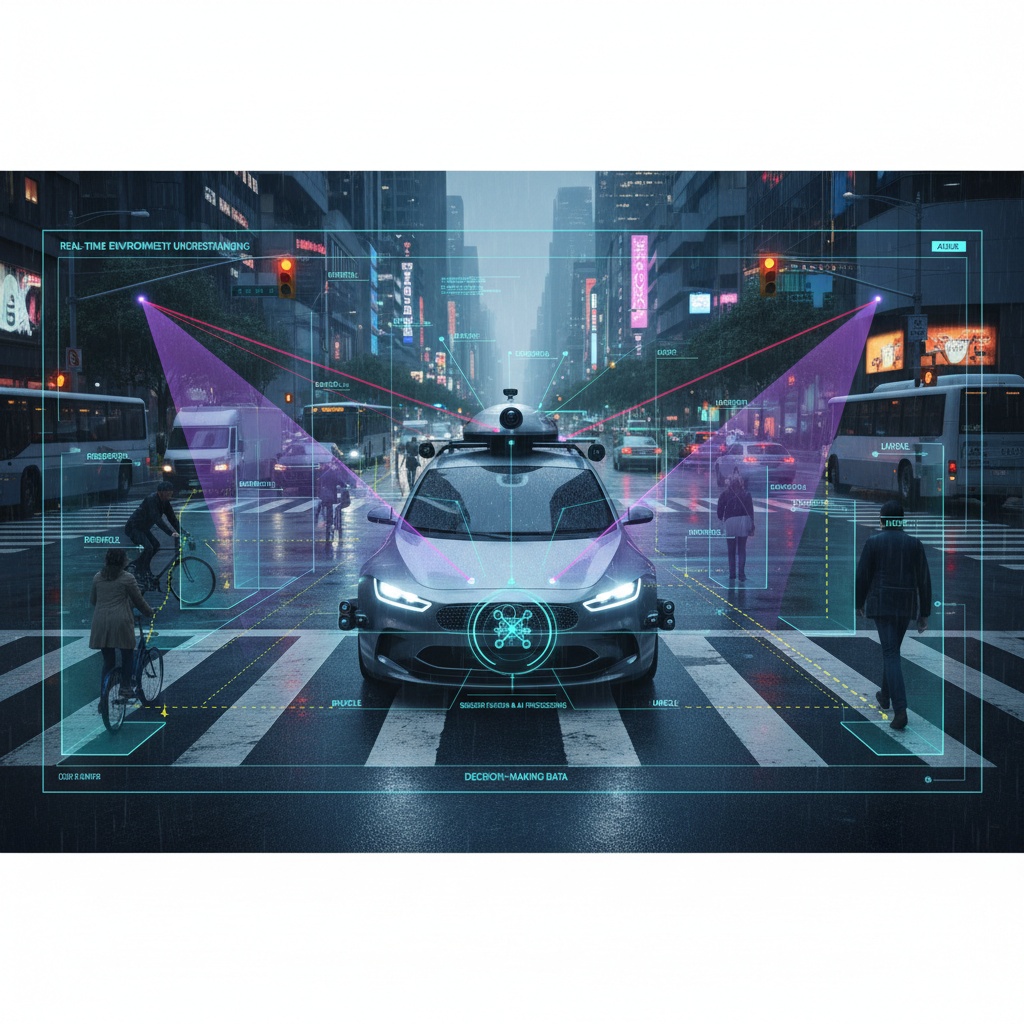
The Transformative Power of AI in Autonomous Vehicles
Artificial intelligence is no longer just a buzzword—it’s the force redefining mobility itself. AI in autonomous vehicles represents the technological brain that enables cars to perceive their surroundings, anticipate events, and make complex decisions without direct human input.
These AI-driven systems blend a full spectrum of capabilities:
- Perception – interpreting sensor data to “see” the environment
- Prediction – anticipating the behavior of pedestrians, cyclists, and other vehicles
- Planning and control – making and executing safe driving decisions in real time
By combining these cognitive layers within powerful autonomous AI systems, vehicles are evolving from passive modes of transportation into active, intelligent agents capable of navigating the world.
This shift marks the progression from basic automotive automation—think adaptive cruise control and lane assist—to true self-driving autonomy, where ai vehicles can operate reliably with little or no human oversight. The result: a new era defined by greater safety, efficiency, and accessibility on the road.
Understanding the Foundations of AI in Autonomous Vehicles
AI in autonomous vehicles serves as the decision-making core that interprets data from cameras, LiDAR, radar, and other sensors to understand the driving environment and act accordingly. This intelligence enables vehicles to perceive surroundings, anticipate movement, and control themselves with minimal or no human input. As advances in deep learning, connectivity, and onboard computing accelerate, autonomous technology has evolved from prototype experiments to large-scale deployments such as robotaxis, autonomous shuttles, and pilot freight fleets. The modern landscape reflects how AI vehicles are transforming mobility by combining software precision with real-world data to achieve safer and more efficient driving.
The Roadmap: Automation Levels from 0 to 5
The development of self-driving systems is best described through the SAE International levels of automation, which range from basic driver-assist to full self-driving capability. These levels define how responsibility shifts between human and machine across increasingly intelligent systems:
| SAE Level | Description | Human Role | Current Examples |
|---|---|---|---|
| Level 0 | No automation | Full control | Traditional cars |
| Level 1 | Single assist (e.g., cruise control, lane assist) | Driver active | Entry-level ADAS features |
| Level 2 | Combined control of steering and speed | Continuous supervision | Tesla Autopilot, GM Super Cruise |
| Level 3 | Conditional automation in defined settings | On-call for takeover | Traffic jam assist on specific highways |
| Level 4 | High automation in geofenced domains | None within ODD | Robotaxis in limited cities |
| Level 5 | Full autonomy anywhere | No driver | Future research prototypes |
Most consumer-focused AI vehicles on the road today function at Level 2, balancing convenience with oversight. Level 3 systems, available in select premium models, can temporarily take over driving in clear conditions but still expect human readiness. Level 4 systems, such as those found in robotaxi fleets from companies operating in cities like Phoenix or Shenzhen, remove the driver altogether but remain restricted to carefully defined operational zones. According to the Center for Sustainable Systems, Level 5 full automation—vehicles that handle every condition independently—remains a longer-term engineering challenge.
From Driver Assistance to Autonomous Intelligence
The boundary between automotive automation and full autonomous technology is crucial to understand. Advanced driver-assistance systems (ADAS) help the human drive better; self-driving AI replaces the driver entirely. This distinction affects not only system design but also responsibility, liability, and regulatory expectations.
- Automotive automation augments human performance by stabilizing speed, lane position, or following distance. Tasks like adaptive cruise control and lane-keeping rely on rules-based automation with the driver still responsible for overall awareness.
- Autonomous AI systems remove that dependency, integrating continuous perception, logical planning, and mechanical control so that machines make and justify every driving decision.
In this full-stack context, the AI perceives traffic, calculates intent of others, plans optimal paths, and executes steering or braking—all within tight safety parameters. The StartUs Insights industry report highlights that this handoff from human guidance to full autonomy marks the defining shift in modern vehicle intelligence.
Market Snapshot: Where AI Vehicles Operate Today
AI-powered mobility has reached distinct deployment categories reflecting different automation levels and business models. Each application demonstrates how autonomous AI systems scale from controlled environments toward open-road use.
- Robotaxis: Operating in tightly defined geofenced areas under permits, these commercial fleets showcase consistent Level 4 performance, coordinated mapping, and remote supervision.
- Autonomous shuttles: Often run in campuses or airports, these low-speed, fixed-route vehicles emphasize safe, conservative operation under predictable conditions.
- Autonomous trucking: Focused on hub-to-hub freight routes where long stretches of highway simplify perception and reduce edge cases; some pilots include remote intervention as backup.
- Delivery bots: Compact machines designed for sidewalks and local roads are redefining last-mile logistics, bridging the technology toward broader mobility applications as explored in the [self-driving delivery robots](https://YOUR WEB/self-driving-delivery-robots-logistics) article.
These implementations point to progressive adoption—not just in complexity but also in the environments where AI can guarantee reliable performance. By building infrastructure and policy frameworks around these domains, cities and regulators have begun preparing for integrated deployment scenarios.
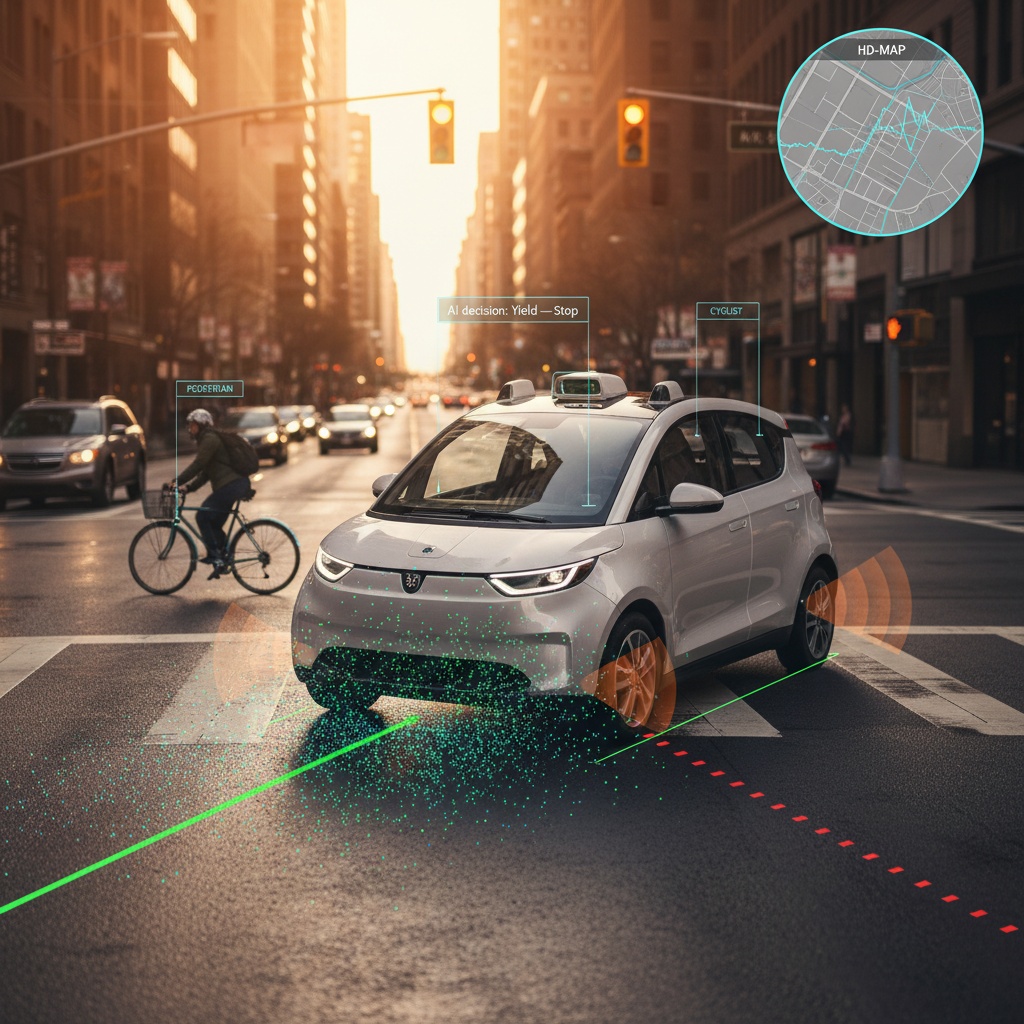
Inside the Software Brain of Autonomous Technology
What makes autonomous driving more than a collection of sensors is the software stack—a layered architecture enabling the car to interpret, decide, and act. Within the broader spectrum of automotive automation, this stack forms a pipeline from perception through control:
- Perception: The AI integrates visual, radar, and LiDAR data to identify road users, lanes, and obstacles in real time.
- Localization: Combines high-definition maps, GPS, and sensor fusion to pinpoint the vehicle’s exact position down to centimeters.
- Prediction: Anticipates how other agents—vehicles, cyclists, pedestrians—may behave in the next few seconds.
- Planning and Control: Converts these insights into executable maneuvers such as braking, accelerating, or turning with minimal delay.
Each function demands resilience to uncertainty and synchronization with the others. Disruptions to one layer—like brief sensor dropout—must not compromise decision continuity. This cascading reliability differentiates production-ready AI from lab-based automation experiments.
Data, Compute, and Continuous Learning
AI in autonomous vehicles thrives on data diversity. Fleets collect billions of sensor frames daily, creating extensive datasets to train and refine the models guiding perception and navigation. Through simulation, rare or risky scenarios such as erratic pedestrian behavior or sudden cut-ins are replicated at scale without endangering anyone. The emerging combination of physical and synthetic learning helps autonomous platforms evolve more rapidly, improving efficiency and safety simultaneously.
Onboard performance relies heavily on automotive-grade GPUs and dedicated AI accelerators that process sensor feeds with millisecond precision. Manufacturers are migrating toward heterogeneous computing architectures capable of balancing real-time throughput with strict thermal and power constraints. Systems use redundant compute chains so that if one pipeline fails, the backup maintains safe vehicle control until reversion or stop. These capabilities distinguish reliable autonomous stacks from conventional automation systems that depend on continuous driver vigilance.
Safety as an Embedded Design Principle
Safety validation defines whether an AI system can move from prototype to commercial deployment. Standards such as ISO 26262 ensure that electronic and electrical components meet functional safety requirements, while ISO 21448 (SOTIF) addresses the safety of intended functionality—especially pertinent for perception algorithms that rely on probabilistic models rather than deterministic logic. Each new operational domain is governed
Advanced AI Integration and the Next Frontier of Vehicle Intelligence
Beyond enabling perception, the newest generation of autonomous AI systems is transforming how vehicles think, learn, and adapt on the road. These systems combine deep neural intelligence with physics-based modeling to interpret uncertain or incomplete data, blending predictive analytics, contextual awareness, and adaptive decision-making into continuously evolving road behavior. Unlike the static rule-based logic of early automation, these learning systems consume vast amounts of sensory data and retrain dynamically—an essential shift as vehicles begin operating in mixed traffic environments with unpredictable humans and other automated fleets.
Adaptive Intelligence in Motion
Modern AI vehicles rely on adaptive autonomy, a concept where algorithms continuously recalibrate based on environment complexity and system confidence. For instance, an autonomous shuttle navigating an urban corridor might dynamically adjust its perception range or planner aggressiveness when it senses higher pedestrian density or poor visibility. This adaptive strategy is supported by reinforcement learning, meta-learning, and continuous domain adaptation techniques, ensuring that even pre-trained models remain responsive to unfamiliar conditions.
These vehicles no longer rely entirely on pre-mapped or rule-defined actions. Instead, probabilistic reasoning and Bayesian deep learning allow AI stacks to operate safely amid uncertainty. Such capabilities make the difference between a hesitation-prone automated driver and a smooth, human-like negotiator capable of interpreting subtle social cues—like anticipating whether a cyclist will cross a lane or yield.
Fleet Learning and Data Network Effects

A defining strength of autonomous technology at scale is the idea of fleet learning. Each vehicle is both a sensor and a data contributor, sending anonymized driving experiences to a centralized cloud platform. These experiences are processed to detect anomalies, generate new training datasets, and enhance collective intelligence across the fleet. For example, if a single ai vehicle encounters a rare construction pattern, all connected vehicles can instantly benefit from that insight after updates propagate through over-the-air (OTA) pipelines.
Companies like Waymo, Cruise, and Motional leverage this data-network effect to incrementally expand their Operational Design Domains (ODDs). Data collected across thousands of hours of real-world and simulated drives becomes the foundation for continual safety and performance validation, aligning machine intelligence with evolving conditions. This process is reshaping how software-defined vehicles evolve—from static products into living, continuously optimized systems.
Simulation-Driven Validation
As deployments move from limited pilots to dense urban operations, physical testing alone cannot scale. AI developers now rely on scenario-driven simulation tools that mirror billions of potential interactions, from erratic jaywalkers to complex multi-agent merges. These synthetic environments combine physics-based dynamics and photorealistic simulation with reinforcement learning to stress-test the autonomous AI systems before road exposure.
Simulation isn’t just a safety gate; it’s a laboratory for innovation. It allows developers to evaluate new neural architectures, study algorithmic bias—such as overfitting to certain road conditions—and optimize response times under real-time constraints. Companies that integrate simulation feedback loops directly into their AI training pipelines reduce both cost and accident risk in live testing, helping validate compliance with functional safety standards like ISO 26262 and ISO 21448 (SOTIF).
Infrastructure Synergy and Cooperative Perception
While perception begins at the vehicle level, its capabilities multiply through collaboration with the surrounding ecosystem. V2X connectivity and intelligent infrastructure provide external viewpoints that extend the perception horizon beyond line-of-sight obstacles. A connected intersection, for example, can broadcast signal-phase-and-timing (SPaT) messages or alerts about approaching emergency vehicles, empowering autonomous vehicles to respond faster than onboard sensors alone would allow.
Emerging 5G edge networks further enhance this cooperation by enabling low-latency data exchange between vehicles and cloud-based AI modules. In practice, this could allow freight convoys or autonomous trucks to maintain formation at optimal fuel efficiency or coordinate braking maneuvers with millisecond precision. Still, experts emphasize independence: vehicles must remain fail-safe if communication drops, confirming that connectivity is an enhancer, not a crutch, for fully autonomous operation.
Human-in-the-Loop Learning
Even in highly automated fleets, human expertise continues to play a quiet but vital role. Remote supervisors, test operators, and data-labeling specialists provide the oversight needed to validate uncertain AI judgments. This hybrid supervision model creates a layered safety mechanism where AI handles most control decisions, but ambiguous cases—like temporary traffic signals or non-standard signage—trigger escalation to monitored human review.
Human feedback also enriches active learning pipelines. When fleet data exposes low-confidence detections, annotators can prioritize those clips for rapid correction and retraining. Over time, this process helps resolve “long tail” issues: rare but serious anomalies that deterministic models might ignore. The evolving mix of AI and human expertise is gradually redefining how automation is certified, trusted, and socially integrated into mobility ecosystems.
Cross-Industry Lessons and Convergence
The breakthroughs driving automotive automation increasingly mirror trends across other AI-heavy sectors. Techniques first proven in industrial robotics or healthcare imaging, such as foundation models and multimodal sensor learning, now inform self-driving architectures. Vision-language models are starting to describe complex driving scenes in plain terms (“pedestrian crossing against signal”), potentially making internal system states interpretable to safety engineers or even regulators.
Simultaneously, hardware convergence is reshaping deployment economics. Automotive-grade GPUs and AI accelerators originally designed for robot vision or manufacturing robots now underpin vehicle compute platforms. This cross-pollination accelerates cost reduction and reliability improvement—critical for large-scale consumer rollouts where affordability must match safety assurance.
Implementation Challenges and Strategic Considerations
Despite enormous progress, engineers confront persistent obstacles when integrating autonomous technology into production systems. Balancing compute demand, sensor cost, and redundancy requirements determines whether an architecture is viable for mass-market vehicles. While robotaxis may employ multi-LiDAR arrays and 360° sensing redundancy, consumer-grade AI vehicles often prioritize compact vision-radar setups with sophisticated software compensation. This strategic divergence underscores the trade-offs between safety performance, capital expense, and scalability.
Another challenge lies in regulatory heterogeneity. Laws governing driverless operations differ widely between jurisdictions, complicating deployment timelines. Developers must validate systems under different ODDs and safety metrics, often duplicating validation frameworks to meet local approval. These regulatory dynamics indirectly shape product design, influencing not only vehicle control stacks but also data governance, cybersecurity infrastructure, and user interface transparency.
Pathways Toward Reliable Commercialization
The long-term credibility of ai in autonomous vehicles depends on building public and institutional trust through measurable safety evidence. Transparent reporting of disengagements, near-miss statistics, and fleet performance has become an industry expectation. Cities that partner with developers on open-data trials or shared urban pilots help accelerate both validation and public comfort. Over time, standardized benchmarks and shared scenario libraries are likely to replace isolated testing, creating a foundation for comparable performance claims industry-wide.
For automakers and fleet operators, a practical roadmap involves layering automation capability with incremental safety validation. By combining modular AI packages with central fleet intelligence, companies can deploy gradually expanding levels of autonomy while maintaining accountability and security at every stage. The resulting systems are not monolithic but evolutionary—adapting through data, guided by continuous human oversight, and shaped by real-world interaction.
As commercial deployments mature, these converging forces—adaptive intelligence, cooperative sensing, hybrid learning, and scalable validation—define the next phase of intelligence-driven mobility. Each advancement pushes AI vehicles closer to behaving not just as automated machines but as perceptive, learning entities capable of coexisting safely and efficiently with human drivers.
Conclusion
Ultimately, the role of AI in autonomous vehicles transcends automation—it defines the very intelligence that allows machines to navigate a human world with precision and judgment. Through advanced perception, predictive modeling, and adaptive planning, these systems convert raw data into real-time decisions that match and increasingly surpass human capabilities behind the wheel.
As the industry progresses from today’s partially automated systems to fully autonomous operations, success will hinge on relentless refinement of algorithms, compute infrastructure, and safety validation. Each breakthrough moves automotive automation from assistance to true autonomy, reinforcing public trust and regulatory confidence through measurable safety and reliability.
The trajectory is clear: autonomous technology is no longer a distant concept but an engineered evolution toward safer, smoother, and more inclusive transportation. Stakeholders that invest now—in scalable AI architectures, transparent safety frameworks, and human-centered design—will shape the roads of the future. The era of intelligent mobility has arrived, and the next move belongs to those ready to drive this transformation forward.
Frequently Asked Questions
What makes AI essential to autonomous vehicles?
AI is the core intelligence that transforms sensor data into actionable understanding, enabling vehicles to perceive their surroundings, predict behavior, plan paths, and control motion safely. Without AI, sensors would only collect raw data with no interpretation. Modern autonomous technology relies on machine learning models that continuously learn from real-world driving scenarios, making decision-making and navigation more adaptive and human-like over time.
How is autonomous technology different from traditional automotive automation?
Automotive automation (like advanced driver-assist systems) supports human drivers in specific tasks such as lane keeping or adaptive cruise control, but still requires active supervision. Autonomous technology, in contrast, allows AI vehicles to take full control within defined conditions—handling perception, planning, and control without human input. This distinction marks the shift from driver assistance to truly self-driving vehicles capable of independent operation.
What are the SAE levels of vehicle automation, and where does AI fit in?
The SAE Levels 0–5 classify how much driving autonomy a vehicle possesses.
- Levels 0–2: The human driver remains responsible; AI provides assistance.
- Level 3: Conditional automation where AI handles driving in limited conditions but expects human takeover.
- Level 4: High automation—AI drives entirely within its defined domain (e.g., robotaxis in specific cities).
- Level 5: Full automation—AI can handle all driving tasks under any conditions.
Today’s AI vehicles mostly operate at Levels 2–3 for consumers and Level 4 in geofenced pilot programs.
How do AI perception systems help vehicles “see” their surroundings?
AI perception systems fuse inputs from cameras, LiDAR, and radar to construct a 3D understanding of the environment. Using advanced sensor fusion and deep learning models such as Convolutional Neural Networks (CNNs), the vehicle identifies lanes, pedestrians, and obstacles. This fusion provides redundancy, ensuring safe performance even when visibility or sensor performance is reduced due to lighting or weather conditions.
What challenges do AI systems in autonomous vehicles still face?
Current limitations include handling rare edge cases, managing adverse weather conditions, and maintaining accuracy when road or map data changes unexpectedly. AI must also balance safety with comfort, ensuring that decisions remain conservative yet efficient. Ongoing training and real-world validation are essential to solve these challenges as vehicles progress toward greater autonomy.
How does AI enable prediction and decision-making in self-driving cars?
AI models analyze vehicle and pedestrian behavior, road geometry, and traffic laws to anticipate future movements of nearby agents. Using trajectory prediction and behavior planning, AI can safely decide when to merge, yield, or stop. These autonomous AI systems incorporate uncertainty modeling to choose the safest and most probable actions while minimizing risks.
What ensures safety and reliability in AI-driven autonomous vehicles?
Safety is enforced through redundant sensors, fail-operational design, and rigorous simulation-based testing. Adherence to standards like ISO 26262 and ISO 21448 (SOTIF) ensures vehicles handle both hardware faults and limitations in AI perception. Additionally, operational design domains (ODDs) restrict where the system can drive autonomously, ensuring that vehicles only operate under validated conditions.
How does AI handle navigation and localization in changing environments?
AI-driven localization combines GPS, IMU, LiDAR, and vision data to achieve centimeter-level accuracy of a vehicle’s position. When road layouts change, AI compares real-time sensor data with HD maps and detects discrepancies, triggering map updates. This adaptability helps autonomous systems safely navigate through dynamic or partially mapped areas without losing reliability.
When will fully autonomous Level 5 vehicles become mainstream?
Level 5 autonomy, where a vehicle can operate anywhere under all conditions, remains under long-term research. Experts predict that widespread deployment will take several more years, dependent on advances in AI robustness, regulatory frameworks, and public trust. Current momentum focuses on refining Level 4 deployments in controlled environments like robotaxis and autonomous shuttles as a stepping stone.
What benefits will widespread AI-powered autonomy bring to transportation?
AI in autonomous vehicles promises safer roads, reduced traffic congestion, and greater mobility access for those unable to drive. By minimizing human error—the cause of most accidents—and enabling optimized, smoother driving patterns, autonomous technology can improve both efficiency and sustainability. When integrated with electric vehicles, AI-powered autonomy could significantly reduce emissions and reshape the future of urban