

Best Robot Simulation Software for Developers and Engineers: Tools, Use Cases, and Workflows
In the fast-evolving world of robotics, robot simulation software has become the silent powerhouse driving faster, safer, and smarter innovation. It acts as the virtual proving ground where robots take their first digital steps—long before a single bolt is tightened or sensor is wired.
By creating and testing a virtual robot in a fully simulated 3D environment, developers can predict performance, debug behaviors, and refine algorithms without risking expensive hardware or downtime. This virtual-first approach streamlines experimentation, accelerates prototyping, and minimizes costly errors once designs move into production.
Unlike robot design software, which focuses on CAD modeling, structural geometry, and mechanical kinematics, robot simulation software emphasizes realistic physics, sensor emulation, and environmental interactions. It allows a robotics software engineer to test navigation, manipulation, and perception strategies under a wide range of real-world-like conditions—rain, glare, obstacles, or even system faults—without ever stepping into a lab.
Who benefits most?
- Robot developers building early prototypes and autonomy stacks.
- Robotics software engineers iterating on SLAM, path planning, and control loops.
- Technical leads and managers validating safety, productivity, or throughput before any hardware investment.
This article explores the top robot simulation software platforms shaping modern robotics, comparing their tools, workflows, and ideal applications across design, AI, and industrial domains.
Why Robot Simulation Software Matters in Modern Robotics Development
In the modern robotics landscape, robot simulation software has become an indispensable tool for every engineer or developer who aims to accelerate innovation while minimizing cost and risk. Acting as a dynamic bridge between concept and physical deployment, it essentially provides a fully functional digital environment where a robot’s design, sensors, logic, and control algorithms can be validated before any piece of hardware is even built. This process builds confidence in early-stage prototypes and allows for greater flexibility during iterative development.
With simulation, developers aren’t just visualizing a 3D model—they’re putting a virtual robot to work in realistic, physics-driven settings that mimic real-world dynamics such as friction, collision, and environmental interaction. For teams aiming to refine a mobile robot’s navigation or an industrial arm’s precision, this digital testing ground significantly reduces the technical and financial risks inherent in physical trials. It’s particularly transformative for industries like manufacturing, logistics, and healthcare, where system downtime or hardware misconfigurations can be incredibly costly.

Robot Simulation Software vs. Robot Design Software
One of the most common sources of confusion among new entrants to robotics is the distinction between robot simulation software and robot design software. While both play important roles across the engineering cycle, their purposes differ in significant ways:
- Robot design software focuses on the physical creation and mechanical feasibility of a system. Engineers use it to develop CAD models, calculate reachability, explore torque limits, and draft components of the robot’s body. These tools help construct the machine mechanically but don’t necessarily predict how it will behave in real-world conditions.
- Robot simulation software, on the other hand, extends beyond static design to bring the model to life in a controlled, virtual environment. It integrates real robot control code, dynamic interactions, and environmental factors to evaluate how sensors, actuators, and algorithms perform under changing conditions.
For instance, when designing a mobile robot intended for warehouse automation, CAD-based design might illustrate how the robot fits into aisles or docks at charging stations. The simulator, however, enables the robotics software engineer to test SLAM algorithms, run obstacle avoidance trials, and optimize routing—all before assembling the first prototype. That contrast—the leap from geometry to behavior—is where simulation proves invaluable.
The Expanding Role of Simulation for Robot Developers
The evolution of robot simulation software has dramatically changed how robot developers approach prototyping and validation. Instead of waiting weeks to verify results on physical robots, they can now evaluate thousands of scenarios virtually. For a team training a manipulator in a manufacturing cell, or a navigation stack on an AMR (Autonomous Mobile Robot), this flexibility translates into faster iterations and deeper analytical insight.
Developers can:
- Fine-tune control parameters such as PID loops and trajectory planners safely.
- Integrate sensors like LiDARs, cameras, or ultrasonic systems with realistic noise modeling.
- Run edge-case testing that would be too dangerous or expensive in real-world setup.
By combining simulation with continuous integration pipelines, many companies now treat virtual environments as living test benches—updating, validating, and optimizing code long before it hits the factory floor or research site. The workflow mirrors practices already seen in software development for cloud applications but is now being applied to the robotics domain.
A Core Enabler for the Robotics Software Engineer
For a robotics software engineer, the real advantage of simulation lies in its ability to align development with reproducibility and accuracy. Whether writing motion planning algorithms or developing a vision pipeline, real-time testing within a simulation loop ensures that changes to one system component don’t destabilize another. Engineers can isolate anomalies faster, tune parameters, and collect structured logs from controlled test cases.
Consider the complexities of Simultaneous Localization and Mapping (SLAM), where sensor fusion accuracy dictates performance. In simulation, these engineers can modify sensor configurations—say, swapping LiDAR placement or altering camera frame rates—to study effect on localization drift. The insights derived from such controlled experimentation feed directly into hardware calibrations later on.
Simulation also aids in testing cross-system reliability. Suppose multiple robots must coordinate to avoid collisions or share work zones; testing such sequences physically could lead to costly damages. Virtual environments provide a safe sandbox for multi-agent experimentation, strengthening collaborative autonomy before it reaches real-floor deployments.
How Simulation Accelerates Innovation
Beyond technical precision, robot simulation software plays a strategic role in overall project momentum. Early-stage teams and established robotics companies alike use simulation to compress development cycles through faster validation loops. By prototyping and adjusting algorithms directly in simulation, bottlenecks that used to appear months into physical testing now surface within days.
This capability drastically changes decision-making. Technical managers and systems architects can evaluate throughput, safety systems, and task feasibility without bottlenecking resources on hardware fabrication. They gain measurable data about process reliability, resource utilization, and potential hazards through digital twins—accurate virtual mirrors of real systems.
Through these insights, teams can:
- Identify failure points before production.
- Refine robot paths, sensor configurations, and timing routines.
- Collaborate across remote teams efficiently with shared simulation environments.
The immediate outcome is lower experimentation cost and reduced integration friction between subsystems such as sensor processing and actuator dynamics.
Testing Real Code on Virtual Platforms
One of the clearest signs of maturity in robot simulation software is its ability to support real robot code. Modern frameworks like ROS and ROS2 provide direct communication layers that allow developers to run unmodified mission scripts used in physical robots. In effect, the virtual space becomes an authentic rehearsal environment where actual navigation or control stacks execute as they would on deployed machines.
This real-code compatibility means the gap between theory and field performance continues to shrink. Developers can calibrate timing loops, latency tolerances, and sensor synchronization from within the simulator, reducing debugging hours once prototypes move into hardware labs. It also allows robotic solutions to scale faster because every configuration or update can be regression-tested against hundreds of environmental models automatically.
Value for Technical Managers and Engineering Leads
For technical decision-makers, the value of simulation lies in its predictive insight. Before authorizing hardware procurement or system integration, teams can simulate assembly-line cell layouts, detect bottlenecks, and measure efficiency under different production speeds. For example, a manufacturer evaluating collaborative arms can simulate worker interaction and path safety before purchasing a single piece of equipment.
This virtual validation process provides tangible benefits:
- Better forecasting of capital expenditure.
- Evidence-driven acceptance testing.
- Reduced training time and deployment uncertainty.
Moreover, integration between simulation platforms and PLM (Product Lifecycle Management) systems unifies mechanical and software validation, promoting early collaboration between mechanical engineers and robotics software engineers.
Expanding Horizons: From Research to Real Deployment
The long-term implications of simulation reach beyond industrial workflows. As robotics continues integrating into domains like health care, urban mobility, and logistics, simulation becomes the key enabler of safety and compliance. For instance, testing AI-assisted arms in medical contexts demands repeatability and strict control over variables. Running these tests in a simulator not only accelerates certification but also uncovers subtle system dependencies. It supports related innovations across healthcare robotics, complementing platforms featured in topics like AI surgery robot development.
Educational and research institutions also rely heavily on simulation to train algorithms and human operators. With platforms like Gazebo or Webots, students and professionals can collaborate globally, iterating on robot behaviors without shared physical equipment. This democratization of experimentation strengthens the global robotics community and fuels applied robotics research that translates directly into commercial solutions.
Building Toward Scalable, Risk-Free Experimentation
As robotics projects scale, so does the need for infrastructure that handles complexity in simulation. Teams begin exploring distributed simulation systems, cloud-based environments, and integrations with fleet management software to coordinate multiple robot instances simultaneously. By fine-tuning algorithms virtually, they create a testing framework that keeps development agile even when projects expand to large fleets or multi-robot coordination scenarios.
Before moving into discussions of specific software capabilities, it
Advanced Applications and Industry Integrations of Robot Simulation Software
Once teams understand the functional power of robot simulation software, its deeper impact emerges through how it reshapes real-world engineering workflows. The next leap is not only in testing within a virtual space but in creating entire ecosystems where a virtual robot and its real counterpart coexist, learn from each other, and evolve continuously. This integration goes beyond testing code—it changes how production lines, research labs, and autonomous systems operate at scale.
Modern manufacturers now embed simulation directly within their product lifecycle management. Industrial robot developers leverage robot design software to construct precise virtual replicas of every work cell, linking simulated data streams with live manufacturing metrics. This practice, often referred to as digital twinning, transforms simulations from mere pre-production testing into an ongoing optimization tool. Factories can adjust cycle times or process routes virtually before committing to any physical configuration, saving considerable cost and reducing downtime. Automotive and aerospace giants commonly operate thousands of these virtual twins in cloud clusters that mirror global facilities, enabling central oversight with local precision.
Simulation as the Heart of Experimentation
Simulation software has also redefined how robotics research proceeds. Academic and commercial labs rely on these environments to explore navigation, grasping, and vision in edge conditions that would be risky or impractical in real life. A robotics software engineer developing autonomous driving algorithms, for instance, might simulate a fleet of vehicles under adverse weather or unpredictable pedestrian behavior, gathering data across millions of test miles.
Beyond environments, robot simulation tools now serve as controlled laboratories for data-driven learning. Reinforcement learning agents can iterate through thousands of virtual trials, adapting their policies in hours rather than months. Once successful, the resulting control models undergo sim-to-real transfer—the critical step where domain randomization, physical parameter tuning, and real-world calibration make these simulations accurate enough to inform behavior on physical platforms. This approach has accelerated advancements in warehouse automation, legged locomotion, and drone navigation, where physical testing would have been prohibitively slow or expensive.
Expanding Beyond Traditional Robotics
The influence of simulation extends far beyond typical robotic arms or AMRs. Hospitals, for example, use simulated operating environments to test surgical manipulator workflows and ensure patient safety before deployment, aligning closely with developments described in [AI in surgical robotics](https://YOUR WEB/ai-surgery-robots-operating-rooms). Similarly, logistics operators validate delivery bot fleets to optimize routing, obstacle detection, and energy consumption, as highlighted in [The Rise of Delivery Bots](https://YOUR WEB/delivery-bot-last-mile-logistics).
In agriculture, virtual testing environments evaluate autonomous tractors and drones under varying soil conditions and crop densities, analyzing algorithms for navigation stability. Construction and mining robots likewise undergo stress testing for material handling under dust, debris, and uneven terrain that would be inefficient to simulate physically. These sectoral uses prove how simulation has become foundational infrastructure rather than optional tooling.
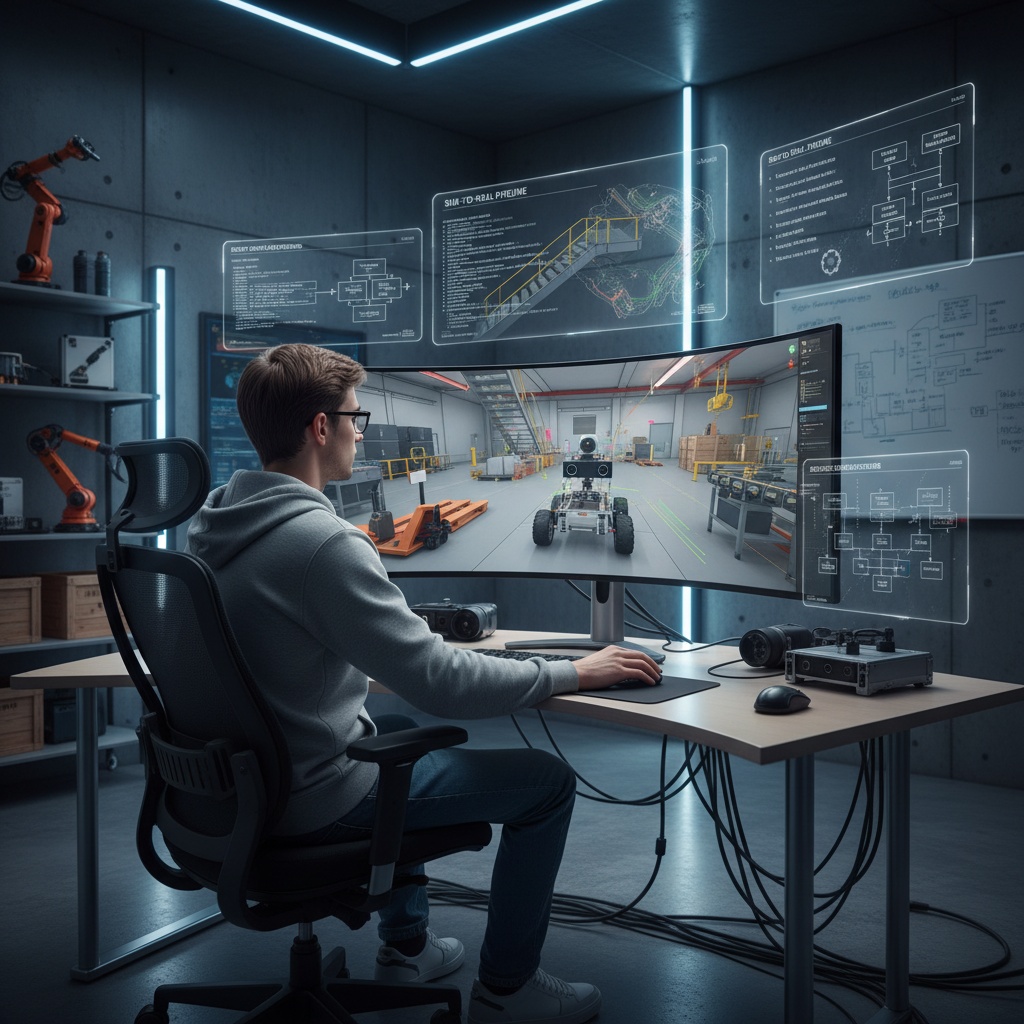
Visual Element: Insert an image here showing a digital twin environment with multiple simulated robots interacting in a factory cell.
Integrating AI and Analytics into the Simulation Workflow
As robotics shifts toward data-centered decision-making, artificial intelligence and simulation are increasingly intertwined. The latest platforms combine sensor emulation and synthetic dataset generation, allowing teams to train computer vision models through photorealistic 3D renderings. Advanced environments such as Isaac Sim or Unity Robotics produce lifelike lighting, materials, and spatial relationships so algorithms generalize effectively to physical cameras.
The analytics layer adds even more insight. Through telemetry capture inside the simulator, developers measure CPU loads, power draws, motion efficiency, and sensor coverage maps. Some companies deploy cloud-native simulation infrastructures, running thousands of concurrent trials to statistically validate autonomy stacks. Others connect simulation outputs to operational analytics platforms, forming continuous feedback loops that flag performance regressions and trigger automatic scenario replays.
These integrations shift robotics validation from episodic tests to continuous verification pipelines. As seen at firms like Formant and Tree C Technology, this practice builds resilience into robots’ decision frameworks, identifying rare safety failures long before they appear in field operations.
Overcoming Operational Challenges
For all its advantages, simulation is not without barriers. Hardware requirements can still be steep, particularly when modeling large fleets or photorealistic scenes. To combat this, organizations often partition workloads: lightweight physics tests run locally, while rendering-intensive perception trials move to GPU-enabled cloud clusters. Some enterprises adopt hybrid workflows where local simulators provide interactive debugging, while cloud servers handle batch testing and data synthesis overnight.
Data fidelity remains another concern. Even slight discrepancies between simulated and physical sensor responses can skew algorithm tuning. Effective teams address this through periodic calibration against real-world recordings and cross-validation using multiple simulators. For instance, running identical test cases in Gazebo, Webots, and Isaac Sim exposes systemic biases that might hide inside one engine’s physics model.
Moreover, the complexity of creating accurate digital twins—especially for multi-robot systems—demands robust collaboration. Engineers, software experts, and business analysts work jointly to define shared modelling standards and integrate mechanical CAD with control logic. The most advanced groups employ version-controlled scene graphs and automate synchronization between design changes and simulation parameters. This ensures that every iteration in the physical workflow has a corresponding update in the virtual environment.
Cross-Disciplinary Collaboration and Ecosystem Development
The maturation of robot simulation ecosystems mirrors larger industry convergences. Game-development engines, industrial automation vendors, and AI research frameworks increasingly share common ground. Unity and Unreal have been retooled to interact with ROS2 pipelines. Matlab, once primarily a control engineer’s tool, now interfaces directly with robotic simulators to bridge analytical and visual modeling.
This interoperability means robot developers no longer operate in silos. A single workflow might begin in CAD-based robot design software, pass through a physics simulator, feed sensor imagery into an AI training platform, and end with automatic deployment scripts sending compiled code to live hardware. Collaboration across this chain reduces integration lag and encourages open innovation.
Companies like ABB are demonstrating the benefits of merging simulation with intelligent manufacturing, an area further explored in [ABB Automation: Driving the Future of Industrial Robotics](https://YOUR WEB/abb-automation-industrial-transformation). By maintaining digital twins synchronized with factory operations, these firms maintain real-time visibility into production efficiency, robotic behavior, and maintenance needs.
Evolving Trends Shaping the Next Wave
Robotic simulation continues to shift toward cloud accessibility, collaborative scene editing, and AI-enhanced automation. Several startups are piloting web-based simulation editors where multiple engineers can prototype a virtual robot simultaneously. The fusion of 5G connectivity and edge computing will soon allow simulations to synchronize in near-real-time with field-deployed robots, supporting continuous learning loops where insights from one inform the other instantly.
Another key development is the integration of standardized data schemas across simulators. Efforts under open-source initiatives like USD (Universal Scene Description) are creating shared interchange formats that preserve physics properties and materials across platforms. This makes it possible for a project designed in an academic simulator to scale into an industrial manufacturing environment without laborious reconfiguration.
Meanwhile, robotics labs are exploring co-simulation—linking specialized software for mechanical systems, electrical networks, and control algorithms. This approach creates a unified testbed where every subsystem, from torque sensors to PLCs, interacts faithfully. It provides unmatched potential for predictive diagnostics and lifecycle forecasting, helping enterprise users preempt maintenance and performance degradation.
By delving into hybrid AI workflows, cloud integrations, and cross-sector adoption, the ongoing evolution of simulation technology continues to redefine how robotics innovation unfolds. The practice now serves not only as a testing framework but as the strategic engine driving autonomy, manufacturing intelligence, and robotics research across industries.
Conclusion
Ultimately, the true advantage of robot simulation software lies in its ability to replace hesitation with momentum. It eliminates costly guesswork, allowing robot developers and every robotics software engineer to build confidence in their designs long before the first bolt is tightened. What once demanded months of trial and error in physical labs can now be achieved through precise, data-driven experimentation in a digital environment.
The evidence is clear: simulation is not a luxury—it’s the new foundation of modern robotics. By leveraging advanced modeling, sensor replication, and physics-rich environments, teams can validate ideas, reveal unseen flaws, and accelerate innovation cycles with unprecedented control. The result is more refined machines, safer deployments, and a seamless bridge from algorithm to action.
Now is the time to transform theory into practice. Begin with a single virtual prototype inside a simulator that aligns with your workflow. Learn its dynamics, refine its behaviors, and scale that insight into complex multi-robot or full-factory simulations. Every incremental step strengthens your foundation for real-world success. Build small, iterate fast, and let simulation pave the path toward a more intelligent, resilient, and efficient robotics future.
Frequently Asked Questions
What is the primary purpose of robot simulation software?
The main purpose of robot simulation software is to create, program, and test a virtual robot within a realistic digital environment before any hardware is built. This allows developers to validate designs, optimize algorithms, and predict real-world performance safely and efficiently. It’s especially valuable for a robotics software engineer or researcher who needs to prototype and debug code without physical constraints or costly lab setups.
How is robot simulation software different from robot design software?
While both tools are essential, they serve very different roles. Robot design software (like CAD or offline programming tools) focuses on mechanical structure, kinematics, and layout—essentially the physical blueprint of a robot. In contrast, robot simulation software models real-world physics, sensors, and environmental interactions to test algorithms, behavior, and system logic. Design software ensures mechanical feasibility; simulation software ensures functional performance and reliability.
Who typically uses robot simulation software in the development process?
A wide range of professionals rely on these tools. Robot developers use them to test autonomy and navigation. A robotics software engineer employs simulation for algorithm design, perception testing, and motion planning. Meanwhile, project managers and manufacturers use them for layout optimization, safety validation, and cycle-time analysis before hardware investment. Essentially, it’s a bridge between engineering design and real-world deployment.
What are the main advantages of using a virtual robot for testing?
Working with a virtual robot offers several major advantages:
- Cost efficiency: Minimizes expensive physical prototypes and lab time.
- Speed: Enables rapid experimentation by adjusting parameters instantly.
- Safety: Tests edge cases (collisions, sensor failures, hazardous scenarios) without risk.
- Scalability: Runs hundreds of simulations in parallel for faster validation.
Together, these benefits shorten development cycles and improve final system reliability.
How accurate are robot simulation results compared to real-world performance?
Simulation accuracy depends on model fidelity—how well the physics, sensors, and materials are represented. With proper calibration, domain randomization, and accurate URDF data, high-quality simulators can closely match real-world behavior. However, no simulation is perfect; developers should periodically validate results with hardware tests to minimize the sim-to-real gap.
What features should I prioritize when selecting robot simulation software?
Look for physics accuracy, sensor simulation, and API integration as core priorities. Good tools also offer ROS/ROS2 compatibility, multi-robot support, and easy integration with AI or machine learning workflows. For industrial or control-heavy projects, assess features like digital twin creation, PLC co-simulation, and offline programming. The right tool aligns with your domain and available computing resources.
Can robot simulation software help reduce project costs and risk?
Yes—substantially. By running simulations early and repeatedly, teams can detect and correct design flaws before fabrication, avoiding costly rework or downtime. Simulators also reduce the risk of accidents by safely modeling unsafe or extreme scenarios. Many companies report savings of 30–50% in development time and cost once simulation becomes a core part of their workflow.
Which robot simulation platforms are best for different use cases?
The best choice depends on your specific focus:
- Gazebo or Webots for mobile robots and ROS development.
- RoboDK or ABB RobotStudio for industrial arms and manufacturing.
- Unreal + AirSim for drones and autonomous vehicles.
- Isaac Sim or Unity Robotics for high-fidelity perception and digital twins.
- MuJoCo or PyBullet for reinforcement learning and motion research.
Choosing based on your domain ensures efficient setup and accurate results.
How can I integrate simulation into my robotics development workflow?
Start by building a minimal virtual robot in your chosen simulator, then connect it to your existing software stack (e.g., ROS2 navigation, control algorithms). Integrate simulation into continuous integration (CI) pipelines so every code change is automatically tested. Over time, expand your environments and add more realistic scenarios to stress-test your system under different conditions.
What common mistakes should new users avoid when using robot simulation software?
New users often make three key mistakes:
- Skipping model calibration, which leads to inaccurate results.
- Overfitting algorithms to the simulator, causing poor real-world transfer.
- Ignoring performance optimization, resulting in slow or unstable simulations.
To avoid these, regularly verify your model against real data, use multiple simulators when feasible, and manage complexity by simulating in stages—from simple to
