

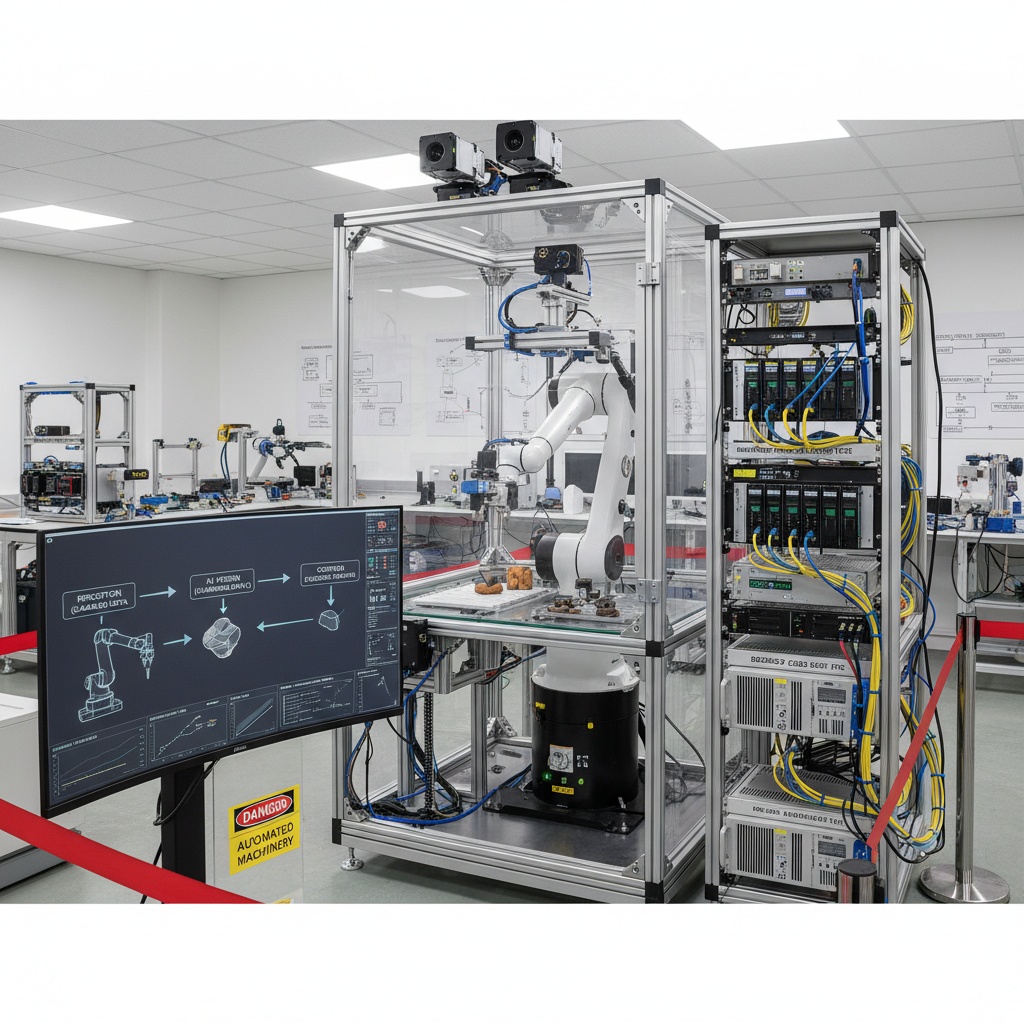
Motion Automation Intelligence: Redefining the Future of Industrial Automation
Factories are evolving from rigid, pre-programmed machines into adaptive ecosystems that can sense, decide, and act. At the heart of this transformation lies motion automation intelligence—the fusion of artificial intelligence, advanced control systems, and robotics that together enable machines to operate with learning and precision.
In today’s hyper-competitive industrial landscape, businesses no longer thrive on static processes. They rely on intelligent automation systems that continuously optimize production, ensure consistency, and respond instantly to variability. This convergence of sensory data, real-time analytics, and autonomous motion marks a turning point for manufacturing leaders seeking operational excellence.
- Adaptive Control: Systems that adjust servo motion and tool paths dynamically
- Predictive Intelligence: AI models that anticipate failures and optimize maintenance cycles
- Collaborative Robotics: Robots that work safely alongside humans while learning from every task
As motion automation intelligence becomes the cornerstone of modern operations, it’s redefining efficiency, flexibility, and safety standards—ushering in a future where factories think and evolve as seamlessly as the products they create.
Understanding the Core Components of Motion Automation Intelligence
Motion automation intelligence combines physical motion systems with digital intelligence, creating a synchronized environment where machines can perceive, decide, and act in real time. Instead of relying on fixed, repetitive programs, this technology stack enables equipment to learn and adjust based on data. The result is an adaptive ecosystem that is self-optimizing, more sustainable, and significantly more resilient to change. To grasp its transformative capacity, it’s essential to understand how its underlying components interact to bring intelligence to industrial motion.
The Interplay Between Sensing, Computation, and Motion Control
At its foundation, a motion automation system functions as a continuous feedback loop. Sensors capture data, intelligent algorithms interpret that information, and motion controllers translate it into precise physical actions. Each component must operate with microsecond-level coordination for the entire system to maintain safety and accuracy.
- Sensors and Perception Tools collect real-time environmental data such as pressure, vibration, visual input, or torque readings.
- Edge Computers and Gateways perform rapid inference using localized AI models that can react within milliseconds.
- Motion Controllers and Servo Drives convert those insights into coordinated movements, aligning trajectory planning with efficiency and safety goals.
These layers communicate through deterministic networks like EtherCAT or Profinet, ensuring reliable synchronization. When deployed correctly, motion automation intelligence turns every movement on the production floor into a data-driven decision.
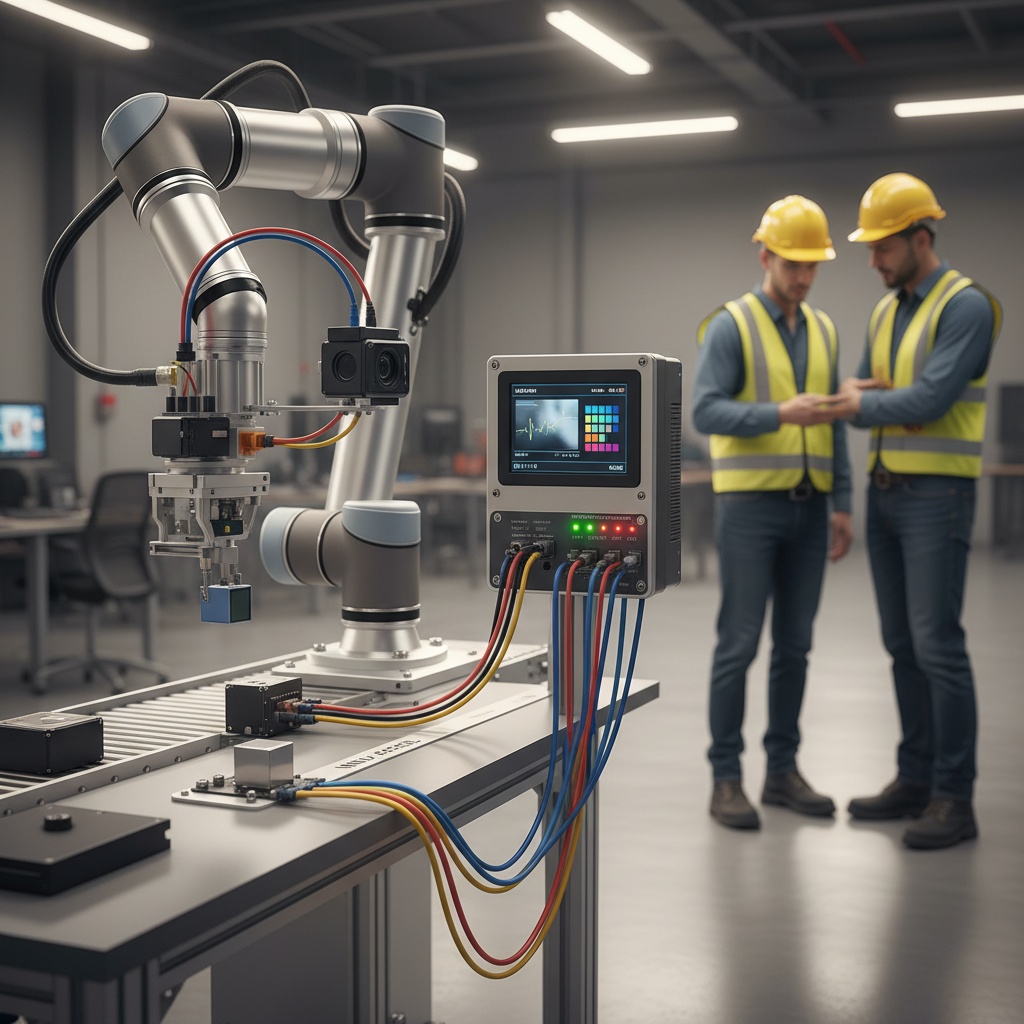
The Sensing Layer: The Eyes and Ears of Intelligent Automation
The sensing layer is where perception begins. High-resolution cameras, LIDAR modules, torque sensors, and proximity detectors feed continuous data streams into control units. This data provides the “situational awareness” that enables robots to adjust their behavior dynamically. For instance, a vision-guided gripper can recognize varying part geometries and adjust its grasping pressure instead of using a fixed setting.
Sensing also evolves through IoT connectivity. Scattered devices across production lines report temperature, vibration, or current load readings. In advanced automation labs, this data is consolidated into digital dashboards that offer predictive insights before mechanical issues manifest. The better the sensory input, the more accurately motion automation intelligence can infer and respond to operational conditions.
Edge Computing and AI Inference: The System’s Real-Time Brain
Traditional automation architecture depended heavily on centralized servers, but in modern setups, significant computation happens at the edge. Edge computers act as the system’s local decision-makers, processing data near the source to minimize latency. An edge inference engine may apply lightweight neural networks to classify defects, optimize torque application, or analyze load balancing—all in milliseconds.
Edge intelligence is integral because any delay breaks determinism in motion control. By blending real-time control logic with AI inference, machines can execute tasks such as adaptive servo tuning or on-the-fly trajectory correction. This concept is central to ai automated intelligence, where learning mechanisms and physical control coalesce.
Industrial leaders like Motion Automation Intelligence show how this edge-centric model transforms time-critical operations—from autonomous packaging lines to high-speed material handling systems—without relying on external cloud dependencies.
Motion Controllers and Drives: Translating Intelligence into Action
The motion layer is where the digital and physical converge. Programmable logic controllers (PLCs), programmable automation controllers (PACs), and smart motion drives convert AI-driven commands into mechanical execution. These controllers are engineered for deterministic operation, maintaining stable synchronization even under variable conditions.
Key performance features include:
- Advanced Servo Control: Real-time feedback loops adjust torque and velocity for precision positioning.
- Adaptive Profiles: Servo drives modify acceleration, jerk, or braking parameters dynamically.
- Safety Monitoring: Certified safety functions like Safe Torque Off (STO) ensure system integrity when human operators enter the workspace.
By integrating intelligent automation with classical control theory, manufacturers achieve faster cycle times and more consistent output. Instead of performing the same movement repeatedly, robots can adjust pace or alignment based on live sensor data—a defining characteristic of robotic intelligence and automation.
Digital Twin and Simulation: Testing Before Touching
Before integrating new workflows on physical equipment, engineers often rely on digital twins—virtual replicas of machines, robots, or entire cells. These simulations allow teams to test algorithms, predict physical dynamics, and validate safety boundaries. Within an automation lab, digital twins become indispensable for training AI models, generating synthetic datasets, and ensuring that adaptive systems operate predictably under different load conditions.
A well-designed twin reduces deployment risks and accelerates iteration cycles. For example, engineers can compare a baseline deterministic trajectory to an adaptive reinforcement learning path within a simulated environment, identifying trade-offs in energy, precision, and wear before initiating real-world motion.
The Communication Backbone and Data Pipeline
Connectivity is the often-overlooked hero of motion automation intelligence. High-bandwidth, low-latency networks make possible the integration of sensors, controllers, and edge modules. EtherCAT, Profinet, and OPC UA form the backbone that maintains time-sensitive communication while transporting telemetry for analytics. Meanwhile, MQTT or REST APIs connect motion layers with MES or cloud services for remote monitoring and retraining workflows.
A streamlined data pipeline ensures that insights flow continuously across the system. Real-time telemetry goes to control units, while aggregated historical data feeds into predictive maintenance dashboards or energy optimization models. This interplay transforms the factory floor into a continuously improving ecosystem capable of learning and refining itself autonomously.
| Layer | Function | Typical Technologies | Time Sensitivity |
|---|---|---|---|
| Sensing | Environmental and process data capture | Cameras, torque/force sensors, IoT nodes | Millisecond feedback |
| Edge Compute | Lightweight inference and signal processing | Industrial PCs, GPUs, local ML models | 1–100 ms |
| Motion Controller | Deterministic actuation | PLCs, PACs, servo drives | Sub-millisecond |
| Connectivity | Communication and synchronization | EtherCAT, OPC UA, MQTT | Deterministic |
| Simulation | Offline training & validation | Digital twin software | Non-real-time |
Why Integration Matters in Modern Manufacturing
When these technologies integrate cohesively, motion automation intelligence does more than enhance efficiency—it enables entirely new forms of production flexibility. In automotive or electronics industries, systems adapt instantly to variations in part design or batch configuration. In logistics, automated guided vehicles navigate congested environments by learning traffic patterns through data aggregation.
This convergence also promotes human-machine collaboration, where robots safely coexist with operators. Adaptive cobots can sense touch or proximity and respond with compliant motion, improving ergonomics and reducing fatigue for assembly workers. Over time, this collaboration drives continuous process improvement without introducing greater safety risks.
Laying the Groundwork for Practical Implementation
Understanding the components and architecture of motion automation intelligence is only the first step. The next stage involves operational readiness assessments, pilot deployments, and controlled testing environments that allow teams to prototype safely. This is why organizations often establish dedicated automation labs, where engineers and data scientists iterate on algorithms, verify safety, and train operators before scaling to full production.
These labs form the transition point between conceptual architecture and live application, bridging the gap between research and operational transformation. The next stage dives deeper into how businesses can set up these controlled environments, validate motion intelligence workflows, and design phased rollouts that align with strategic
Implementing Motion Automation Intelligence: Practical Application Steps
Introducing motion automation intelligence into an existing industrial architecture requires more than installing new equipment or software—it demands a holistic transformation across processes, people, and technology. Successful adoption follows a structured path grounded in data readiness, performance validation, and phased rollout planning that aligns technical progress with measurable business outcomes.
1. Assessing Current Capabilities and Readiness
Implementation starts with a comprehensive diagnostic of the plant’s existing state. This assessment should map automation maturity across critical categories: sensing and control infrastructure, data quality, network latency, and safety compliance. Engineering teams review historical operational data, while IT counterparts evaluate whether current bandwidth and compute capacity can support intelligent automation tasks like visual inference or dynamic trajectory adjustment.
An operational readiness scorecard helps translate this diagnostic into actionable insights. Each category—data fidelity, hardware compatibility, workforce competency—earns a measurable score. Plants with lower maturity ratings in any area can schedule incremental upgrades such as adding time-synchronized sensors or introducing lightweight ML inference gateways before moving toward full-scale integration.
A practical next step involves auditing robotic intelligence and automation assets already in use. Many facilities already deploy PLCs, PACs, or programmable servo drives capable of firmware updates that support new communication protocols like OPC UA or MQTT. Identifying these upgrade paths allows teams to modernize incrementally, reducing risk and capital requirements.
2. Data Infrastructure and Model Deployment Planning
Once readiness is confirmed, the second stage focuses on building the digital foundation that enables motion-aware systems to learn and respond. This involves establishing secure data pipelines between sensors, controllers, and analytic nodes. Selecting the right balance between edge and cloud processing is crucial. Motion-critical operations typically rely on edge compute systems for instant response, while long-term optimization functions—like retraining path planning models—can be offloaded to the cloud.
To sustain accuracy and prevent model drift, data engineers create feedback routines where production data continuously refines deployed models. These retraining cycles may run weekly or monthly, depending on production variance and throughput demands. A model registry, similar to MLOps frameworks used in digital enterprises, ensures every model update is version-controlled and validated before redeployment.
This phase also defines governance boundaries between automation and corporate IT networks. Applying principles such as network segmentation and zero-trust authentication shields motion networks from potential cybersecurity threats while allowing limited data sharing for operational analytics.

3. Building and Utilizing an Automation Lab
An automation lab acts as both a technical sandbox and a cultural bridge. Located within or near production areas, it functions as a live experimentation site where engineers validate AI algorithms under realistic conditions. Teams can simulate torque disturbances, lighting variations, or camera line-of-sight occlusions without halting production.
The lab environment should replicate the actual production interface stack—same PLC firmware, identical fieldbus protocols, and equivalent networking configurations—to ensure transferability of test results. Digital twins mirror each robot or conveyance system to trial control strategies before mechanical movement occurs. This hybrid setup of hardware and virtual simulation enables machine learning models to train on synthetic edge cases that rarely appear in production but can cause critical failures when unaddressed.
Training and workforce development occur concurrently. Operators learn how adaptive servo profiles interact with quality targets, while maintenance technicians explore diagnostic dashboards linked to vibration or temperature data streams. This emphasis on experiential learning strengthens technical confidence and accelerates adoption on the shop floor.
4. Phased Rollout and Iterative Deployment
Rolling out motion automation intelligence follows a deliberate, low-risk progression. Instead of introducing system-wide automation updates, organizations should establish pilot projects—limited cells or single production lines—to validate benefits and collect performance baselines. For example, a small-scale adaptive assembly station may first be integrated into a noncritical product line. After demonstrating cycle-time reductions and improved repeatability, the technology scales across additional lines.
Each deployment phase should align with predefined metrics: first-pass yield, energy per unit, mean time between failures, and latency compliance between sensing and actuator response. Deviations from expected targets trigger root-cause analytics before advancing to the next stage. This measured approach allows organizations to manage ROI expectations while maintaining consistent quality and output standards.
Integrators often reference collaborative templates from organizations like Motion Industries or MotionAi, whose multi-phase deployment frameworks emphasize standardization across hardware, data schemas, and governance structures to ensure long-term scalability.
5. Cross-Functional Coordination and Governance Framework
Even the most advanced ai automated intelligence architecture will underperform without cross-functional collaboration. The integration of AI-driven motion systems blurs traditional departmental boundaries. Engineering teams handle control loop reliability; data science teams own model accuracy; IT ensures cybersecurity and infrastructure integrity. Establishing a governance council that includes stakeholders from each area prevents misalignment and fosters accountability.
This council reviews every proposed model update, hardware modification, or process redesign before implementation. Governance meetings also define fallback protocols in case of unexpected system behavior—when to switch from autonomous to manual control, how to log decisions, and what triggers an emergency stop sequence. These procedures maintain operational safety while preserving confidence in autonomous systems.
From a compliance standpoint, adherence to ISO 10218 and IEC 61508 certifications should guide every rollout milestone. Safety officers participate in each validation cycle to verify functional testing according to approved risk analysis frameworks.
6. Optimizing Through Continuous Feedback
The installation of motion automation intelligence transforms not just workflows but data culture. Once systems are operational, ongoing optimization revolves around continuous feedback. Predictive analytics monitor parameters such as inference latency or actuator duty cycles. These metrics feed dashboards that visualize performance trends and signal when interventions are needed.
Some manufacturers are now experimenting with adaptive learning frameworks that update servo control or inspection routines directly from live production insights. For instance, a packaging line might modify gripping pressure in response to humidity variations detected in its environmental sensors, preserving output consistency across seasonal conditions.
Regular data audits and model monitoring sessions become part of standard maintenance routines. This closes the loop between digital and physical operations, enabling factories to progress from automation to autonomy over time.
7. Scaling Intelligent Automation Across the Enterprise
Once early implementations reach stability, the challenge shifts toward replication and scale. Standardizing model formats, data labeling conventions, and semantic communication structures ensures interoperability across plants or business units. Many organizations adopt federated learning approaches where sites share anonymized insights to continuously improve shared motion models without exposing proprietary data sets.
Supply chain partners can also join this networked intelligence fabric. By connecting upstream suppliers through shared motion and quality data streams, manufacturers gain early visibility into component variability that can influence downstream production parameters. The broader effect is a distributed ecosystem where adaptive motion control extends beyond factory walls into logistics, warehousing, and end-of-line packaging networks.
A phased scaling roadmap, maintained by the automation leadership team, maps out each expansion wave over quarterly or annual cycles. Each site reuses validated templates from pilot deployments, accelerating time to productivity.
8. Measuring Impact and Sustaining Improvement
Precise measurement validates the effort invested in intelligent automation deployment. Benchmarking involves comparing baseline operational data against post-implementation performance. Key indicators include tool wear reduction, energy efficiency, and machine utilization rate. When aligned with business KPIs, these datasets justify further investment and guide reinvestment strategies.
Dashboards designed within the automation lab context can migrate into enterprise analytics systems, allowing executives to visualize cross-site performance in real time. Reporting frequency—often monthly or quarterly—should mirror continuous improvement cadences common in lean manufacturing.
To maintain long-term success, every new dataset collected becomes part of the next optimization cycle. Engineers continue refining control loops, modelers retrain algorithms, and operators provide annotated feedback on system behavior. This iterative process transforms automation from a one-time modernization effort into an evolving capability embedded within organizational DNA.
Through structured assessment, iterative experimentation, and disciplined scaling, the integration of motion automation intelligence transforms industrial
Conclusion
Modern industry is no longer defined by static processes and fixed control logic—it thrives on intelligence, agility, and precision. Incorporating motion automation intelligence empowers organizations to operate at that level, transforming rigid production lines into self-optimizing systems capable of adapting in real time. This shift delivers measurable results: streamlined operations, reduced costs, superior quality, and a level of flexibility that ensures long-term competitiveness.
Success begins with clarity of intent. Launching pilot projects anchored by concrete metrics provides the data-driven foundation needed to scale with confidence. These early wins build organizational momentum, validate technology choices, and demonstrate tangible ROI to stakeholders. In doing so, businesses evolve from experimenting with automation to mastering intelligent motion as a strategic advantage.
Ultimately, the integration of intelligent automation marks the turning point from efficiency to excellence. Those who act now set the benchmark others will chase. Define your pilot, measure your progress, refine your results—and lead the next era of industrial innovation with systems that move, think, and improve continuously.
Frequently Asked Questions
What’s the difference between an automation assessment and an automation strategy?
An automation assessment is a time-bound evaluation that measures readiness, identifies high‑impact processes, and produces a prioritized roadmap. An automation strategy is broader and ongoing—it sets your long-term vision, operating model, funding approach, and governance. The assessment feeds the strategy with hard data and a sequenced plan, ensuring your automation and AI in the workplace efforts deliver tangible outcomes, not just intentions.
How long does an automation assessment take and who needs to be involved?
A focused assessment typically runs 6–12 weeks, aligned to the 90‑day roadmap. Involve a cross‑functional core team: process owners, IT/architecture, data/privacy, risk/compliance, finance (for ROI), and change management. Keep executive sponsors engaged through structured check‑ins so decisions on scope, prioritization, and funding happen fast.
How do we calculate ROI for automation and AI (ROI AI) with confidence?
Anchor your model to a clear baseline: volume, FTE effort, cycle time, error rates, and compliance incidents. Include full TCO (licenses, infra, build, model training, support) and all benefits (hours saved, quality uplift, throughput, risk/fines avoided). Calculate payback, NPV, and IRR, and run sensitivity at ±20–30% on benefits and costs. Typical quick‑win automations pay back in 3–9 months; AI use cases may span 6–18 months depending on data prep and model complexity.
Which processes should we avoid automating even if they look high-volume?
Be cautious with processes that are unstable, have high exception/judgment rates, or rely on unstructured or low‑quality data you can’t remediate quickly. Also avoid workflows under regulatory scrutiny without strong auditability or human‑in‑the‑loop controls. Stabilize and standardize first; then revisit as candidates once variance and data issues are addressed.
What data and access do we need before we start discovery and scoring?
You’ll need process metrics (volumes, handle time, exceptions), system access for task/process mining or screen capture, and data dictionaries to assess quality and structure. Confirm governance early—who approves data use, privacy constraints, and security reviews—so discovery tools and interviews can run without delays. Clean, accessible data accelerates both automation and ROI AI estimates.
How do we choose between RPA, workflow, iPaaS, and AI/ML (including GenAI)?
Match the tool to the work pattern. Use RPA for UI-driven, rules-based tasks across legacy apps; workflow/BPM for multi-step processes with approvals and SLAs; iPaaS for API-centric integrations; AI/ML/GenAI for classification, predictions, document understanding, and unstructured text. When in doubt, start with the lowest-complexity tool that meets requirements, then add AI components where they raise value without spiking complexity.
What are the biggest risks when scaling automation and AI in the workplace, and how do we govern them?
Top risks include model risk/bias, security/privacy gaps, and orphaned automations without ownership. Govern with a lightweight but firm framework: risk tiers, design standards, change control, audit trails, human‑in‑the‑loop for sensitive steps, and rollback playbooks. Establish a COE to enforce controls while enabling speed, with clear RACI for build, run, and incident response.
How will workforce automation affect roles, and how should we manage change?
Expect shifts in task mix rather than wholesale job loss: repetitive work declines while exception handling, analysis, and customer work increase. Pair automation with role redesign and reskilling/upskilling so employees move up the value chain. Communicate early and often, measure adoption, and celebrate wins tied to CX/EX improvements to reduce resistance and sustain momentum.
What if our maturity is low—should we still run a pilot, and what budget should we plan?
Yes—use the assessment to close gaps while delivering a quick win. Start with a stable, rules-based process and a small, cross‑functional team. Typical pilot budgets: $20k–$75k for RPA/workflow quick wins; $50k–$200k for AI pilots depending on data readiness. Keep scope tight, measure benefits weekly, and reinvest early returns into capability building and governance.
How often should we refresh the automation pipeline and what KPIs matter most?
Reassess quarterly to refresh the pipeline with new candidates and incorporate lessons learned. Track leading KPIs—adoption, automation health/error rates, and SLA adherence—and lagging KPIs—FTE hours saved, cycle time, defects, and compliance outcomes. Tie KPI dashboards to the original business case so ROI and value realization remain visible and defensible.