

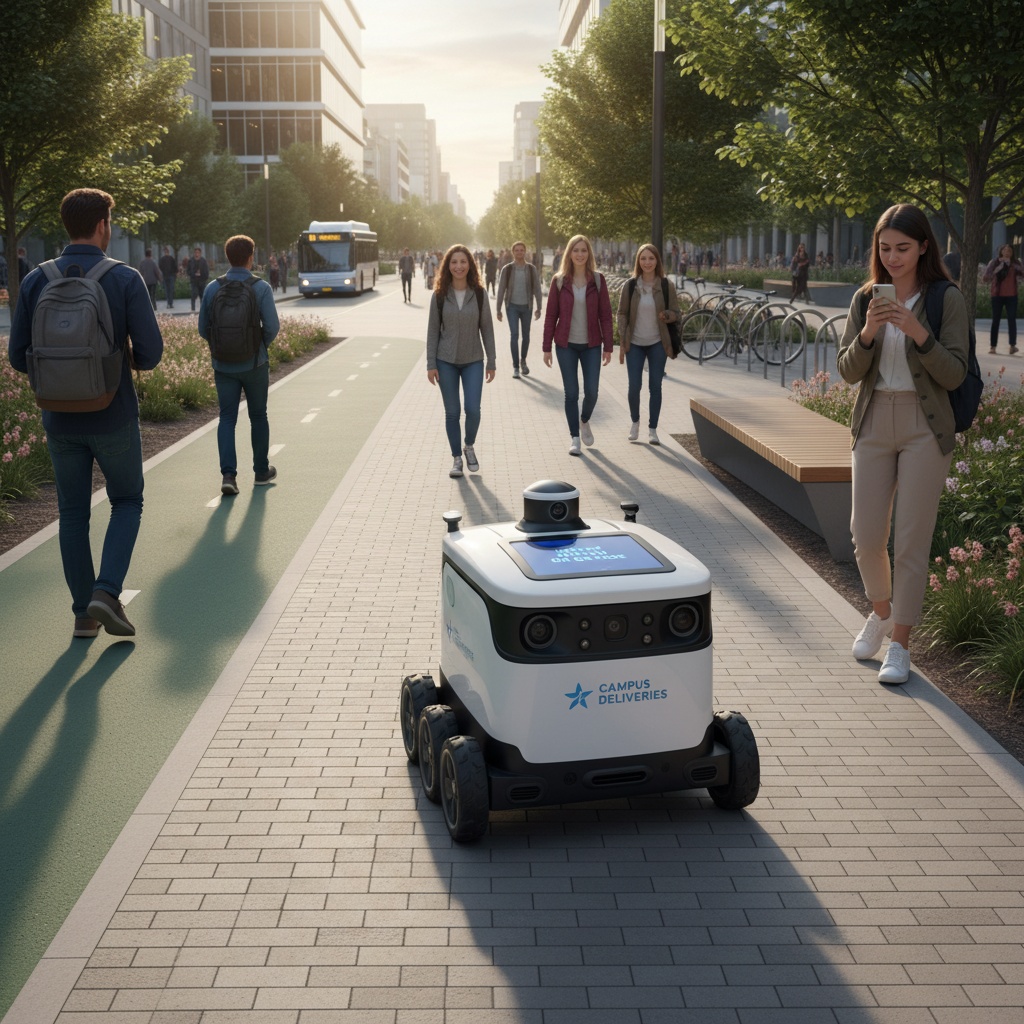
The Delivery Bot Revolution: How Autonomous Robots Are Redefining Last-Mile Logistics
The delivery bot isn’t science fiction anymore—it’s rolling down city sidewalks, crossing suburban streets, and transforming how businesses move goods from store to doorstep. These compact, intelligent machines mark a profound turning point in logistics, reimagining the so-called last mile—the most expensive and complex stage of delivery.
Traditional last-mile distribution has long strained the global supply chain, consuming up to 28% of total shipment costs. Labor shortages, urban congestion, and sustainability pressures have only amplified the challenge. Enter the autonomous delivery robot: a new class of electric, self-navigating couriers engineered to reduce costs, cut emissions, and speed up service.
From autonomous food delivery robots weaving through college campuses to road-approved autonomous delivery vehicles like those pioneered by Nuro, these systems signal a massive shift in both consumer convenience and operational efficiency. The race is on among leading delivery robot companies to scale fleets that can safely, reliably, and affordably handle everyday deliveries across urban and suburban environments.
In this exploration, we’ll uncover how delivery bots work, where they shine, and why they’re fast becoming the backbone of next-generation logistics.
Understanding the Growing Role of the Delivery Bot
Across urban sidewalks, corporate campuses, and suburban neighborhoods, the delivery bot is reshaping how goods travel the “last mile.” Once a futuristic concept, these autonomous machines now deliver meals, groceries, and pharmacy orders every day, guided by AI, advanced sensors, and precise geolocation systems. Their emergence signals a shift in the logistics landscape, addressing long-standing challenges in speed, cost, and sustainability associated with last-mile delivery. According to Formant’s definition of a delivery robot, these units operate independently without human drivers, using technologies like GPS, LiDAR, cameras, and obstacle detection to move safely across complex environments.
The economics driving their adoption are undeniable. The final leg of a product’s journey—often only a few miles—accounts for nearly 28% of total shipment costs. That inefficiency, combined with growing consumer expectations for rapid, contactless service, has created the perfect opening for autonomous solutions. Companies now view the delivery bot as an operational asset that scales effortlessly, runs continuously, and adapts to dense or distributed service areas.
The Distinct Categories of Modern Delivery Bots
Sidewalk Delivery Bots: Agile Navigators for Urban Environments
Sidewalk delivery bots are the most recognizable class of autonomous couriers. Compact in design and friendly in appearance, these wheeled robots roam along sidewalks or pedestrian-friendly roads at walking speeds between 3 and 6 miles per hour. Their small payload range—typically 5 to 15 pounds—makes them ideal for short-distance food orders, pharmacy refills, and lightweight packages.
These machines rely on sensors such as LiDAR, radar, and cameras to detect curbs, pedestrians, and obstacles in real time. Integrated with machine learning software, they continuously refine navigation routes and obstacle avoidance strategies. The bots’ low profile and limited speed minimize safety concerns and allow fleet operators to obtain city permits more easily compared to full-sized delivery vehicles.
Brands like Starship Technologies, Kiwibot, and Serve Robotics have become synonymous with sidewalk autonomy. Starship delivery systems operate across campuses and neighborhoods worldwide, illustrating how these bots harmonize with pedestrian traffic and integrate with mobile ordering platforms. For businesses, sidewalk bots reduce delivery costs by 60% or more while increasing reliability through algorithmic precision.

Road-Going Autonomous Delivery Vehicles: Expanding Range and Payload
Beyond the sidewalks, a new generation of autonomous delivery vehicles blurs the line between bot and vehicle. These road-approved machines—exemplified by Nuro’s autonomous delivery vehicles—operate at moderate road speeds within regulated, low-traffic zones. Unlike sidewalk bots, they feature larger compartments capable of transporting bulky loads, from grocery bags to multiple restaurant orders in one trip.
By design, these units meet automotive safety standards, including lighting, braking, and vehicle stability systems, while remaining electric-powered for zero-emission operation. They navigate using high-precision GPS and real-time kinematic positioning to maintain lane accuracy and obey road signals. For fleet operators, this mid-mile capability bridges warehouses, fulfillment centers, and neighborhoods without the cost or emissions of standard delivery vans.
Operationally, road-going bots thrive in geofenced areas where predictable traffic conditions and digital mapping exist. Partnerships between Nuro and major retailers demonstrate how the autonomous delivery vehicle can connect online purchases directly to residential zones. Instead of drivers managing multiple drop-offs, software optimizes routes and dispatches vehicles in synchronized waves, transforming how last-mile logistics scale.
Indoor and Campus Bots: Precision in Controlled Spaces
Another specialized category, indoor delivery robots, functions within confined environments like hospitals, corporate offices, large retail complexes, or university grounds. Their compact frames, modular compartments, and precise sensors allow operation across hallways, elevators, and interbuilding paths. The AI software guiding these robots is tuned for repetitive routes and obstacle-rich indoor layouts.
Hospitals leverage them for medication delivery and specimen transport, freeing staff for patient care. Universities deploy campus-specific bots for food and parcel services to dormitories or administrative offices. Their autonomy level is often near 100% since their routes are predictable and mapped in advance, making them reliable for continuous operations.
Vendors such as Ottonomy and Cartken specialize in these indoor and hybrid models, emphasizing integration with building access control systems and facility management protocols. Indoor bots highlight how automation extends beyond streets and sidewalks, demonstrating adaptability in settings requiring both hygiene and precision.
Comparative Landscape of Delivery Bot Types
| Delivery Bot Type | Operational Domain | Payload Range | Speed | Ideal Applications |
|---|---|---|---|---|
| Sidewalk Bots | Urban/suburban sidewalks and pedestrian zones | 5–15 lbs | 3–6 mph | Food, pharmacy, and small package delivery |
| Road-Going Autonomous Vehicles | Public low-speed roads and suburban neighborhoods | 20–50+ lbs | 15–35 mph | Groceries, mid-mile retail deliveries |
| Indoor/Campus Robots | Controlled indoor or semi-enclosed environments | Varies (modular design) | 2–4 mph | Hospital logistics, campus meals, office mail delivery |
The distinctions between these models reflect the industry’s broader approach to right-sizing vehicles for various delivery profiles. Each type optimizes the balance between capacity, regulatory compliance, and environmental integration, ensuring efficiency across multiple contexts. Businesses evaluating deployment often adopt hybrid fleets—mixing compact sidewalk bots with road-tier vehicles—to achieve flexibility and economic balance.
What Sets Delivery Bots Apart from Traditional Couriers
Unlike human couriers, delivery bots operate continuously without fatigue or safety risks associated with long hours on the road. They can be dispatched instantly to meet demand spikes and maintain predictable speed and route adherence. Compared to traditional delivery vans, bots occupy less road space, reduce emissions, and increase route density within a small radius.
Studies such as those by MAPFRE’s sustainability research quantify how these autonomous systems cut delivery-related emissions while slashing energy and labor expenses. For retail and restaurant operators, the transition means lowering per-order costs while achieving greener operations.
Yet, these robots rarely replace human drivers outright. In most cases, companies adopt hybrid models—using bots for repetitive or short-range tasks while assigning complex deliveries or customer interactions to human partners. This approach enhances efficiency without compromising service flexibility, representing the next phase in logistics evolution.
Market Expansion and Emerging Players in Delivery Robotics
The delivery bot ecosystem now includes dozens of active developers and service providers. Industry pioneers like Starship Technologies lead sidewalk deployments across North America and Europe, while Nuro remains a front-runner in larger road-going vehicles. In China, Meituan and JD.com run extensive pilot operations, using thousands of small autonomous vehicles integrated into existing e-commerce networks.
Younger companies such as Serve Robotics, Coco, and Kiwibot focus on modularity and cost optimization to make autonomous delivery more accessible to local businesses. On the backend, technology partners provide teleoperation systems, fleet management software, and machine-vision algorithms that form the operational infrastructure behind each bot.
As the industry matures, the differentiation between hardware and software providers is becoming clearer. Hardware makers are streamlining production for scalability, while software developers focus on AI routines that improve real-time navigation, perception, and route optimization.
The Evolutionary Step in Last-Mile Efficiency
Every category of autonomous food delivery robot brings the logistics sector closer to fully automated commerce. When aligned with micro-fulfillment centers and connected retail systems, bots help redefine last-mile economics by slashing delivery times and resource waste. Their role in sustainability, workforce adaptation, and customer experience offers compelling advantages for cities aiming to modernize their mobility ecosystems.
For retailers and logistics platforms exploring next steps, understanding these distinct delivery bot categories is critical to designing scalable deployment strategies. The emerging wave of innovation in perception systems, communications, and autonomy levels promises to expand their operational range even further,
Accelerating Maturity: From Autonomous Trials to Scalable Urban Systems
The delivery bot industry is entering a phase of technical and regulatory inflection. Early pilots proved that autonomous delivery is operationally feasible; the next stage centers on scale, resilience, and interoperability across diverse environments. Central to this evolution is perception—the robot’s ability to interpret its surroundings with precision. In practice, perception is transitioning from simple obstacle avoidance to full environmental understanding. Leading systems integrate sensor fusion architectures that combine LiDAR, radar, ultrasonic data, and multispectral cameras. By cross-validating these inputs, a bot learns to differentiate between a rain puddle and a curb, or a moving stroller and a static bench. This enhanced sensing reduces the false positives that once triggered unnecessary stops or teleoperator takeovers, which previously limited efficiency in high-traffic areas.
Advances in computing hardware are making this fusion possible at the edge. Next-generation GPUs and neural accelerators process multiple sensor streams locally, allowing decisions to be made within milliseconds. The effect is tangible: in pilot programs documented by firms like Proven Robotics, bots equipped with multi-modal perception achieved a 40% improvement in route continuity during adverse weather events. These systems also incorporate thermal imaging, helping the robot distinguish pedestrians at night or in fog conditions when optical cameras lose clarity. As algorithms mature, autonomous food delivery robots may reach a point where human intervention becomes statistically rare rather than operationally necessary.
Expanding Geographies Through Policy and Infrastructure
Innovation alone cannot unlock scale without regulation that keeps pace. Until recently, limited municipal approvals created operational bottlenecks; each new city often required a unique negotiation cycle. Progressive cities are now developing standardized ordinances, treating delivery bots as a defined class of micro-mobility vehicles rather than experimental hardware. These frameworks establish permissible speed ranges, insurance requirements, and data-sharing policies, creating predictability for developers and fleet operators. According to research from MAPFRE Innovation, jurisdictions that adopt robot-friendly policies can cut pilot approval times by over 60%. The emergence of model legislation in states like Arizona and Virginia is laying the groundwork for cross-jurisdictional operations, reducing certification overhead for autonomous delivery vehicle manufacturers.
Urban planning is also changing in response. Infrastructure updates such as widened sidewalks, dedicated robot lanes, and integrated charging nodes within smart poles are helping cities accommodate the growing fleets. When paired with data-sharing partnerships, municipalities gain access to aggregated mobility patterns that can inform pedestrian safety improvements and curbside design.

The Push Toward Full Autonomy and Reduced Human Oversight
Reliance on teleoperators has long been the quiet cost center of automated delivery. Each time a bot encounters a situation too complex for onboard logic—a blocked path, malfunctioning signal, or heavy rain—a remote human must intervene. However, machine learning models trained on these edge cases are now beginning to close that gap. By capturing sensor and decision data from every intervention, developers feed models that refine predictive behavior. Over time, a robot that once stalled at construction detours learns to recognize temporary signage and reroute on the fly.
These improvements are moving machines closer to Level 4 autonomy, where human oversight is limited to strategic monitoring rather than active control. Companies like Starship have reported that intervention rates have dropped below 1% in stable service zones—a signal that full autonomy is nearing commercial viability. Once that threshold stabilizes, bots will operate effectively across previously restricted regions, including areas with variable weather and denser pedestrian presence.
Intensifying Competitive Dynamics Among Delivery Robot Companies
Market competition is shifting from proof-of-concept to platform dominance. Established delivery robot companies are investing heavily in proprietary autonomy stacks, fleet management ecosystems, and localized partnerships with retailers. Starship Technologies continues to refine its software layers for scalability, while competitors like Serve Robotics are forming alliances with large on-demand logistics platforms. In contrast, Nuro focuses on road-legal autonomous vehicles that integrate directly with grocery and retail partners, offering greater payload capacity but higher capital requirements.
A growing trend is strategic consolidation, where autonomous delivery startups are aligning with established e-commerce networks. This integration streamlines data exchange between ordering platforms and fulfillment systems. Partners such as DoorDash and Uber Eats, for instance, already collaborate with robotic startups to test blended fleet models combining human drivers and autonomous couriers. Analysts predict these alliances will tighten, making access to customer ecosystems the defining factor for market survival rather than pure technical superiority.
Investors are beginning to treat delivery bot operations as infrastructure plays rather than standalone robotics ventures. Much like electric-vehicle charging networks, success depends on network density, uptime standards, and software integration depth. For emerging players, entering the market now often means providing niche capabilities—such as weatherized units or modular cargo systems—rather than building full-stack solutions from scratch.
Technical Differentiation and the New Arms Race
As intellectual property matures across the sector, differentiation increasingly hinges on reliability metrics. Autonomy success rates, defined by the proportion of fully independent trips, are becoming key competitive indicators alongside cost per delivery. Vendors are publishing transparency reports demonstrating progress on safety and operational continuity. Across multiple case studies referenced by Formant, fourth-generation bots now sustain 98% completion rates while maintaining low incident frequencies.
Hardware resilience is another frontier. Multi-layered sensor casings, hydrophobic lenses, and redundant braking systems expand operation hours without weather-related downtime. Battery chemistry improvements, particularly the shift toward solid-state designs, extend runtime while reducing maintenance load. Each advancement shrinks operating gaps between autonomous robots and traditional courier vans, not only on cost but on reliability across time and environment.
The Road to Interoperable Ecosystems
One of the emerging challenges lies in interoperability. With each manufacturer relying on proprietary mapping formats and teleoperation protocols, cross-fleet management remains fragmented. To reach true scale, standardization efforts are underway to define universal APIs that allow bots from different vendors to share traffic data or coordinate route overlaps. Industry consortia and research bodies are modeling frameworks similar to those used in drone airspace coordination. Once successful, this would allow mixed fleets—comprising both sidewalk bots and autonomous vehicles—to operate efficiently within a single urban map infrastructure.
Several analysts interpret this momentum as the prelude to a hybrid delivery ecosystem. A package might be transported from a central micro-fulfillment hub by a large road vehicle such as Nuro’s R2 and transferred at a neighborhood node to a smaller sidewalk unit for final doorstep delivery. This handoff requires seamless communication and scheduling between different robot types, an area now under active development among logistics integrators.
Policy, Technology, and Market Forces Converging
The confluence of improved perception technologies, favorable regulatory environments, and intensified competition signals a rapid maturation curve for the sector. Each advancement reinforces the next: sophisticated autonomy reduces human overhead; predictable legal frameworks accelerate adoption; and market competition drives hardware and software refinement. As these forces compound, cities, retailers, and technology providers are moving beyond pilot programs into permanent integration of robotic delivery within everyday logistics infrastructure.
Conclusion
Ultimately, the rise of the delivery bot marks a decisive turning point in how goods move through cities and supply chains. What began as a bold experiment in automation has matured into a critical enabler of scalable, sustainable logistics. These autonomous couriers now define the next phase of last-mile innovation—one that replaces inefficiency with intelligence, and congestion with coordination.
The transformation extends far beyond convenience. Autonomous food delivery robots and road-capable autonomous delivery vehicles are recalibrating the very structure of urban economies. They shrink environmental footprints, unlock continuous service availability, and transform delivery into a data-driven science. In doing so, they integrate seamlessly with smart city infrastructure and reimagine the built environment around micro-fulfillment and adaptive mobility.
The evidence is clear: automation in the final mile is no longer experimental—it is essential. Companies that embrace this evolution now will secure lasting advantages in cost efficiency, sustainability compliance, and customer satisfaction. Those who hesitate will find themselves constrained by legacy logistics models unsuited to tomorrow’s digital ecosystems.
In conclusion, autonomous delivery networks have redefined what’s possible in logistics—combining precision, safety, and sustainability in one intelligent system. The next step belongs to innovators, retailers, and city planners ready to operationalize these technologies into daily life. As automation continues to accelerate, the delivery bot becomes not just a tool of efficiency but a symbol of progress for every connected, forward-looking city.
Frequently Asked Questions
What exactly does a delivery bot do during the delivery process?
A delivery bot autonomously handles the entire last-mile delivery—the final leg of transporting goods from a local hub or store to the customer’s doorstep. After receiving an order, the bot is dispatched automatically, navigates sidewalks or low-speed roads using cameras, LiDAR, and GPS, and avoids obstacles like pedestrians or vehicles. Once it reaches its destination, the recipient unlocks the compartment using a PIN or QR code, ensuring secure and contactless delivery. If a delivery fails, the bot can return to its hub or await pickup instructions.
How are delivery bots different from drones or traditional couriers?
Unlike drones that fly or human couriers who drive, delivery bots travel on the ground and operate autonomously within predefined, geofenced routes. They excel in short-distance, high-frequency deliveries such as food orders or small packages, usually within 1–3 miles of the store. Bots operate 24/7, consume no fuel, and have a much lower cost per delivery, making them more sustainable and economical than both drivers and aerial delivery options. Drones, by contrast, face more weather and airspace limitations.
What kind of technology allows a delivery bot to navigate safely?
Delivery bots rely on a multilayered sensor and software stack. Their “eyes” include LiDAR sensors and HD cameras that continuously map surroundings and identify obstacles in real time. GPS and inertial sensors handle precise localization, while machine learning algorithms process data to make split-second navigation decisions. The bots also employ SLAM (Simultaneous Localization and Mapping) to operate safely without pre-existing maps. If the bot encounters a difficult situation, a remote operator can intervene temporarily for manual assistance.
Where are autonomous food delivery robots being used today?
Autonomous food delivery robots have become common on university campuses, corporate parks, and urban neighborhoods. Leading vendors such as Starship Technologies and Kiwibot operate fleets that deliver meals, groceries, and small packages across North America, the UK, and select European locations. You’ll most often find them in dense, pedestrian-friendly zones like college quads or city centers, where short routes and repeatable demand make operations efficient.
How much do delivery bot programs typically cost for businesses to start?
The initial investment depends on scale and geography. A single delivery robot unit generally costs $15,000–$50,000, while small pilot programs involving 10–20 bots might require $200,000–$500,000 in startup costs. Additional expenses include charging stations, software licenses, and municipal permits. Yet, over time, businesses can reduce last-mile delivery costs by up to 60–65%, achieving a payback period of about 2–4 years in dense delivery zones.
Can delivery bots operate in all weather and terrain conditions?
Not yet. While the latest bots are designed with weather sensors and sealed compartments, most still pause in heavy snow, ice, or extreme rain because visibility and traction decline dramatically. They handle light rain and moderate winters but avoid steep slopes and stairs. Current sidewalk bots function best on flat, paved surfaces in temperate weather. Advanced generations with sensor fusion and improved traction systems are being developed to support all-weather operations.
What are the environmental benefits of using autonomous delivery vehicles?
Since most delivery bots are fully electric, they produce zero tailpipe emissions and dramatically lower carbon footprints compared to fuel-based vehicles. By right-sizing each delivery vehicle to its payload, fleets reduce congestion and energy waste. Over time, widespread adoption of bots could cut urban traffic and CO₂ emissions from delivery vans while supporting broader city goals for sustainability and air quality improvement.
How do cities regulate delivery robots on sidewalks and streets?
Each municipality sets its own rules for robot speed limits, operation zones, and permits. Typical regulations limit bots to 3–6 mph and confine them to sidewalks and bike lanes. Some cities require operators to carry insurance and provide data-sharing access for oversight. Road-going bots, like Nuro’s autonomous delivery vehicles, must obtain special licenses and comply with Department of Transportation safety protocols. The regulatory landscape is evolving rapidly, with more cities now piloting robot-friendly programs.
What happens if a delivery bot gets stuck or vandalized?
If a bot detects an obstruction or system fault, it automatically sends an alert to a remote operator, who can take control