


The world of artificial intelligence continues to accelerate, with new innovations reshaping how we build, regulate, and interact with intelligent systems. This November 2025 edition of our AI recent news digest brings together the most impactful developments across AI research, technology, policy, and enterprise adoption.
From groundbreaking multimodal frameworks and next-gen hardware to key updates in regulation and safety standards, this roundup distills what matters most — and why — for those leading or implementing AI-driven transformation.
What You’ll Discover in This Month’s AI Briefing
- AI Research News: The latest academic and open-source breakthroughs driving next-generation capabilities.
- AI Technology News: Product launches, infrastructure updates, and emerging tools shaping developer productivity.
- Artificial Intelligence Policy Updates: Regulatory movements influencing compliance, ethics, and operational strategy.
- Safety & Governance: New frameworks for risk management, red-teaming, and responsible AI operation.
This digest curates trusted sources — from peer-reviewed research to major industry releases — and translates them into actionable context for engineers, data scientists, and executives navigating today’s evolving tech news AI landscape.
AI Research Breakthroughs Redefining the Landscape
As part of this month’s AI recent news, research labs and open-source communities have unveiled frameworks and models that signal another leap forward for those building or governing AI. November’s developments reflect how universities and startups are translating cutting-edge research into open, usable tools. These updates highlight expanding multimodal capabilities and cost-efficient reasoning models, both of which are reshaping how teams design and deploy intelligent agents at scale.
Stanford’s Multimodal Agent Framework: AgentFlow
Stanford University has introduced AgentFlow, an open-source multimodal agent framework that coordinates models working across text, visual, auditory, and sensory data streams. Unlike prior systems limited to single-modal reasoning, this framework is optimized for orchestrating interactions between language models, computer vision, and code generation modules to complete complex, multi-step instructions.
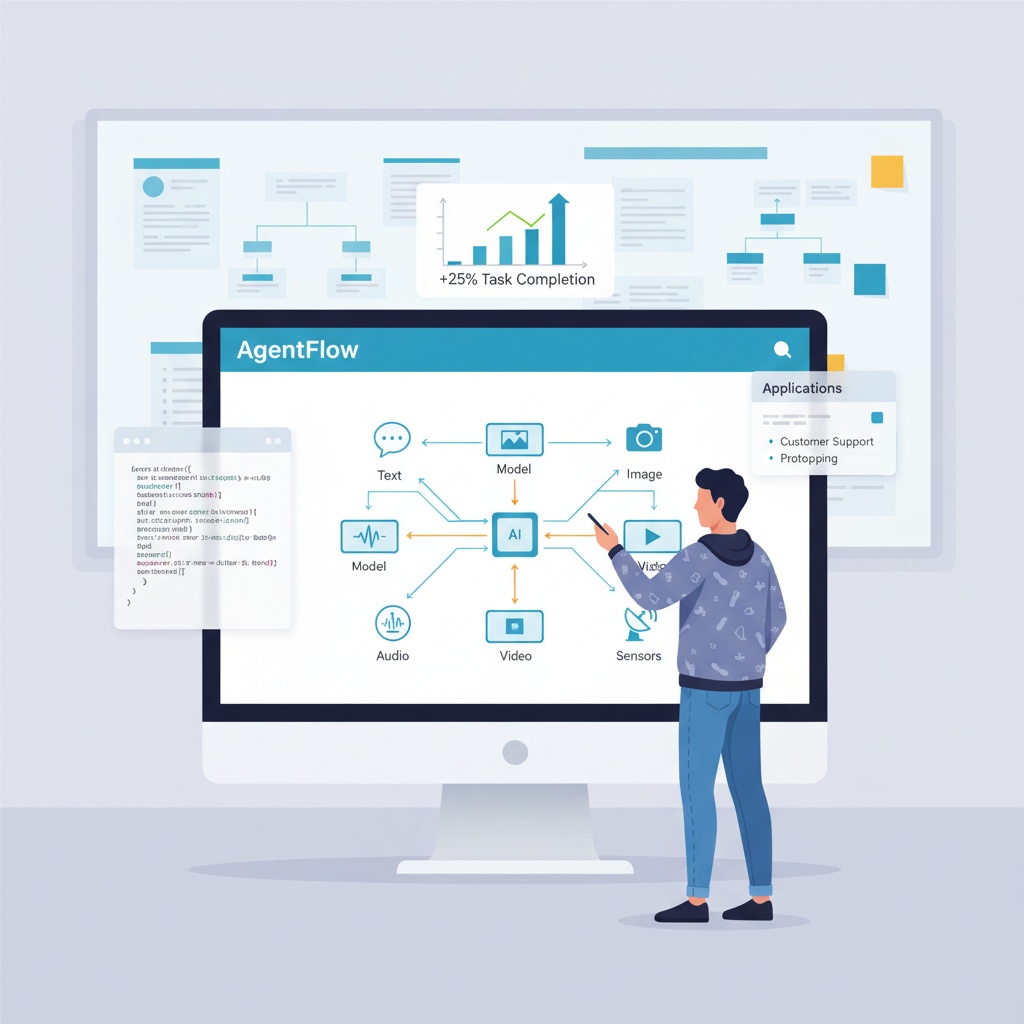
Researchers reported that AgentFlow achieves a 25% improvement in task completion accuracy compared to existing agent orchestration architectures. This jump in performance becomes most visible when systems need to integrate multiple modalities, such as reading a chart, interpreting its trends, and writing the underlying analysis code. Early benchmarks on the new AgentBench test suite suggest that AgentFlow establishes a fresh baseline for multi-domain automation.
For builders and data scientists, this is more than academic news. Integrating AgentFlow means it’s now possible to prototype agents capable of analyzing audio transcripts, generating code for specific functions, and interacting with APIs all within one cohesive workflow. Developers experimenting with customer support automation, analytics reporting, or operational assistants can tie the system to mainstream APIs like OpenAI or Anthropic through lightweight connectors. The code repository provides a plug-in architecture, allowing integration with internal databases or external SaaS workflows.
In practical terms:
- Prototype end-to-end pipelines: Incorporate perception (image recognition) and cognition (reasoning models) for richer context understanding.
- Enhance customer-facing bots: Combine text generation with chart interpretation or log analysis for more analytical responses.
- Accelerate experimentation: Built-in benchmarking enables quantitative tracking of performance improvements during iteration.
However, there are limitations worth noting. The framework struggles in low-data environments where task-specific fine-tuning data is scarce. Although the project operates under a permissive license, users must include attribution in any derivative work, a requirement aligned with most academic releases. Despite those caveats, its design encourages collaborative exploration of intelligent orchestration—a crucial feature for enterprises scaling internal automation.
This type of agentic coordination also represents a preview of what’s next for AI technology news: research that bridges open science with production-readiness. By lowering barriers to experimentation, AgentFlow could shorten the distance between academic discoveries and enterprise deployment cycles.
Mistral-7B v2: Redefining Cost-Efficient Reasoning
Another highlight in AI research news this month is Mistral AI’s release of Mistral-7B v2, a mid-size open large language model that refines multilingual reasoning performance while maintaining efficiency. The model was trained with improved instruction-tuning datasets, achieving notable increases across standardized benchmarks in code generation, factual accuracy, and low-resource language understanding.
Compared to previous deployments such as Llama 3 8B, Mistral-7B v2 demonstrates superior performance on critical reasoning tasks—all while consuming less compute power at inference time. This makes it particularly attractive for startups, internal development teams, and research units that need quality generative capability without large-scale infrastructure.
Key strengths include:
- Enhanced multilingual comprehension across major European and Asian languages.
- Optimized reasoning accuracy for mathematical and procedural tasks.
- Reduced latency thanks to improved model quantization and prompt optimization.
Teams deploying generative agents or chat-based copilots can use Mistral-7B v2 in production settings through frameworks like Hugging Face or vLLM. Common applications include multilingual chatbots, automated documentation assistants, and employee knowledge tools that operate cost-effectively. Developers may also integrate it into existing orchestration pipelines, combining Mistral as the language reasoning hub within multimodal systems similar to AgentFlow.
Despite its strengths, some trade-offs remain. The model is limited to an 8K token context window, restricting accuracy for long document summarization or multi-turn conversations. For small enterprises or edge devices, though, this limitation is often acceptable given its balance between speed and cost.
Beyond technical benchmarks, this model signals a deeper trend in tech news AI coverage: the democratization of capable models under permissive licenses. As open models close the gap with proprietary systems, they are enabling broader experimentation across industries—from education to logistics—while maintaining ethical transparency. Engineers no longer need to rely solely on paid APIs to test new product concepts; they can spin up full reasoning systems using local hardware or affordable cloud instances.
To understand why this matters for leadership teams and policy stakeholders, consider the economic ripple effect. Open, efficient LLMs reduce dependency on single vendors and allow internal compliance teams to audit model behavior directly. Enterprises exploring regulated use cases such as finance or healthcare gain visibility into training data sources, which simplifies risk mitigation under new frameworks like NIST’s updated AI Risk Management recommendations.
How Research Insights Connect to Upcoming AI Technology News
The simultaneous release of AgentFlow and Mistral-7B v2 offers a clear snapshot of where artificial intelligence news is trending: toward modular, composable systems that are accessible outside of big-tech labs. For developers, these breakthroughs translate into actionable starting points—agentic frameworks and reasoning models that can be tested today without enterprise-level budgets.
These research announcements also anchor the stories that will follow in the next part of this month’s digest. The shift from theoretical architecture to deployable tools continues in Section 2, where the focus turns from academic progress to AI technology news—including product releases and new service offerings by cloud providers. As the line between research and production continues to blur, understanding both the underlying models and their commercial implementations becomes critical for any team building with AI.
Expanding Landscape of AI Product and Platform Innovations
The New Era of Cloud-Native Intelligence
The edge between traditional cloud infrastructure and intelligent automation is narrowing fast. AI technology news this month illustrates how hyperscalers are evolving from offering static machine learning APIs to dynamic, orchestrated ecosystems capable of managing end-to-end intelligent workflows. Instead of simply running prebuilt models, developers now configure adaptive agents and retrieval pipelines that learn continuously from new data streams. This shift signals a deeper trend: platforms are prioritizing interoperability, context retention, and sustained adaptability over brute computational power.
AWS Serverless Vector Database: Simplifying Real-Time Intelligence
Amazon’s new serverless vector database introduces a foundational upgrade for developers building retrieval-augmented generation pipelines. Unlike traditional managed vector services that require scaling clusters manually, the serverless design automatically adjusts for traffic surges and optimizes indexing in real time. For teams managing unpredictable workloads—like customer chatbots, recommendation engines, or documentation search—this flexibility means significant savings in both latency and operational overhead.
Beyond the infrastructure advantages, the most impactful innovation lies in real-time data synchronization. Through tight integration with Bedrock and SageMaker, embeddings can be updated continuously as data shifts, improving the quality and accuracy of AI-generated responses. Developers can directly embed semantic search within their applications without preloading full datasets, a change that reduces cold start times and improves energy efficiency.
Practical deployment looks different from previous AWS solutions. Teams can import existing vectors from systems like Pinecone or Qdrant using batch transformation tools, then align them with custom embeddings from any supported provider. AWS also introduced a tighter permissioning system leveraging IAM roles to separate inference access from embedding generation. For large enterprises, this distinction helps audit user behavior while maintaining data governance. The pay-per-query model aligns costs to usage instead of idle storage time, further strengthening its position in operational cost comparison tables for AI services.
For engineers, integration follows familiar paths. Python and JavaScript SDKs allow low-friction testing across frameworks. An enterprise prototype could combine Bedrock’s LLM API for contextual reasoning with the vector database’s nearest-neighbor search to surface internal documentation snippets within milliseconds. While it might sound incremental, this approach represents a pivot from inference-heavy workloads toward knowledge-grounded reasoning pipelines that sustain relevance over time.
This model also sparks competitive positioning among providers. By enabling real-time RAG at scale with serverless efficiency, AWS challenges cloud-native data systems like Google’s AlloyDB and Microsoft’s Cosmos DB to prioritize retrieval capabilities. It shows how AI infrastructure and data vectorization are becoming inseparable layers in cloud architecture.

Google Cloud’s Vertex AI Agents: Orchestrating Human and Machine Collaboration
In parallel, Google Cloud’s Vertex AI Agents framework represents a different trajectory. Rather than optimizing storage or data retrieval, it focuses on orchestrating instruction-following systems capable of chaining multiple APIs and user interactions. The concept echoes the agentic AI trend seen in research labs but pushes it into enterprise territory where reliability and auditability matter most.
Developers can now build composite agents that switch between internal databases, language models, and action APIs. For example, a logistics company could deploy an agent that identifies delivery delays from structured data, queries an external weather service, and then alerts a human dispatcher through an integrated message queue—all within a single workflow. This architecture transcends the basic chatbot design; it’s a foundation for interactive process automation.
The platform’s graph-based interface in Vertex AI allows architects to visualize how tasks flow between nodes representing reasoning modules, retrieval points, and external connectors. Google’s focus on interpretability ensures each handoff in the chain is logged and explainable, an essential feature for teams preparing for AI compliance standards under forthcoming regulations. The orchestration layer also includes prebuilt connectors for BigQuery, Firebase, and Pub/Sub, letting organizations enhance their existing cloud infrastructure with cognitive automation capabilities.
Pricing and adoption pathways demonstrate a graduated commitment model. A 90-day free trial allows enterprises to run pilot projects before expanding into production-class volumes. Because billing is tied to function invocation, experiment-level developers can test live prototypes without incurring persistent costs. Google provides templates and guided labs through its Cloud Skills Boost platform that show how to create agents capable of parsing documents, performing human-informed verifications, and automating operational dashboards.
From an engineering perspective, Vertex AI Agents fill a critical gap between research-grade prototypes and scalable, production-ready automations. Architecting such systems previously required patching multiple libraries for function calling, state tracking, and error handling. Now, developers can implement robust multi-step reasoning workflows with unified reliability and logging.
Comparative Adoption Patterns
While AWS emphasizes the autonomic infrastructure layer, Google’s approach focuses on workflow intelligence and execution orchestration. These philosophies reveal distinct strategies: one optimizing retrieval efficiency and cost control, the other reinforcing human alignment and explainability. Companies selecting between them are less making a performance comparison than aligning infrastructure philosophy with product strategy.
In practice, many enterprises will likely blend both. A digital bank might use AWS’s vector storage for transaction search while leveraging Vertex Agents for customer-facing automation. Integrating across platforms is becoming strategically acceptable thanks to the adoption of common data interchange formats and open connectors. This hybrid strategy allows businesses to maintain flexibility as the competitive landscape matures.
Developer Takeaways and Emerging Opportunities
- Adopt modular architectures. Use serverless vector layers for knowledge indexing while reserving orchestration layers for complex decision-making tasks.
- Prioritize evaluation metrics. Track not only performance and latency but also transparency and handoff fidelity across chained tasks.
- Automate responsibly. Integrate audit logs and consent mechanisms early in design, aligning with forthcoming regulatory expectations.
- Operationalize experimentation. Leverage pay-per-use billing in both AWS and Google Cloud to validate use cases before scaling.
- Prepare for convergence. As AI platforms advance, expect interoperability where retrieved data directly informs reasoning layers within orchestrated agents.
The ongoing advances in AI platforms show that intelligent automation is evolving into a layered system—one that connects storage, reasoning, and human oversight seamlessly. Cloud providers are racing not merely to offer the fastest model endpoints but to become the operating systems for machine cognition. The next wave of artificial intelligence news will likely center on how these foundational changes ripple outward into new industry verticals, each developing its distinct interpretation of machine-aware infrastructure.
Conclusion
The November 2025 landscape marks a turning point in the evolution of artificial intelligence—one defined by smarter agents, leaner infrastructure, and clearer governance. Multimodal frameworks like AgentFlow showcase that AI systems can now reason across vision, language, and code with unprecedented coherence, ushering in a new era of automation for builders and enterprises alike. The arrival of serverless vector databases and next-generation accelerators drives efficiency to levels once out of reach, transforming how organizations prototype, deploy, and scale advanced models.
At the same time, the maturing regulatory environment—with NIST’s refined guidance and federal policy realignments—anchors innovation within well-defined risk management and accountability standards. Businesses that align now will gain both compliance readiness and market trust as competition intensifies.
Ultimately, this month’s insights converge on one unmistakable theme: momentum. Those who stay engaged with evolving artificial intelligence news and act early on these developments will lead the next wave of intelligent systems innovation. Keep following our monthly ai recent news digest to stay ahead of the curve—and turn information into strategic advantage before your peers do.
Frequently Asked Questions
What’s the difference between an automation assessment and an automation strategy?
An automation assessment is a time-bound evaluation that measures readiness, identifies high‑impact processes, and produces a prioritized roadmap. An automation strategy is broader and ongoing—it sets your long-term vision, operating model, funding approach, and governance. The assessment feeds the strategy with hard data and a sequenced plan, ensuring your automation and AI in the workplace efforts deliver tangible outcomes, not just intentions.
How long does an automation assessment take and who needs to be involved?
A focused assessment typically runs 6–12 weeks, aligned to the 90‑day roadmap. Involve a cross‑functional core team: process owners, IT/architecture, data/privacy, risk/compliance, finance (for ROI), and change management. Keep executive sponsors engaged through structured check‑ins so decisions on scope, prioritization, and funding happen fast.
How do we calculate ROI for automation and AI (ROI AI) with confidence?
Anchor your model to a clear baseline: volume, FTE effort, cycle time, error rates, and compliance incidents. Include full TCO (licenses, infra, build, model training, support) and all benefits (hours saved, quality uplift, throughput, risk/fines avoided). Calculate payback, NPV, and IRR, and run sensitivity at ±20–30% on benefits and costs. Typical quick‑win automations pay back in 3–9 months; AI use cases may span 6–18 months depending on data prep and model complexity.
Which processes should we avoid automating even if they look high-volume?
Be cautious with processes that are unstable, have high exception/judgment rates, or rely on unstructured or low‑quality data you can’t remediate quickly. Also avoid workflows under regulatory scrutiny without strong auditability or human‑in‑the‑loop controls. Stabilize and standardize first; then revisit as candidates once variance and data issues are addressed.
What data and access do we need before we start discovery and scoring?
You’ll need process metrics (volumes, handle time, exceptions), system access for task/process mining or screen capture, and data dictionaries to assess quality and structure. Confirm governance early—who approves data use, privacy constraints, and security reviews—so discovery tools and interviews can run without delays. Clean, accessible data accelerates both automation and ROI AI estimates.
How do we choose between RPA, workflow, iPaaS, and AI/ML (including GenAI)?
Match the tool to the work pattern. Use RPA for UI-driven, rules-based tasks across legacy apps; workflow/BPM for multi-step processes with approvals and SLAs; iPaaS for API-centric integrations; AI/ML/GenAI for classification, predictions, document understanding, and unstructured text. When in doubt, start with the lowest-complexity tool that meets requirements, then add AI components where they raise value without spiking complexity.
What are the biggest risks when scaling automation and AI in the workplace, and how do we govern them?
Top risks include model risk/bias, security/privacy gaps, and orphaned automations without ownership. Govern with a lightweight but firm framework: risk tiers, design standards, change control, audit trails, human‑in‑the‑loop for sensitive steps, and rollback playbooks. Establish a COE to enforce controls while enabling speed, with clear RACI for build, run, and incident response.
How will workforce automation affect roles, and how should we manage change?
Expect shifts in task mix rather than wholesale job loss: repetitive work declines while exception handling, analysis, and customer work increase. Pair automation with role redesign and reskilling/upskilling so employees move up the value chain. Communicate early and often, measure adoption, and celebrate wins tied to CX/EX improvements to reduce resistance and sustain momentum.
What if our maturity is low—should we still run a pilot, and what budget should we plan?
Yes—use the assessment to close gaps while delivering a quick win. Start with a stable, rules-based process and a small, cross‑functional team. Typical pilot budgets: $20k–$75k for RPA/workflow quick wins; $50k–$200k for AI pilots depending on data readiness. Keep scope tight, measure benefits weekly, and reinvest early returns into capability building and governance.
How often should we refresh the automation pipeline and what KPIs matter most?
Reassess quarterly to refresh the pipeline with new candidates and incorporate lessons learned. Track leading KPIs—adoption, automation health/error rates, and SLA adherence—and lagging KPIs—FTE hours saved, cycle time, defects, and compliance outcomes. Tie KPI dashboards to the original business case so ROI and value realization remain visible and defensible.